Meaning and Functions of Money — Syllabus
ICSE · Class 10 · Economics
What Meaning and Functions of Money covers in ICSE Class 10 Economics: 4 topics, for the 2026-27 session. Part of the ICSE Class 10 Economics syllabus.
Interactive on Super Tutor
Studying Meaning and Functions of Money? Get the full interactive chapter.
Quizzes, flashcards, AI doubt-solver and a step-by-step study plan — built for syllabus and more.
Free trial, no card needed.
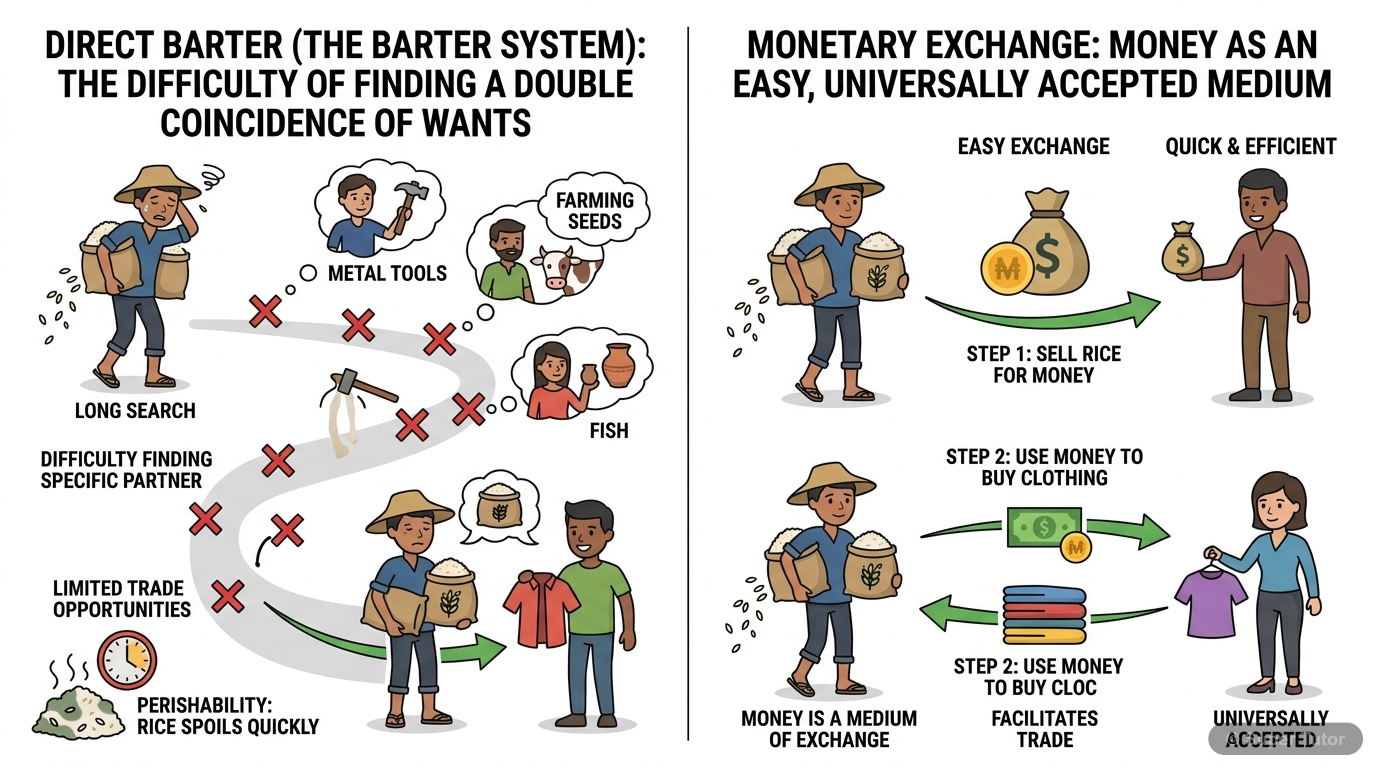
Learn better with visuals Super Tutor pairs illustrations like this with notes and quizzes for Meaning and Functions of Money.
Get startedTopics in Meaning and Functions of Money
Barter System and Its Difficulties
- In barter system, goods and services are exchanged directly for other goods and services.
- Barter economy is called C-C economy, where C stands for commodity.
- The barter system was used in the early stage of human civilisation.
Evolution of Money
- Economists have identified five stages in the evolution of money.
- The five stages are animal money, commodity money, metallic money, paper money, and bank money.
- Animal money was used in the earliest period of human civilisation.
Meaning and Definitions of Money
- The word money is derived from the Latin word Moneta.
- Money is anything commonly accepted as a medium of exchange.
- Money may be defined from legal, functional, and general acceptability points of view.
Forms of Money
- Full bodied money is money whose value as a commodity is equal to its value as money.
- A rupee coin during the British period in India was made of silver and is an example of full bodied money.
- Fiat money is government issued currency with no intrinsic value.
Key Concepts
Central concept: Money as a medium of exchange and a core tool of economic life
Work through every topic in Meaning and Functions of Money with notes and quizzes
Start This ChapterFrequently Asked Questions
What are the important topics in Meaning and Functions of Money for ICSE Class 10 Economics?
How should I revise Meaning and Functions of Money for the ICSE Class 10 board exam?
Sources & Official References
Content is aligned to the official syllabus. Refer to the board website for the latest curriculum.
More resources for Meaning and Functions of Money
Practice Quiz
Test yourself with a quick quiz
Important Questions
Exam-style questions with answers
Revision Notes
Key points for last-minute revision
Chapter Summary
Understand the chapter at a glance
Concept Maps
See how topics connect
Study Plan
Step-by-step plan for this chapter
Flashcards
Quick-fire cards for active recall
For serious students
Get the full Meaning and Functions of Money chapter — start free.
Quizzes, flashcards, an AI doubt solver and a study plan for ICSE Class 10 Economics. Free to start, no card needed.