Listening Skills
ICSE · Class 10 · English Language - Archer
Flashcards for Listening Skills — ICSE Class 10 English Language - Archer. Quick Q&A cards covering key concepts, definitions, and formulas.
Interactive on Super Tutor
Studying Listening Skills? Get the full interactive chapter.
Quizzes, flashcards, AI doubt-solver and a step-by-step study plan — built for flashcards and more.
1,000+ Class 10 students started this chapter today
Learn better with visuals Super Tutor has hundreds of illustrations like this across every chapter — all free to try.
Get startedWhat is hearing?
Answer
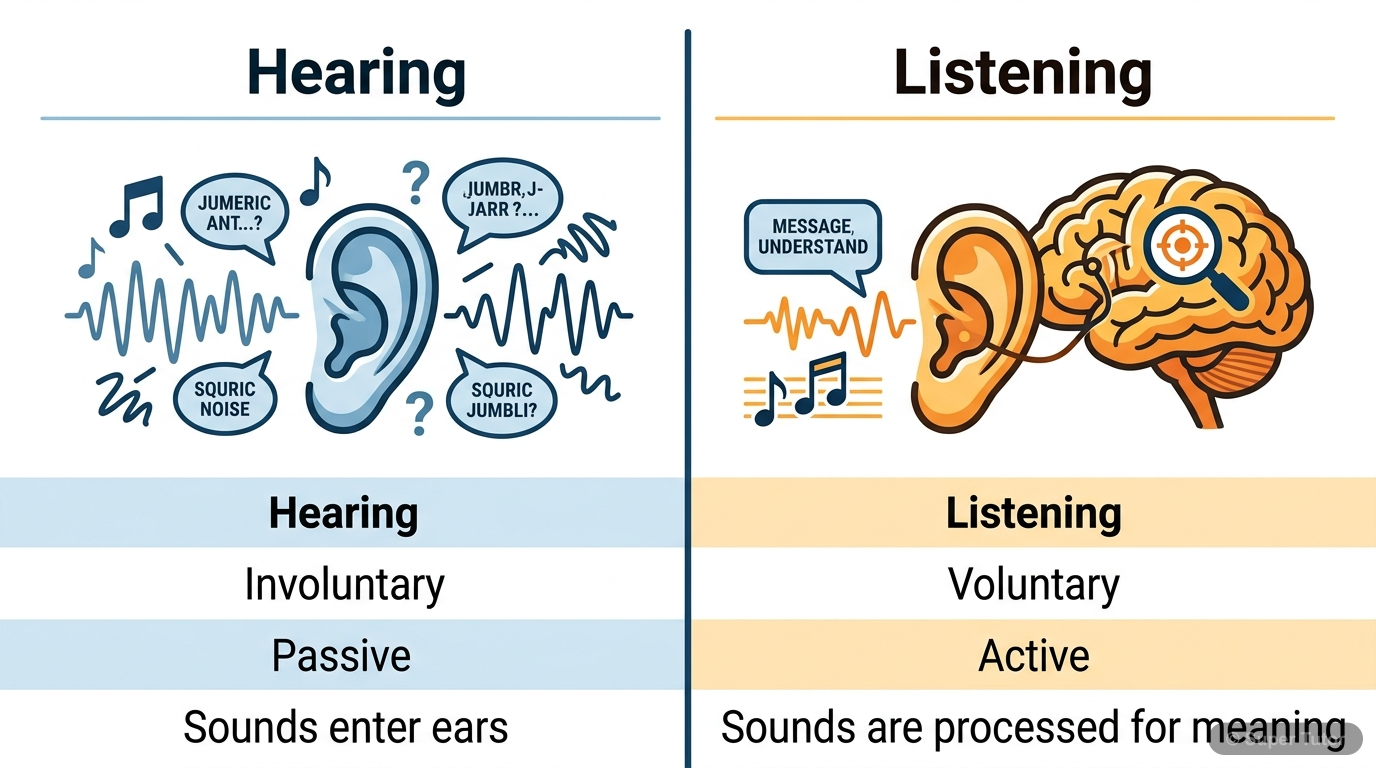
Hearing is an involuntary process. All sounds, noises, music, and speech that enter the ears are part of hearing.
What is listening?
Answer
Listening is a voluntary and active process. It means trying to understand each sound and noise with attention and purpose.
Why is listening called an active process?
Answer
Listening is active because the mind works on the sounds being heard. The listener pays attention, selects important details, and tries to understand the meaning.
Why should listening be practised carefully?
Answer
Listening should be practised carefully to comprehend and respond appropriately, become a better communicator, resolve conflicts, improve relationships, empathise, reflect, and follow instructions.
What is the first rule for good listening?
Answer
Remove distractions and focus only on what is being said. Full concentration helps in catching important information clearly.
Why is it helpful to look at the speaker?
Answer
Looking at the speaker helps catch information that may be missed by hearing alone. Facial expressions and movements also support understanding.
What kind of notes should be taken during listening?
Answer
Brief notes of important details and keywords should be taken. The aim is to capture useful points, not write the entire passage.
What should be avoided while making notes?
Answer
Unnecessary scribbling and trying to write the entire passage should be avoided. Good notes are short, clear, and useful for recalling details later.
+26 more flashcards available
Practice AllFrequently Asked Questions
What are the important topics in Listening Skills for ICSE Class 10 English Language - Archer?
How to score full marks in Listening Skills — ICSE Class 10 English Language - Archer?
How many flashcards are available for Listening Skills?
Sources & Official References
Content is aligned to the official syllabus. Refer to the board website for the latest curriculum.
More resources for Listening Skills
Practice Quiz
Test yourself with a quick quiz
Important Questions
Practice with board exam-style questions
Revision Notes
Key points for last-minute revision
Formula Sheet
All formulas in one place
Chapter Summary
Understand the chapter at a glance
Concept Maps
See how topics connect visually
Study Plan
Step-by-step plan to ace this chapter
Syllabus
What topics to cover
NCERT Solutions
Every textbook question solved step by step
For serious students
Get the full Listening Skills chapter — for free.
Quizzes, flashcards, AI doubt-solver and a step-by-step study plan for ICSE Class 10 English Language - Archer.