Notice and E-Mail — Flashcards
ICSE · Class 10 · English Language - Archer
36 flashcards for Notice and E-Mail (ICSE Class 10 English Language - Archer) to test yourself on key terms and facts. Sample: "What is a notice?"
Interactive on Super Tutor
Studying Notice and E-Mail? Get the full interactive chapter.
Quizzes, flashcards, AI doubt-solver and a step-by-step study plan — built for flashcards and more.
Free trial, no card needed.
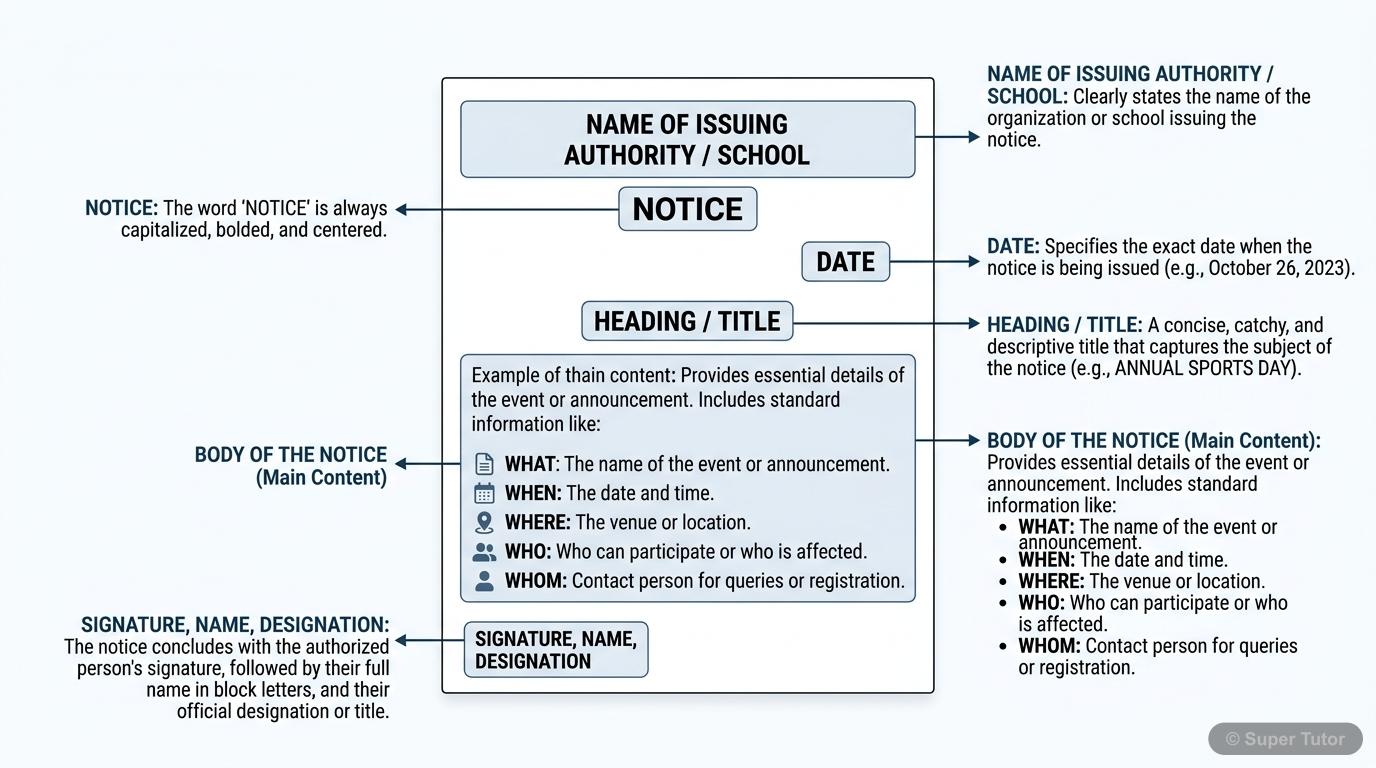
Learn better with visuals Super Tutor pairs illustrations like this with notes and quizzes for Notice and E-Mail.
Get startedWhat is a notice?
Answer
A notice is a short, formal piece of writing used to give important information to a group of people. It is usually written in a clear and direct way so that the main message is easy to understand.
What is an e-mail in formal writing?
Answer
An e-mail is a formal electronic message sent to a person or organisation. In formal writing, it should have a proper subject, a polite salutation, a clear body, and a full name in the subscription.
What are the main elements of a notice?
Answer
A notice must have Heading, Statement, Date, Time, Venue, and Particulars of the event. These parts help present the information in a neat and complete format.
What are the main elements of a formal e-mail?
Answer
A formal e-mail must have E-mail ID, Subject, Salutation, Opening sentence, Body, Closing sentence, and Subscription. Each part has a specific role in making the message complete and polite.
Why is the heading important in a notice?
Answer
The heading gives the notice its identity and tells the reader what the event or announcement is about. It should be catchy, clear, and suitable for the event.
What does the statement in a notice do?
Answer
The statement briefly explains the purpose of the notice. It tells the reader what event, activity, or announcement is being made, in one clear sentence.
How much is the heading worth in a notice?
Answer
The heading carries 1 mark. It is one of the most important parts because it introduces the notice clearly and attractively.
How is the venue element marked in a notice?
Answer
The venue element carries a total of 1 mark, split into two half marks. The venue should be written clearly and completely.
+28 more flashcards
Practise AllFrequently Asked Questions
What are the important topics in Notice and E-Mail for ICSE Class 10 English Language - Archer?
How many flashcards are available for Notice and E-Mail?
How should I revise Notice and E-Mail for the ICSE Class 10 board exam?
Sources & Official References
Content is aligned to the official syllabus. Refer to the board website for the latest curriculum.
More resources for Notice and E-Mail
Practice Quiz
Test yourself with a quick quiz
Important Questions
Exam-style questions with answers
Revision Notes
Key points for last-minute revision
Chapter Summary
Understand the chapter at a glance
Concept Maps
See how topics connect
Study Plan
Step-by-step plan for this chapter
Syllabus
What topics to cover
For serious students
Get the full Notice and E-Mail chapter — start free.
Quizzes, flashcards, an AI doubt solver and a study plan for ICSE Class 10 English Language - Archer. Free to start, no card needed.