Listening Skills
ICSE · Class 10 · English Language - Archer
Practice quiz for Listening Skills — ICSE Class 10 English Language - Archer. MCQs and questions with answers to test your preparation.
Interactive on Super Tutor
Studying Listening Skills? Get the full interactive chapter.
Quizzes, flashcards, AI doubt-solver and a step-by-step study plan — built for practice quiz and more.
1,000+ Class 10 students started this chapter today
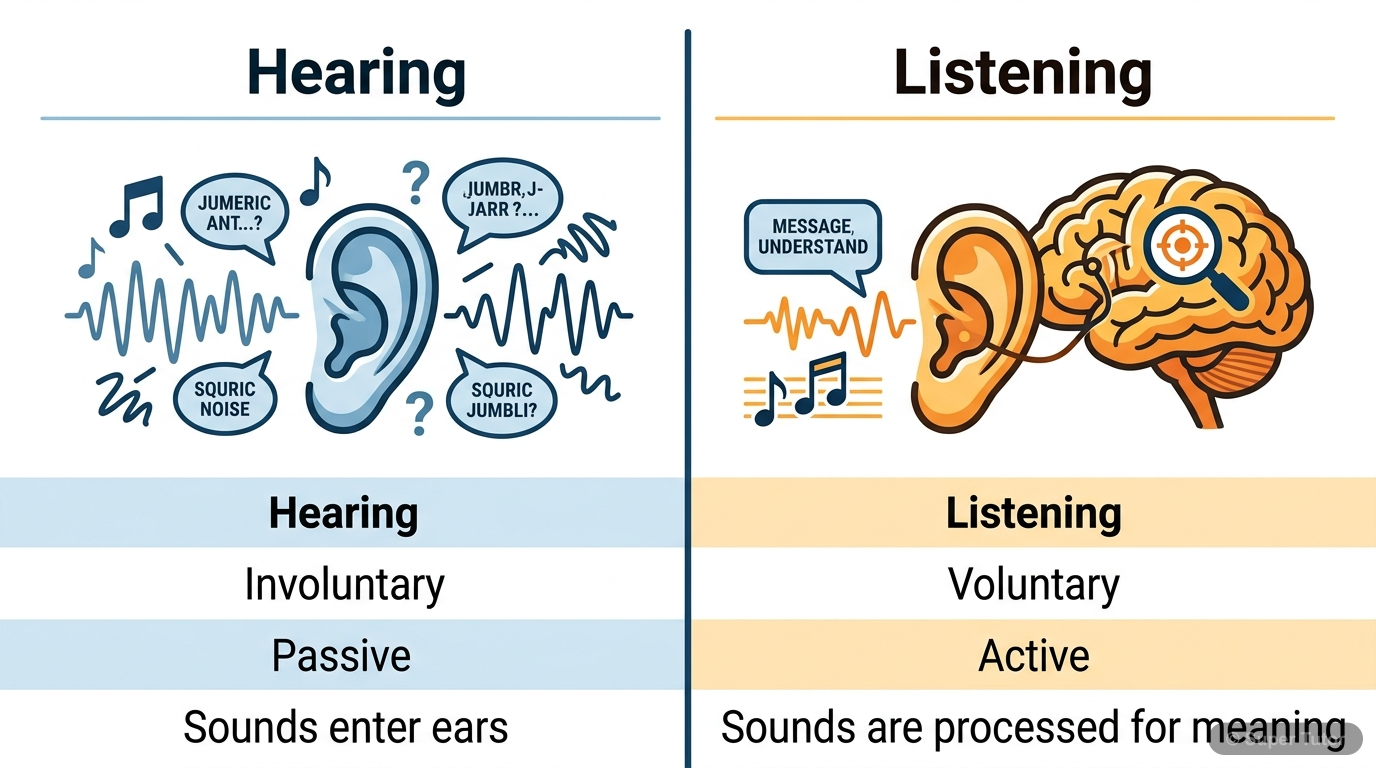
Learn better with visuals Super Tutor has hundreds of illustrations like this across every chapter — all free to try.
Get startedQuick Quiz: Listening Skills
0/4Tap an answer to check it instantly. No sign-up needed for these 4.
What is the main difference between hearing and listening?
What should you do first when preparing to listen actively?
When we listen for detail, we are trying to answer questions that ask:
In the examination context, how many times is the passage read aloud?
Sample Questions
Which of the following are reasons why we should listen actively?
Show answer
To comprehend and respond appropriately, To become better communicators, To empathise with others, To follow instructions properly
Step 1: Review the purposes of active listening mentioned in the chapter. Step 2: Identify that comprehending and responding appropriately helps in effective communication. Step 3: Recognize that better listening skills make us better communicators overall. Step 4: Understand that empathy requires actively listening to others' feelings and perspectives. Step 5: Note that following instructions correctly depends on careful listening. The incorrect option contradicts the purpose of listening, which is to understand, not create confusion.
True or False: Taking down notes of every single word while listening is recommended for effective listening.
Show answer
False
Step 1: Recall the chapter's advice about note-taking during listening. Step 2: Understand that trying to write down every word can distract from actual listening. Step 3: Recognize that the chapter advises taking notes only of important details, not everything. Step 4: Remember that 'scribbling unnecessarily or trying to take down the entire passage' is listed as something to avoid. Step 5: Effective listening requires focus on understanding, not mechanical transcription of every word.
Which of the following should be avoided while listening?
Show answer
Letting your mind wander, Listening half-heartedly, Getting distracted by noise
Step 1: Review the 'What should we avoid?' section in the chapter. Step 2: Identify that letting your mind wander prevents focus on the speaker's message. Step 3: Recognize that half-hearted listening means not giving full attention to the content. Step 4: Understand that getting distracted by noise diverts attention from the main message. Step 5: Note that looking at the speaker and taking important notes are actually recommended practices, not things to avoid.
True or False: Looking at the speaker while listening helps you pick up information you might miss while just hearing.
Show answer
True
Step 1: Locate the chapter's advice about looking at the speaker. Step 2: Find the statement 'Look at the speaker—that way you pick up information you miss out while hearing.' Step 3: Understand that visual cues like facial expressions and body language provide additional information. Step 4: Recognize that speakers often use gestures and expressions to emphasize points. Step 5: This visual information supplements what we hear auditorily, making comprehension more complete.
+41 more questions available
Practice AllFrequently Asked Questions
What are the important topics in Listening Skills for ICSE Class 10 English Language - Archer?
How to score full marks in Listening Skills — ICSE Class 10 English Language - Archer?
Sources & Official References
Content is aligned to the official syllabus. Refer to the board website for the latest curriculum.
More resources for Listening Skills
Important Questions
Practice with board exam-style questions
Revision Notes
Key points for last-minute revision
Formula Sheet
All formulas in one place
Chapter Summary
Understand the chapter at a glance
Concept Maps
See how topics connect visually
Study Plan
Step-by-step plan to ace this chapter
Flashcards
Quick-fire cards for active recall
Syllabus
What topics to cover
NCERT Solutions
Every textbook question solved step by step
For serious students
Get the full Listening Skills chapter — for free.
Quizzes, flashcards, AI doubt-solver and a step-by-step study plan for ICSE Class 10 English Language - Archer.