Synthesis of Sentences
ICSE · Class 10 · English Language - Archer
Flashcards for Synthesis of Sentences — ICSE Class 10 English Language - Archer. Quick Q&A cards covering key concepts, definitions, and formulas.
Interactive on Super Tutor
Studying Synthesis of Sentences? Get the full interactive chapter.
Quizzes, flashcards, AI doubt-solver and a step-by-step study plan — built for flashcards and more.
1,000+ Class 10 students started this chapter today
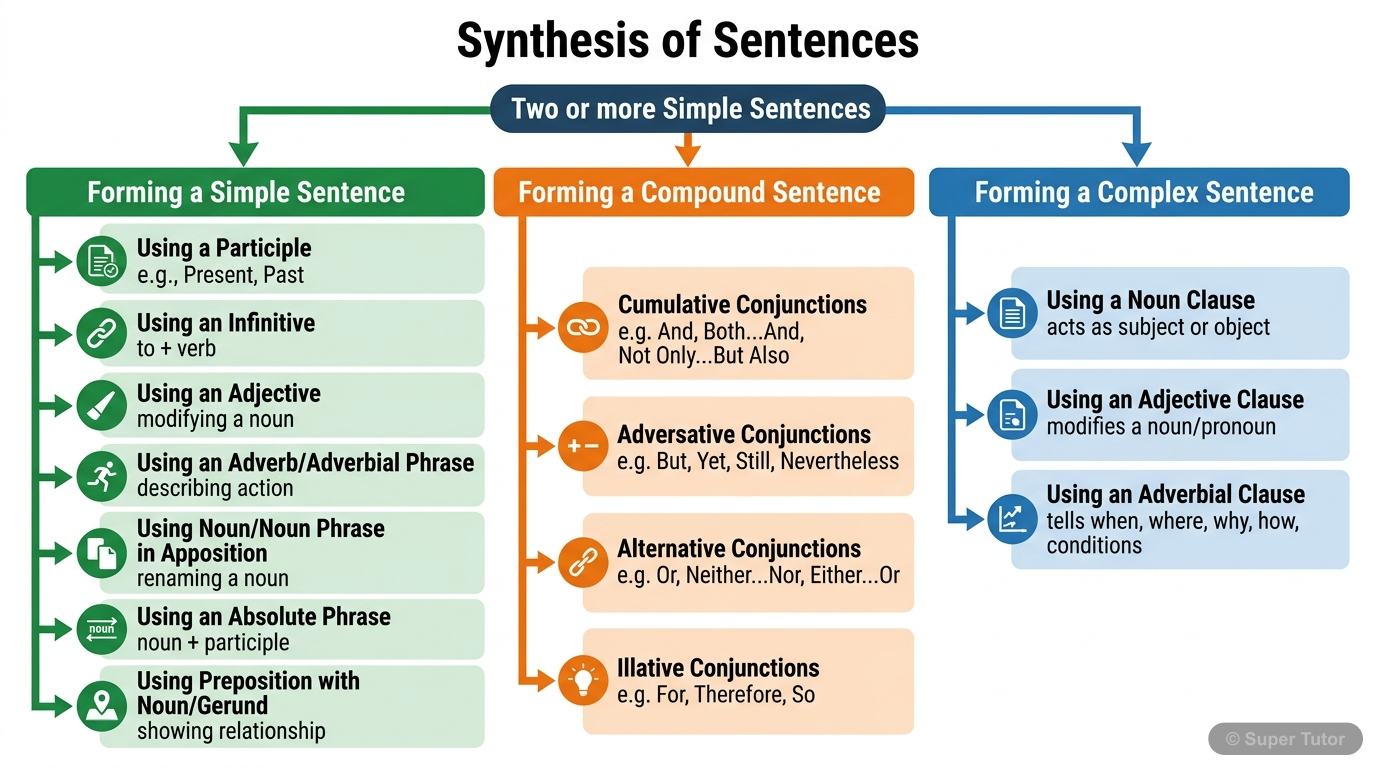
Learn better with visuals Super Tutor has hundreds of illustrations like this across every chapter — all free to try.
Get startedWhat is synthesis of sentences?
Answer
Synthesis of sentences is combining two or more sentences into a new sentence. The new sentence may be simple, complex, or compound.
What kinds of sentences can be formed by synthesis?
Answer
Synthesis can form a simple sentence, a complex sentence, or a compound sentence.
What is a simple sentence in synthesis?
Answer
A simple sentence has one finite verb, and combined simple sentences must retain only one finite verb. This is why other parts of speech or phrases are used to join ideas without adding another finite…
What is a phrase?
Answer
A phrase has no finite verb and cannot stand on its own. It works as part of a sentence, not as a complete sentence.
What is a sentence?
Answer
A sentence has at least one finite verb and can always stand on its own. It expresses a complete thought.
What is a clause?
Answer
A clause has one finite verb and may or may not stand on its own. Some clauses are complete enough to stand alone, while others depend on another part of the sentence.
How do phrase, clause, and sentence differ?
Answer
A phrase has no finite verb and cannot stand on its own. A clause has one finite verb and may or may not stand on its own. A sentence has at least one finite verb and can always stand on its own.
How are two or more simple sentences joined to form one simple sentence?
Answer
Two or more simple sentences are joined into one simple sentence by using a participle, infinitive, adjective, adverb or adverbial phrase, noun or noun phrase in apposition, absolute phrase, or a prep…
+28 more flashcards available
Practice AllFrequently Asked Questions
What are the important topics in Synthesis of Sentences for ICSE Class 10 English Language - Archer?
How to score full marks in Synthesis of Sentences — ICSE Class 10 English Language - Archer?
How many flashcards are available for Synthesis of Sentences?
Sources & Official References
Content is aligned to the official syllabus. Refer to the board website for the latest curriculum.
More resources for Synthesis of Sentences
Practice Quiz
Test yourself with a quick quiz
Important Questions
Practice with board exam-style questions
Revision Notes
Key points for last-minute revision
Formula Sheet
All formulas in one place
Chapter Summary
Understand the chapter at a glance
Concept Maps
See how topics connect visually
Study Plan
Step-by-step plan to ace this chapter
Syllabus
What topics to cover
NCERT Solutions
Every textbook question solved step by step
For serious students
Get the full Synthesis of Sentences chapter — for free.
Quizzes, flashcards, AI doubt-solver and a step-by-step study plan for ICSE Class 10 English Language - Archer.