A Poison Tree
ICSE · Class 10 · English Literature-Treasure Chest ( Poems and Short Stories)
Complete topic list for A Poison Tree in ICSE Class 10 English Literature-Treasure Chest ( Poems and Short Stories). Key concepts, sub-topics, and what to focus on for board exams.
Interactive on Super Tutor
Studying A Poison Tree? Get the full interactive chapter.
Quizzes, flashcards, AI doubt-solver and a step-by-step study plan — built for syllabus and more.
1,000+ Class 10 students started this chapter today
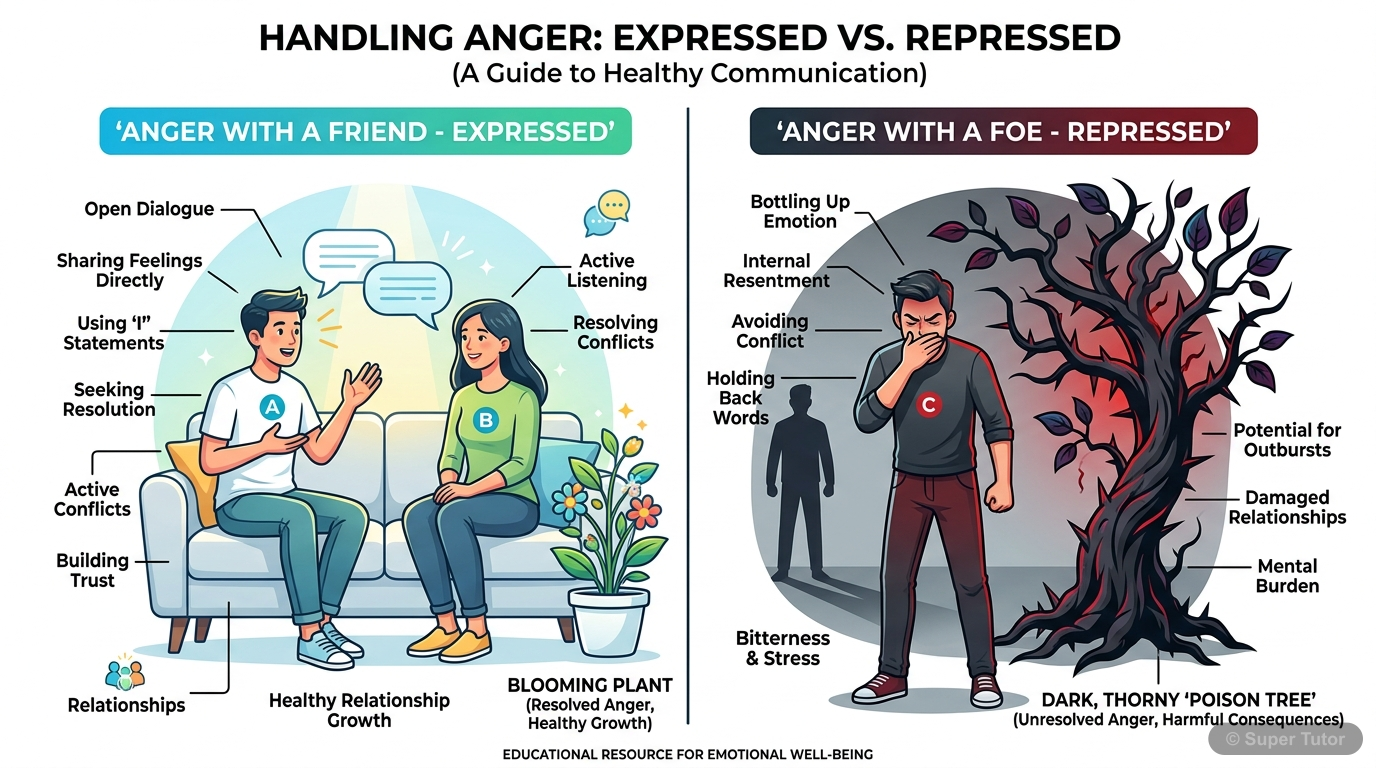
Super Tutor has 5+ illustrations like this for A Poison Tree alone — flashcards, concept maps, and step-by-step visuals.
See them allTopics in A Poison Tree
About the Poet and the Poem
- William Blake was an English poet and painter.
- He left formal schooling by age ten and was educated at home by his mother.
- He was enrolled in drawing classes instead of regular school because of his temperament.
Central Idea and Theme
- The poem shows how anger grows when it is hidden.
- Telling anger to a friend causes it to end.
- Hiding anger from a foe causes it to grow.
Stanza-wise Key Points
- First stanza: the speaker was angry with his friend and told him, so the wrath ended.
- First stanza: the speaker was angry with his foe and did not tell him, so the wrath grew.
- Second stanza: hidden anger is watered in fears and tears.
Literary Devices
- Allegory: the whole poem stands for the danger of hidden anger.
- Symbolism: the poison tree represents suppressed anger.
- Symbolism: the apple represents temptation and destruction.
Key Concepts
Central concept: Repressed anger and its destructive consequences
Frequently Asked Questions
What are the important topics in A Poison Tree for ICSE Class 10 English Literature-Treasure Chest ( Poems and Short Stories)?
How to score full marks in A Poison Tree — ICSE Class 10 English Literature-Treasure Chest ( Poems and Short Stories)?
Sources & Official References
Content is aligned to the official syllabus. Refer to the board website for the latest curriculum.
More resources for A Poison Tree
Practice Quiz
Test yourself with a quick quiz
Important Questions
Practice with board exam-style questions
Revision Notes
Key points for last-minute revision
Formula Sheet
All formulas in one place
Chapter Summary
Understand the chapter at a glance
Concept Maps
See how topics connect visually
Study Plan
Step-by-step plan to ace this chapter
Flashcards
Quick-fire cards for active recall
NCERT Solutions
Every textbook question solved step by step
For serious students
Get the full A Poison Tree chapter — for free.
Quizzes, flashcards, AI doubt-solver and a step-by-step study plan for ICSE Class 10 English Literature-Treasure Chest ( Poems and Short Stories).