A Poison Tree
ICSE · Class 10 · English Literature-Treasure Chest ( Poems and Short Stories)
Summary of A Poison Tree for ICSE Class 10 English Literature-Treasure Chest ( Poems and Short Stories). Key concepts, important points, and chapter overview.
Interactive on Super Tutor
Studying A Poison Tree? Get the full interactive chapter.
Quizzes, flashcards, AI doubt-solver and a step-by-step study plan — built for chapter summary and more.
1,000+ Class 10 students started this chapter today
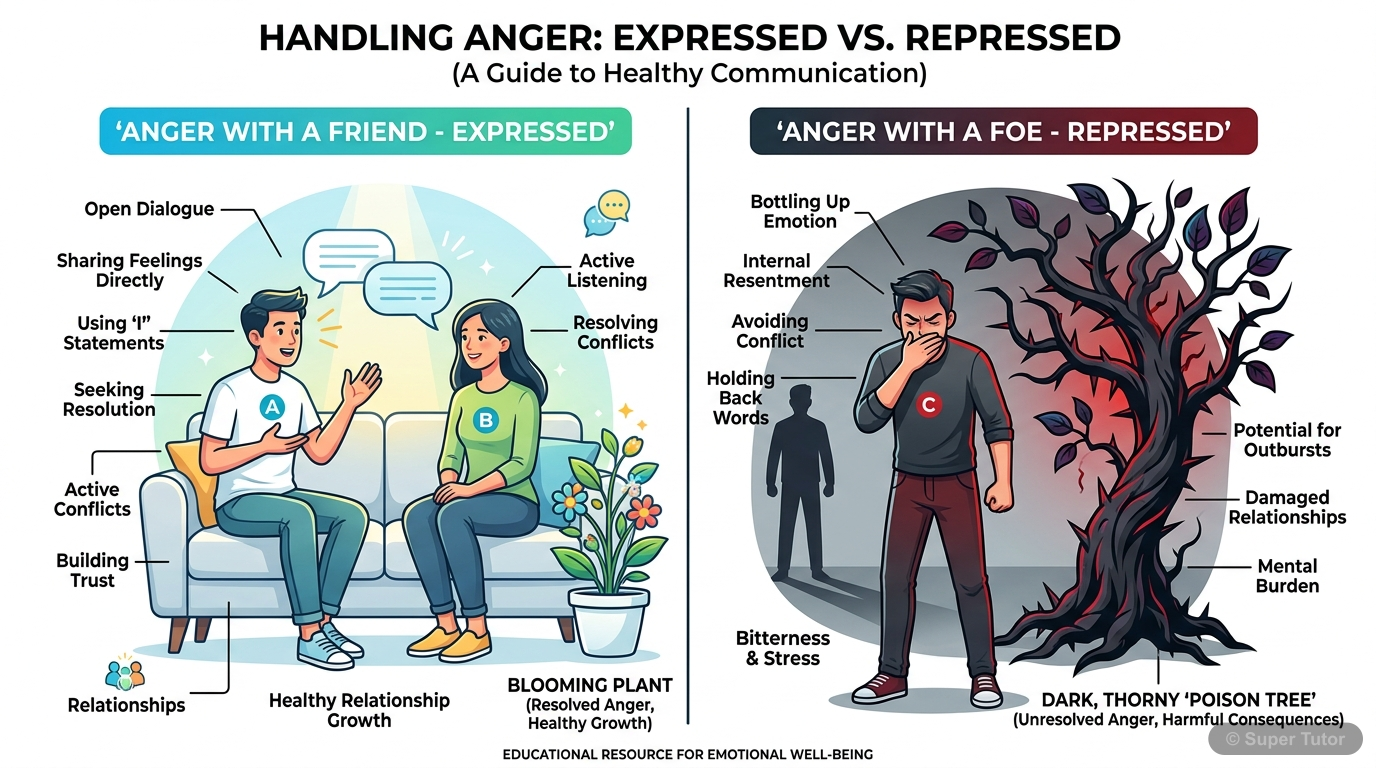
Super Tutor has 5+ illustrations like this for A Poison Tree alone — flashcards, concept maps, and step-by-step visuals.
See them allOverview
A Poison Tree is a short poem by William Blake that presents a powerful warning about anger. The poem shows a clear contrast between anger that is expressed openly and anger that is hidden. When anger is shared with a friend, it ends. When it is kept secret, it grows stronger and becomes dangerous.
Key Concepts
The poem shows that anger spoken
The poem shows that anger spoken to a friend ends, but anger hidden from a foe grows and becomes dangerous. This is the main idea of the poem.
The poem works as an allegory
The poem works as an allegory for the danger of bottling up emotions. The growing tree stands for hidden anger, and the fruit shows the result of that
The apple is a symbol
The apple is a symbol of temptation and destruction. It attracts the foe and leads to a fatal result.
Blake contrasts two situations
Blake contrasts two situations: anger shared with a friend and anger hidden from a foe. One brings relief, and the other brings harm.
The speaker feels glad when
The speaker feels glad when the foe is found dead beneath the tree. This unexpected reaction creates irony and makes the poem disturbing.
Learning Objectives
- Understand the central message of the poem about anger and its consequences.
- Identify the contrast between the friend and the foe in the poem.
- Explain how hidden anger grows into a poisonous force.
- Recognize the symbolic meaning of the tree and the apple.
- Analyse the use of irony, contrast, and symbolism in the poem.
Frequently Asked Questions
What are the important topics in A Poison Tree for ICSE Class 10 English Literature-Treasure Chest ( Poems and Short Stories)?
How to score full marks in A Poison Tree — ICSE Class 10 English Literature-Treasure Chest ( Poems and Short Stories)?
Sources & Official References
Content is aligned to the official syllabus. Refer to the board website for the latest curriculum.
More resources for A Poison Tree
Practice Quiz
Test yourself with a quick quiz
Important Questions
Practice with board exam-style questions
Revision Notes
Key points for last-minute revision
Formula Sheet
All formulas in one place
Concept Maps
See how topics connect visually
Study Plan
Step-by-step plan to ace this chapter
Flashcards
Quick-fire cards for active recall
Syllabus
What topics to cover
NCERT Solutions
Every textbook question solved step by step
For serious students
Get the full A Poison Tree chapter — for free.
Quizzes, flashcards, AI doubt-solver and a step-by-step study plan for ICSE Class 10 English Literature-Treasure Chest ( Poems and Short Stories).