Entrepreneurship — Chapter Summary
ICSE · Class 11 · Business Studies
Summary of Entrepreneurship for ICSE Class 11 Business Studies. Part of the ICSE Class 11 Business Studies syllabus.
Interactive on Super Tutor
Studying Entrepreneurship? Get the full interactive chapter.
Quizzes, flashcards, AI doubt-solver and a step-by-step study plan — built for chapter summary and more.
Free trial, no card needed.
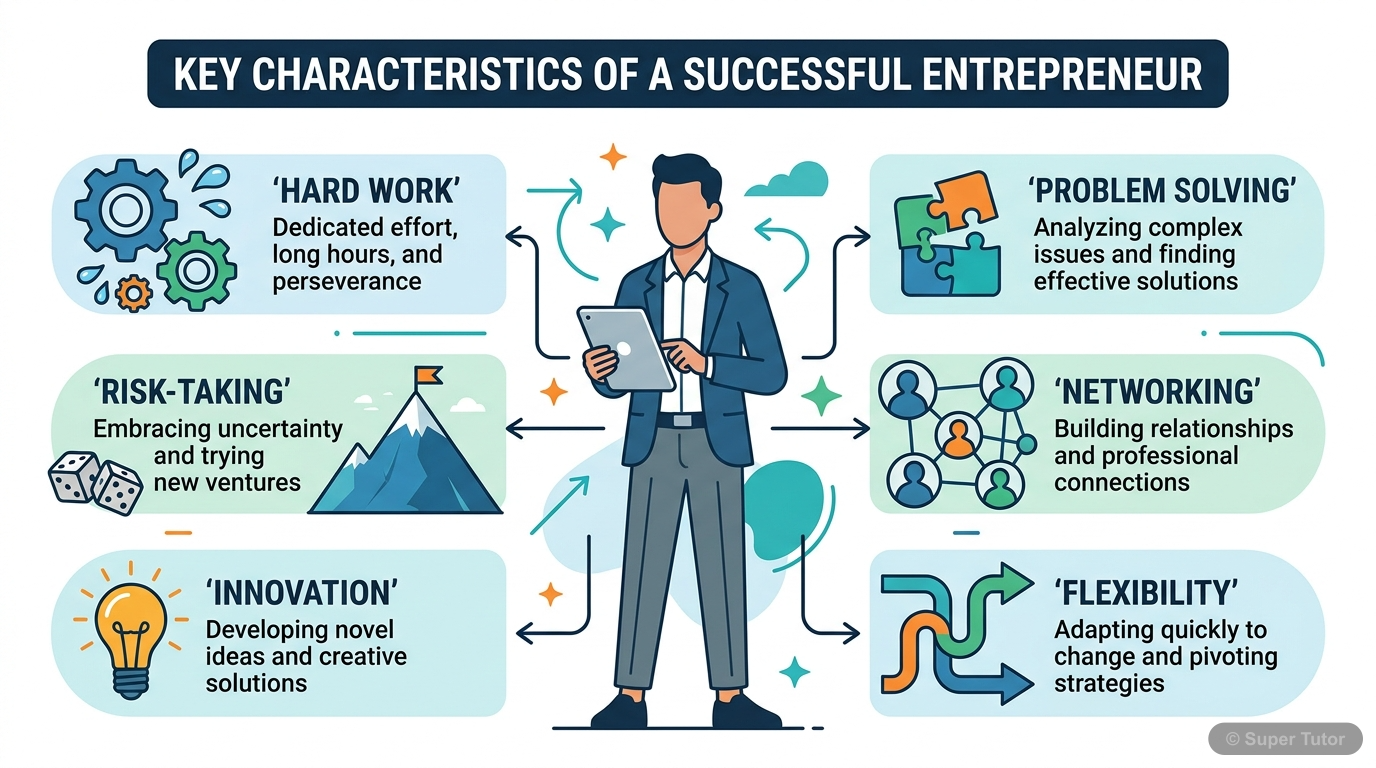
An illustration from Super Tutor's Entrepreneurship chapter — alongside flashcards, concept maps and practice questions.
Overview
Entrepreneurship is the process of creating and running a business enterprise by recognising opportunities, organising resources, and taking calculated risk. It is closely linked with innovation, decision-making, and value creation. The chapter explains the meaning of entrepreneur, the meaning of en
Key Concepts
An entrepreneur is a person who
An entrepreneur is a person who undertakes an enterprise. The term was first used for economic activities by Richard Cantillon. An entrepreneur combin
The concept of entrepreneur is linked
The concept of entrepreneur is linked with three elements: risk-bearing, organising, and innovating. An entrepreneur takes risk, arranges resources, a
Different thinkers described the entrepreneur
Different thinkers described the entrepreneur in different ways. Cantillon emphasised buying at certain prices and selling at uncertain prices. J. B.
Entrepreneurs can be classified as independent
Entrepreneurs can be classified as independent entrepreneurs and spin-off entrepreneurs. Independent entrepreneurs start a new organisation from their
Danhof classified entrepreneurs into four types
Danhof classified entrepreneurs into four types: innovative, imitating or adoptive, Fabian, and drone. Innovative entrepreneurs create new products or
Learning Objectives
- Understand the meaning and definition of entrepreneur and entrepreneurship.
- Identify the main functions of an entrepreneur: risk-bearing, organising, and innovating.
- Distinguish between independent entrepreneurs and spin-off entrepreneurs.
- Classify entrepreneurs according to Clarence Danhof's types.
- Recognise the characteristics of a successful entrepreneur.
Frequently Asked Questions
What are the important topics in Entrepreneurship for ICSE Class 11 Business Studies?
How should I revise Entrepreneurship for Class 11 exams?
Sources & Official References
Content is aligned to the official syllabus. Refer to the board website for the latest curriculum.
More resources for Entrepreneurship
For serious students
Get the full Entrepreneurship chapter — start free.
Quizzes, flashcards, an AI doubt solver and a study plan for ICSE Class 11 Business Studies. Free to start, no card needed.