Rocks — Concept Maps
ICSE · Class 11 · Geography
4 concept maps of Rocks for ICSE Class 11 Geography, each also written out as a text outline. Part of the ICSE Class 11 Geography syllabus.
Interactive on Super Tutor
Studying Rocks? Get the full interactive chapter.
Quizzes, flashcards, AI doubt-solver and a step-by-step study plan — built for concept maps and more.
Free trial, no card needed.
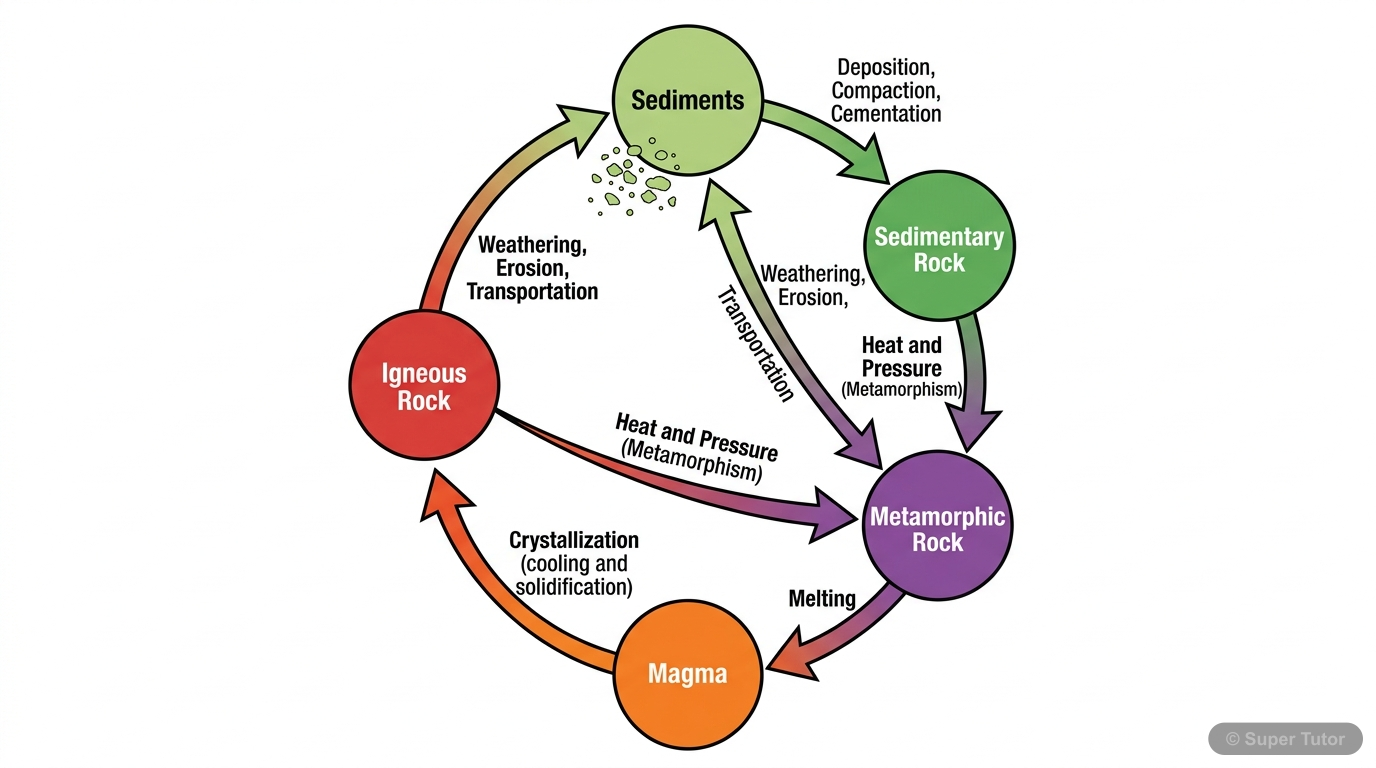
Learn better with visuals Super Tutor pairs illustrations like this with notes and quizzes for Rocks.
Complete Overview of Rocks Chapter
The map in words
- ROCKS
- Minerals
- 2000 total minerals
- 12 Rock-formers
- Silicates 87 percent crust
- Carbonates
- Sulphides
- Metals
- Igneous Rocks
- Origin from Magma
- Parent or Primary Rocks
- Classification
- By Composition
- Mafic Fe and Mg rich
- Felsic Feldspar rich
- By Texture
- Phaneritic large crystals
- Aphanitic small crystals
- Porphyritic mixed size
- By Location
- Extrusive Basalt Obsidian
- Intrusive
- Plutonic Granite
- Hypabyssal Dolerite
- By Composition
- Rock Bodies
- Batholith largest
- Stock smaller
- Laccolith dome shaped
- Sill horizontal
- Dyke vertical
- Sedimentary Rocks
- Formed by deposition
- Stratified layered
- Lithification process
- Classification
- Clastic broken particles
- Non-clastic chemical organic
- Organic Calcareous Carbonaceous
- Inorganic Arenaceous Argillaceous
- By Agent Marine Riverine Aeolian Glacial
- Contains Fossils
- Metamorphic Rocks
- Heat and Pressure change
- Types
- Dynamic Pressure
- Thermal Temperature
- Regional Large scale
- Contact Local zone
- Examples
- Granite to Gneiss
- Limestone to Marble
- Sandstone to Quartzite
- Shale to Slate
- Rock Cycle
- Igneous to Sedimentary
- Sedimentary to Metamorphic
- Metamorphic back to Magma
- Driven by Earth heat
- Driven by Solar energy
- India Distribution
- Deccan Trap Igneous Basalt
- Indo Gangetic Plain Sedimentary
- Himalayas Metamorphic Core
- Minerals
Flowchart showing the two main types of metamorphism and resulting rock transformations
The map in words
- Original Rocks
- Metamorphic Agency?
- Pressure Dynamic Metamorphism": Foliated Rocks Visible banding Layered structure
- Granite → Gneiss
- Shale → Schist
- Coal → Anthracite
- Heat Thermal/ Contact Metamorphism": Non-foliated Rocks No visible layers Crystalline
- Limestone → Marble
- Sandstone → Quartzite
- Shale → Slate
- Pressure Dynamic Metamorphism": Foliated Rocks Visible banding Layered structure
- Metamorphic Agency?
Pie chart showing the percentage composition of the eight most abundant elements in Earth's crust
The map in words
- Oxygen: 46
- Silicon: 28
- Aluminium: 8
- Iron: 6
- Magnesium: 4
- Calcium: 2.4
- Potassium: 2.3
- Sodium: 2.1
Rocks as natural materials forming the earth's crust and their classification by origin, composition, texture, and transformation
The map in words
- Rocks as natural materials forming the earth's crust and their classification by origin, composition, texture, and transformation
- Lithosphere
- Minerals
- Silicates
- Carbonates
- Sulphides
- Metals
- Igneous rocks
- Sedimentary rocks
Explore these maps interactively
Explore DiagramsFrequently Asked Questions
What are the important topics in Rocks for ICSE Class 11 Geography?
What do the concept maps for Rocks show?
How should I revise Rocks for Class 11 exams?
Sources & Official References
Content is aligned to the official syllabus. Refer to the board website for the latest curriculum.
More resources for Rocks
Practice Quiz
Test yourself with a quick quiz
Important Questions
Exam-style questions with answers
Revision Notes
Key points for last-minute revision
Chapter Summary
Understand the chapter at a glance
Study Plan
Step-by-step plan for this chapter
Flashcards
Quick-fire cards for active recall
Syllabus
What topics to cover
For serious students
Get the full Rocks chapter — start free.
Quizzes, flashcards, an AI doubt solver and a study plan for ICSE Class 11 Geography. Free to start, no card needed.