Rocks — Chapter Summary
ICSE · Class 11 · Geography
Summary of Rocks for ICSE Class 11 Geography. Key concepts: The lithosphere is the outer, About 2 and Quartz is made of silicon.
Interactive on Super Tutor
Studying Rocks? Get the full interactive chapter.
Quizzes, flashcards, AI doubt-solver and a step-by-step study plan — built for chapter summary and more.
Free trial, no card needed.
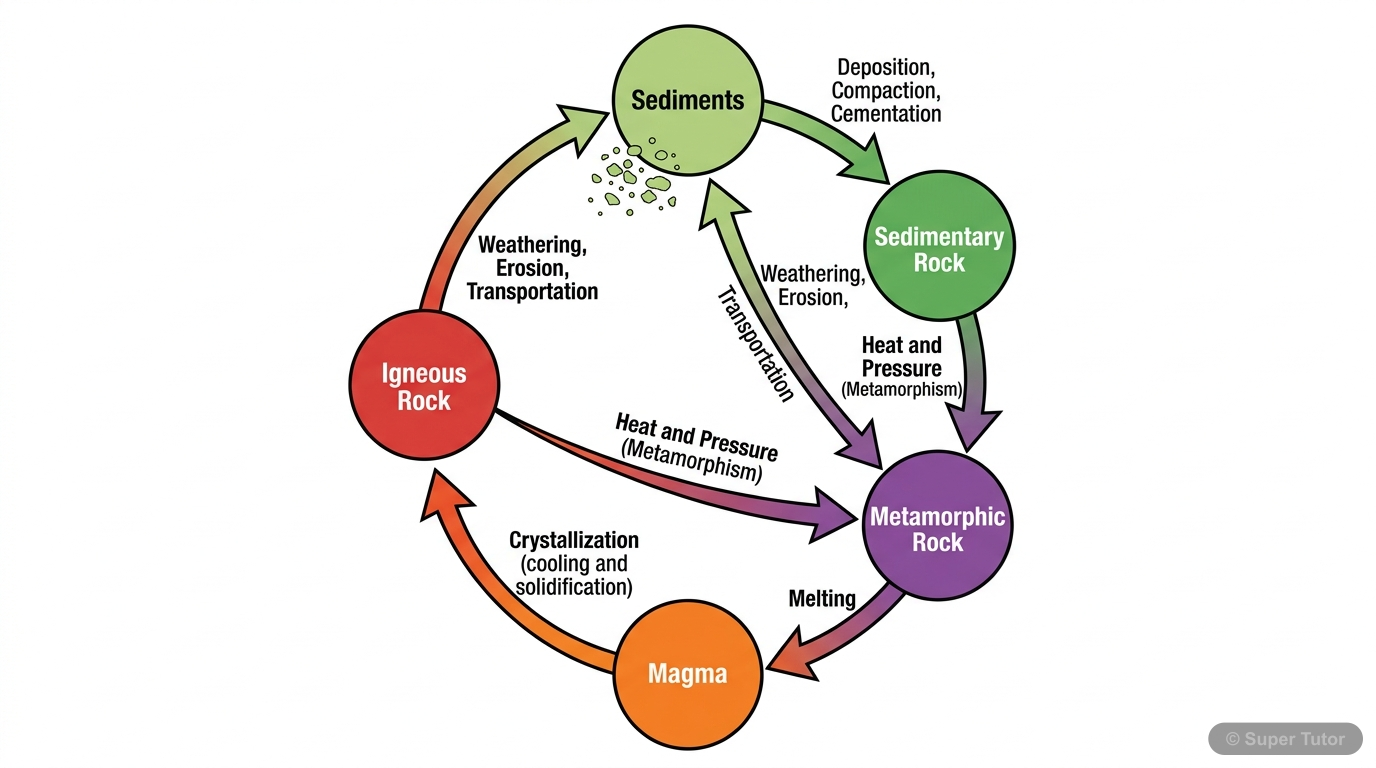
Learn better with visuals Super Tutor pairs illustrations like this with notes and quizzes for Rocks.
Overview
Rocks are the materials that form the earth's crust and make up the most significant part of the lithosphere, the sphere of rock. Down to a depth of 16 km, about 95% of the earth's crust materials are rocks. Rocks are made of minerals, and minerals are natural chemical substances that may occur as e
Key Concepts
The lithosphere is the outer crust
The lithosphere is the outer crust of the earth and literally means the sphere of rock. It is the zone where rocks are the most important materials.
About 2
About 2,000 minerals are known, but only 12 are common rockformers. The earth's crust contains many minerals, and about 87% of them are silicates.
Quartz is made of silicon
Quartz is made of silicon and oxygen and is hard and resistant. Feldspar is the most abundant silicate, but it is weak and breaks down quickly into cl
Calcite is the most important carbonate
Calcite is the most important carbonate mineral. It is usually white but may show shades of grey, yellow, pink, or brown. It reacts vigorously with hy
Igneous rocks form by the solidification
Igneous rocks form by the solidification of molten magma or lava. The word igneous comes from a Latin word meaning fire. These rocks are called parent
Learning Objectives
- Understand the meaning of rocks and their place in the lithosphere
- Identify the main mineral groups that form rocks
- Classify rocks into igneous, sedimentary, and metamorphic types
- Explain the formation, features, and examples of each rock type
- Recognize important igneous rock bodies and sedimentary structures
Frequently Asked Questions
What are the important topics in Rocks for ICSE Class 11 Geography?
How should I revise Rocks for Class 11 exams?
Sources & Official References
Content is aligned to the official syllabus. Refer to the board website for the latest curriculum.
More resources for Rocks
For serious students
Get the full Rocks chapter — start free.
Quizzes, flashcards, an AI doubt solver and a study plan for ICSE Class 11 Geography. Free to start, no card needed.