Rocks — Important Questions
ICSE · Class 11 · Geography
44 important questions from Rocks for ICSE Class 11 Geography, with answers. Includes multiple choice questions.
Interactive on Super Tutor
Studying Rocks? Get the full interactive chapter.
Quizzes, flashcards, AI doubt-solver and a step-by-step study plan — built for important questions and more.
Free trial, no card needed.
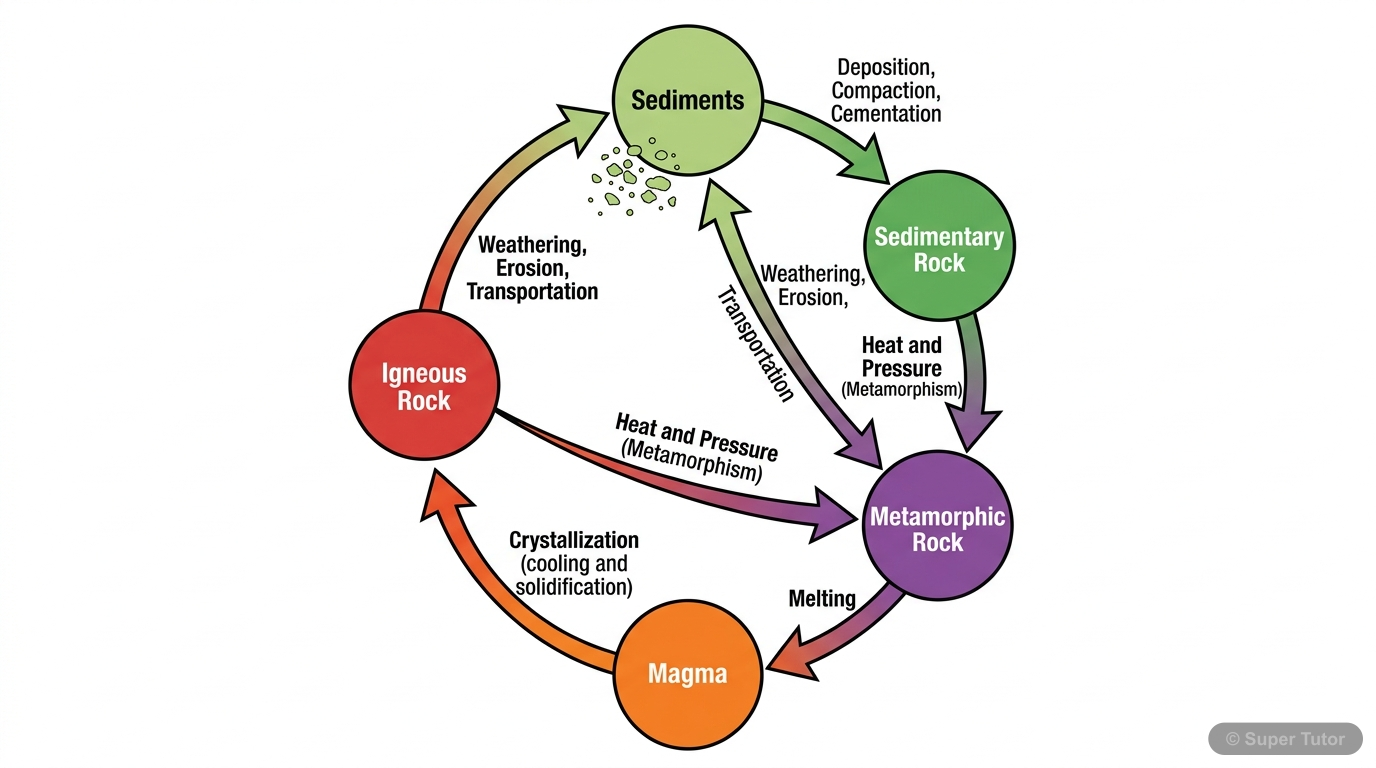
Learn better with visuals Super Tutor pairs illustrations like this with notes and quizzes for Rocks.
Important Questions from Rocks
The process of converting sediment into hard rock layers by pressure is known as:
Show answer
Lithification
Step 1: The question focuses on the specific process that turns loose sediment into solid rock. Step 2: When sediment layers accumulate, the weight of the upper layers puts pressure on lower layers, compressing them. Step 3: Water is squeezed out and the particles bond together to form hard rock — this process is called 'lithification'. Step 4: 'Diagenesis' refers to all physical and chemical changes during conversion of sediment to rock, while lithification is specifically the pressure-based hardening process. Step 5: Metamorphism involves heat and pressure changing existing rocks, and weathe
Which type of metamorphism is caused by pressure alone?
Show answer
Dynamic metamorphism
Step 1: Metamorphism can be caused by heat, pressure, or both. Step 2: The question asks about the type caused by pressure alone. Step 3: Dynamic metamorphism is caused by pressure — for example, granite is converted into gneiss, and clay/shale becomes schist due to pressure at great depths. Step 4: Thermal (contact) metamorphism is caused by high temperatures, such as when magma comes in contact with surrounding rocks. Step 5: Regional metamorphism involves both heat and pressure over large areas, so it is not caused by pressure alone.
The fertile black soil formed from the weathering of basalt rocks in India is locally known as:
Show answer
Regur
Step 1: Basalt is the main igneous rock of the Deccan Trap region. Step 2: Over millions of years, basalt undergoes weathering and breaks down. Step 3: The weathered product of basalt is a rich, dark-coloured soil called 'regur', also known as black cotton soil. Step 4: Regur is very fertile and ideal for cotton cultivation, hence it is also called 'black cotton soil'. Step 5: Loess is wind-deposited sediment, alluvium is river-deposited material, and laterite is a soil formed in hot, wet regions — none of these come from basalt weathering.
The Taj Mahal in Agra is made of which metamorphic rock?
Show answer
Marble
Step 1: The Taj Mahal is one of India's most famous monuments, located in Agra. Step 2: It is built from pure white marble, which is a metamorphic rock. Step 3: Marble is formed when limestone (a sedimentary rock) is subjected to high heat and pressure — this is thermal/contact metamorphism. Step 4: The white marble used for the Taj Mahal comes from Alwar, Ajmer, Jaipur, and Jodhpur districts of Rajasthan and near Jabalpur in Madhya Pradesh. Step 5: Slate, quartzite, and gneiss are all metamorphic rocks but are not used in the construction of the Taj Mahal.
+40 more questions on Rocks (ICSE Class 11 Geography)
Practise AllFrequently Asked Questions
What are the important topics in Rocks for ICSE Class 11 Geography?
How many important questions are there in Rocks?
Sources & Official References
Content is aligned to the official syllabus. Refer to the board website for the latest curriculum.
More resources for Rocks
For serious students
Get the full Rocks chapter — start free.
Quizzes, flashcards, an AI doubt solver and a study plan for ICSE Class 11 Geography. Free to start, no card needed.