Volcanoes and Earthquakes — Practice Quiz
ICSE · Class 11 · Geography
Try a 4-question quiz on Volcanoes and Earthquakes for ICSE Class 11 Geography: tap an answer to check it and see why.
Interactive on Super Tutor
Studying Volcanoes and Earthquakes? Get the full interactive chapter.
Quizzes, flashcards, AI doubt-solver and a step-by-step study plan — built for practice quiz and more.
Free trial, no card needed.
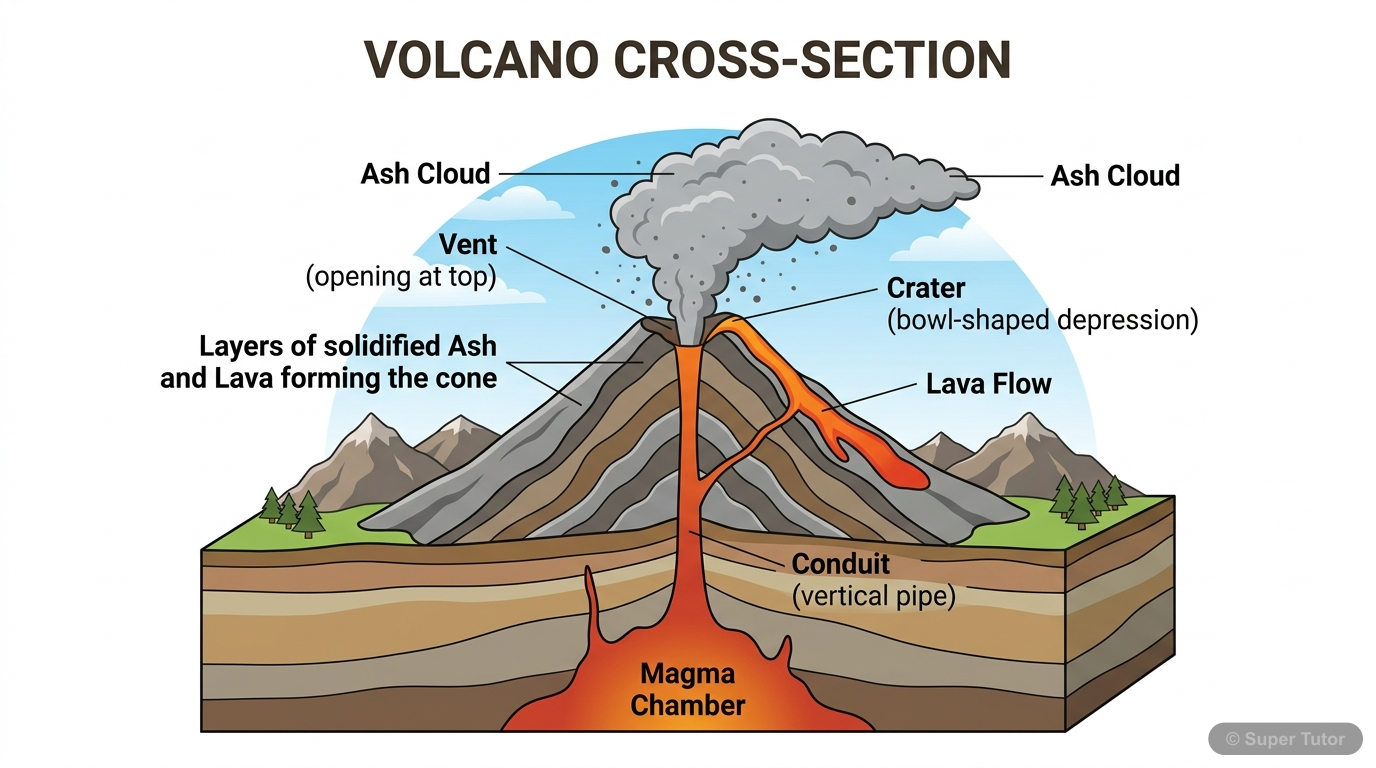
One of 2 illustrations for Volcanoes and Earthquakes in Super Tutor — alongside flashcards, concept maps and practice questions.
Quick Quiz: Volcanoes and Earthquakes
0/4Tap an answer to check it instantly. No sign-up needed for these 4.
What is the term used for molten rock material beneath the earth's crust?
Which part of a volcano is the funnel-shaped depression at the top of the cone?
The Stromboli volcano is known as the 'Light House of the Mediterranean' because:
Which type of volcanic eruption is responsible for the formation of the Deccan Plateau in India?
Sample Questions
The science of earthquakes is known as:
Show answer
Seismology
Step 1: Each natural science has its own branch of study. Step 2: Geology is the study of the earth's structure and rocks. Step 3: Meteorology is the study of weather and atmosphere. Step 4: Vulcanology (or volcanology) is specifically the study of volcanoes. Step 5: SEISMOLOGY comes from the Greek word 'seismos' meaning earthquake — it is the science dedicated to the study of earthquakes. The instrument used to record earthquake waves is called a Seismograph. So the correct answer is Seismology.
What is the point on the earth's surface directly above the focus of an earthquake called?
Show answer
Epicentre
Step 1: An earthquake originates at a point inside the earth. Step 2: The point of origin INSIDE the earth is called the FOCUS or HYPOCENTRE. Step 3: The point on the earth's SURFACE that is directly above the focus is called the EPICENTRE. Step 4: The shaking is strongest at the epicentre because it is closest to the source of the earthquake. Step 5: As we move away from the epicentre, the intensity of shaking decreases. So hypocentre = underground origin, epicentre = point on surface above it.
The Richter Scale was devised by Charles F. Richter in which year?
Show answer
1935
Step 1: Earthquakes are measured using two main scales — the Mercalli Scale (intensity) and the Richter Scale (magnitude). Step 2: The Richter Scale measures the magnitude of an earthquake based on the energy released at the earthquake centre. Step 3: It was devised by the eminent seismologist Charles F. Richter in the year 1935. Step 4: It was later modified in 1965 by Richter and his colleague Beno Gutenberg. Step 5: Note: 1965 refers to when it was modified, not when it was originally created — 1935 is the correct year of origin.
Which of the following is the 'Ring of Fire'?
Show answer
The volcanic belt along the borders of the Pacific Ocean
Step 1: Volcanoes are not randomly distributed on the earth — they follow specific belts. Step 2: The most important volcanic belt in the world is found along the borders (coasts) of the Pacific Ocean. Step 3: This belt contains about 403 active volcanoes out of the world's total — that is about 83% of all active volcanoes. Step 4: Because of the intense volcanic and earthquake activity along the Pacific coasts, this belt is dramatically called the 'Ring of Fire'. Step 5: The Alpine-Himalayan belt (option C) is called the Mid-World Belt, not the Ring of Fire.
+40 more questions on Volcanoes and Earthquakes (ICSE Class 11 Geography)
Practise AllFrequently Asked Questions
What are the important topics in Volcanoes and Earthquakes for ICSE Class 11 Geography?
How many practice questions are there for Volcanoes and Earthquakes?
Sources & Official References
Content is aligned to the official syllabus. Refer to the board website for the latest curriculum.
More resources for Volcanoes and Earthquakes
Important Questions
Exam-style questions with answers
Revision Notes
Key points for last-minute revision
Chapter Summary
Understand the chapter at a glance
Concept Maps
See how topics connect
Study Plan
Step-by-step plan for this chapter
Flashcards
Quick-fire cards for active recall
Syllabus
What topics to cover
For serious students
Get the full Volcanoes and Earthquakes chapter — start free.
Quizzes, flashcards, an AI doubt solver and a study plan for ICSE Class 11 Geography. Free to start, no card needed.