Volcanoes and Earthquakes — Chapter Summary
ICSE · Class 11 · Geography
Summary of Volcanoes and Earthquakes for ICSE Class 11 Geography. Key concepts: Vulcanicity includes all, A volcano is a sudden and Volcanoes eject gases.
Interactive on Super Tutor
Studying Volcanoes and Earthquakes? Get the full interactive chapter.
Quizzes, flashcards, AI doubt-solver and a step-by-step study plan — built for chapter summary and more.
Free trial, no card needed.
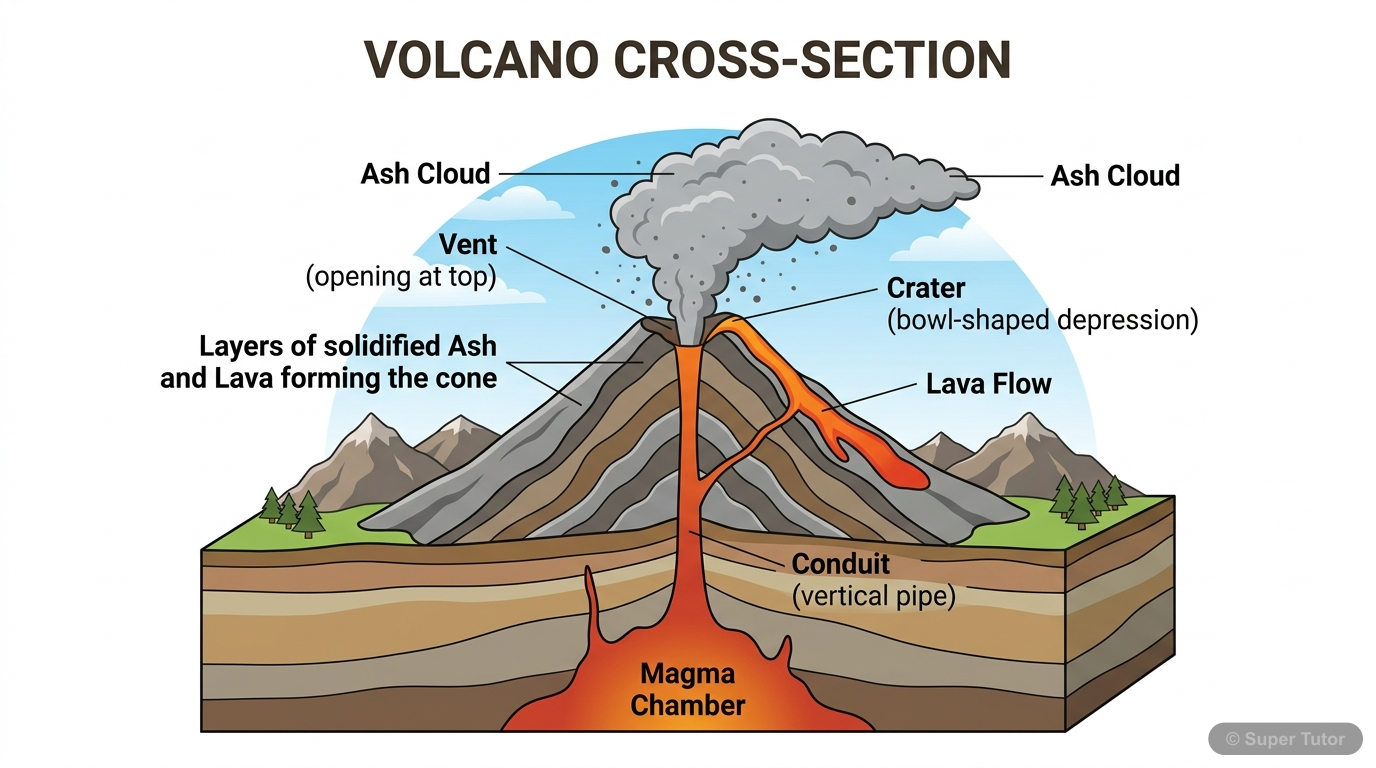
One of 2 illustrations for Volcanoes and Earthquakes in Super Tutor — alongside flashcards, concept maps and practice questions.
Overview
Volcanoes and earthquakes are two major natural processes linked with movements inside the Earth. Volcanoes are openings through which magma, gases, dust and solid materials escape, while earthquakes are sudden tremors caused by vibrations passing through rocks. Both are closely connected with plate
Key Concepts
Vulcanicity includes all processes by
Vulcanicity includes all processes by which solid, liquid or gaseous materials are forced into the Earth’s crust or escape to the surface. Volcanism i
A volcano is a sudden
A volcano is a sudden and abrupt explosion in the crust through which magma, gas, dust, smoke and solid material are ejected. Its main parts are the v
Volcanoes eject gases
Volcanoes eject gases, liquids and solids. Water vapour forms 60 to 90 per cent of volcanic gases. Fresh lava usually has a temperature between 600°C
Volcanoes are classified as central eruption
Volcanoes are classified as central eruption type, fissure eruption, and mud volcanoes. Central eruption types include Hawaiian, Strombolian, Vulcania
Active volcanoes erupt at frequent intervals
Active volcanoes erupt at frequent intervals, dormant volcanoes remain inactive for long periods but may become active again, and extinct volcanoes ha
Learning Objectives
- Understand the meaning of vulcanicity, volcanism, volcanoes and earthquakes
- Identify the parts, types and landforms of volcanoes
- Explain the causes, distribution and effects of volcanic eruptions
- Describe the origin, causes and measurement of earthquakes
- Distinguish between earthquake intensity and magnitude
Frequently Asked Questions
What are the important topics in Volcanoes and Earthquakes for ICSE Class 11 Geography?
How should I revise Volcanoes and Earthquakes for Class 11 exams?
Sources & Official References
Content is aligned to the official syllabus. Refer to the board website for the latest curriculum.
More resources for Volcanoes and Earthquakes
For serious students
Get the full Volcanoes and Earthquakes chapter — start free.
Quizzes, flashcards, an AI doubt solver and a study plan for ICSE Class 11 Geography. Free to start, no card needed.