Partnership Accounts : Fundamentals of Partnership — Study Plan
ICSE · Class 12 · Accountancy
A step-by-step study plan for Partnership Accounts : Fundamentals of Partnership, ICSE Class 12 Accountancy: what to learn first, what to practise.
Interactive on Super Tutor
Studying Partnership Accounts : Fundamentals of Partnership? Get the full interactive chapter.
Quizzes, flashcards, AI doubt-solver and a step-by-step study plan — built for study plan and more.
Free trial, no card needed.
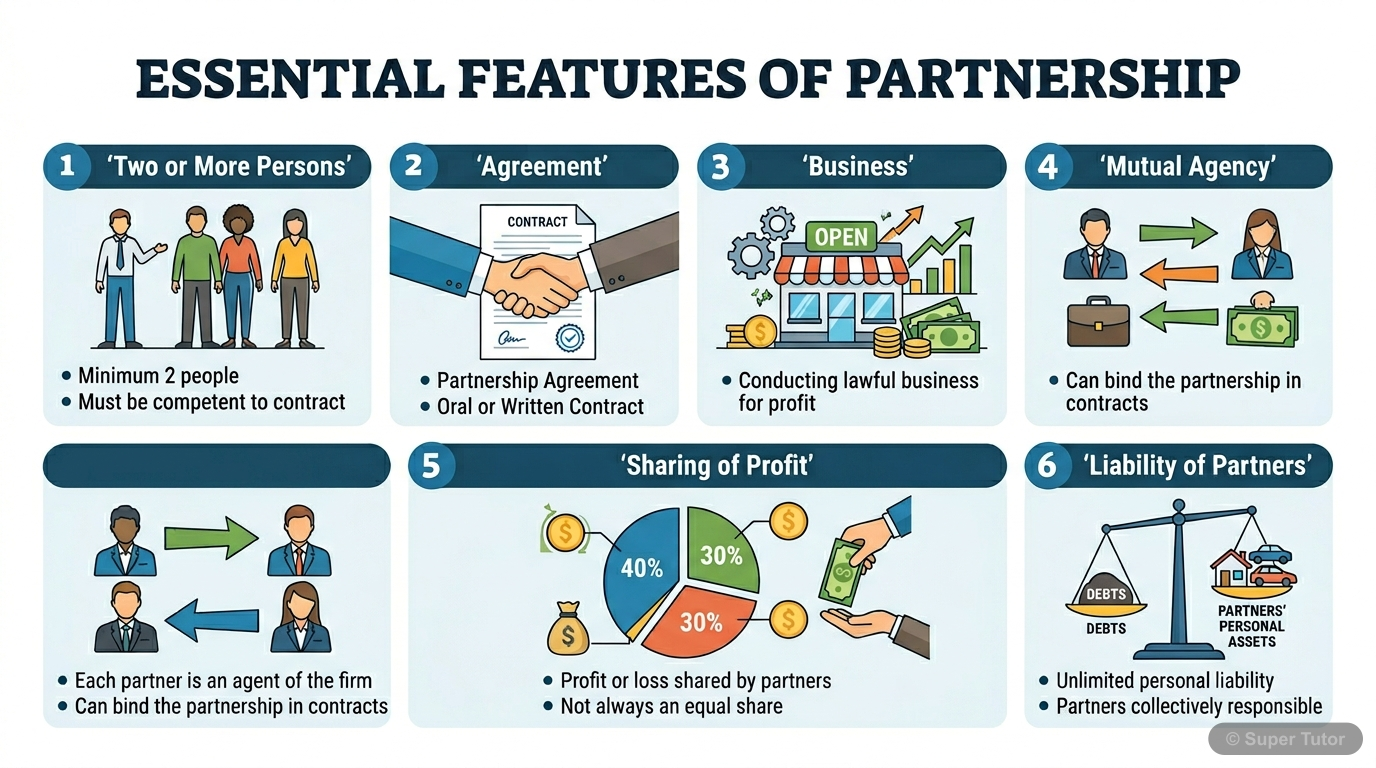
One of 10 illustrations for Partnership Accounts : Fundamentals of Partnership in Super Tutor — alongside flashcards, concept maps and practice questions.
Study Plan
Learn the Theory
Read the textbook chapter carefully. Note down definitions, formulas and key ideas. Focus on: Meaning, Features, and Legal Position of Partnership, Partnership Deed and Rules When No Deed Exists, Profit and Loss Appropriation Account.
Practise
Solve the textbook exercises and extra practice questions. There are 70 questions available for this chapter.
Revise & Test
Revise key points without looking at your notes. Take a practice quiz and mark weak areas for another pass.
Spaced Revision
Come back to Partnership Accounts : Fundamentals of Partnership after a week. Use flashcards for quick recall and try past exam questions on this chapter.
What to Focus On
- Minimum two persons are required to form a partnership.
- Partners are the individuals; the business is the firm.
- Partnership is created by agreement, not by status.
- At least two competent persons are needed.
- Maximum partners are 50 for others; no limit for specified professionals.
- Agreement is essential.
- Partnership deed is a written, signed, and stamped agreement.
- It defines the relationship among partners.
- It helps settle disputes and misunderstandings.
Common Mistakes to Avoid
If partners invest money in different amounts, profit must be shared in the same capital ratio.
Interest on capital is always allowed even if the firm has no profit.
Interest on partner's loan and interest on capital are the same thing.
Memory Tips
Meaning of partnership under Section 4 of the Indian Partnership Act, 1932
Haney's definition of partnership
Minimum and maximum number of partners
Rules applicable in absence of partnership deed
Want a personalised study plan?
Super Tutor builds a day-by-day plan for ICSE Class 12 Accountancy that fits your exam date and pace.
Create My Study PlanFrequently Asked Questions
What are the important topics in Partnership Accounts : Fundamentals of Partnership for ICSE Class 12 Accountancy?
How should I revise Partnership Accounts : Fundamentals of Partnership for the ICSE Class 12 board exam?
Sources & Official References
Content is aligned to the official syllabus. Refer to the board website for the latest curriculum.
More resources for Partnership Accounts : Fundamentals of Partnership
Practice Quiz
Test yourself with a quick quiz
Important Questions
Exam-style questions with answers
Revision Notes
Key points for last-minute revision
Chapter Summary
Understand the chapter at a glance
Concept Maps
See how topics connect
Flashcards
Quick-fire cards for active recall
Syllabus
What topics to cover
For serious students
Get the full Partnership Accounts : Fundamentals of Partnership chapter — start free.
Quizzes, flashcards, an AI doubt solver and a study plan for ICSE Class 12 Accountancy. Free to start, no card needed.