Chapter 1 of 10
Revision Notes
Partnership Accounts : Fundamentals of Partnership — Revision Notes
ICSE · Class 12 · Accountancy
Partnership Accounts : Fundamentals of Partnership revision notes for ICSE Class 12 Accountancy: 4 topics in quick points.
70 questions42 flashcards5 concepts
Interactive on Super Tutor
Studying Partnership Accounts : Fundamentals of Partnership? Get the full interactive chapter.
Quizzes, flashcards, AI doubt-solver and a step-by-step study plan — built for revision notes and more.
Free trial, no card needed.
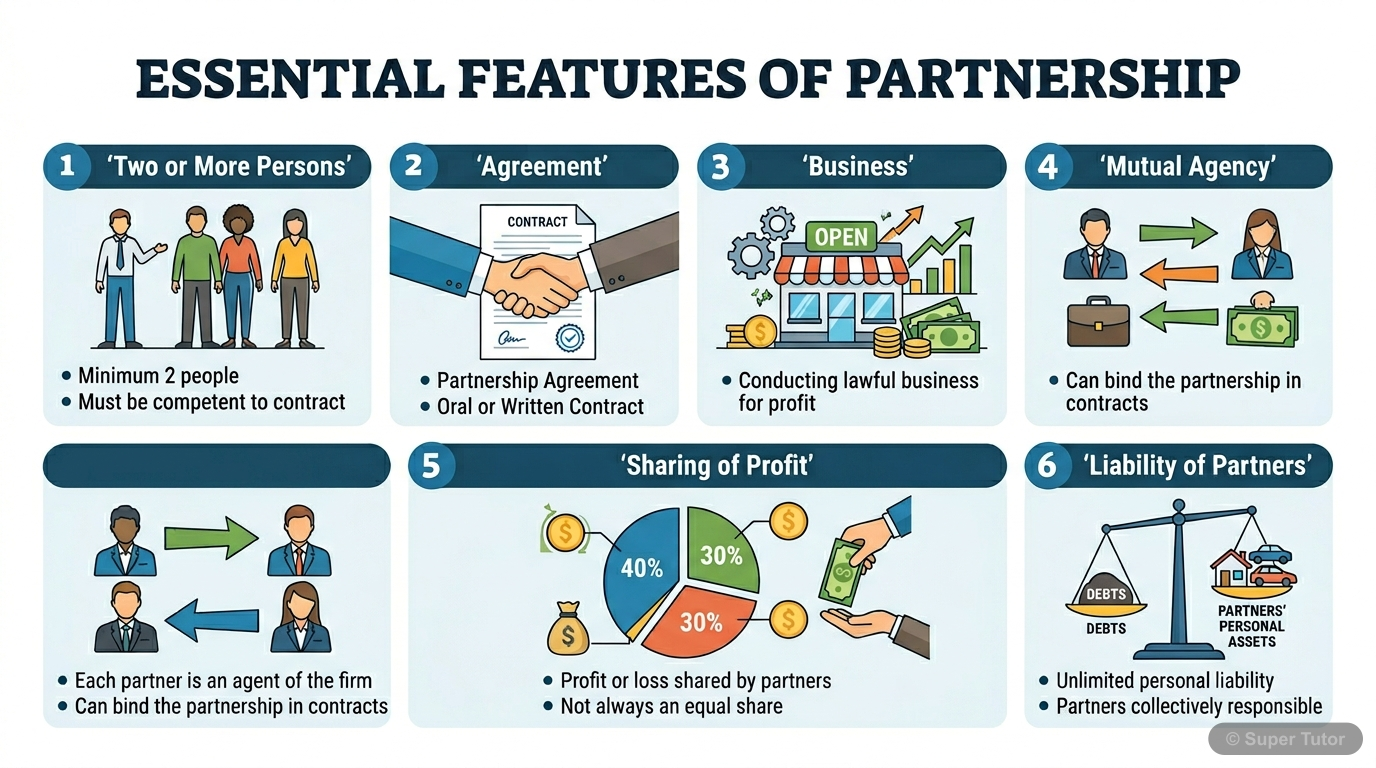
Super Tutor
One of 10 illustrations for Partnership Accounts : Fundamentals of Partnership in Super Tutor — alongside flashcards, concept maps and practice questions.
Key Topics to Revise
1
Meaning, Features, and Legal Position of Partnership
- A partnership is formed by agreement, not by status or law.
- The relation is between persons who agree to share profits of a business carried on by all or any of them acting for all.
- Minimum two persons are required to form a partnership.
2
Partnership Deed and Rules When No Deed Exists
- A partnership deed is a written, signed, and duly stamped agreement among partners.
- It is also called the Partnership Deed, Articles of Partnership, or Constitution of Partnership Firm.
- A deed is important because it regulates rights, duties, liabilities, and dispute resolution.
3
Profit and Loss Appropriation Account
- Profit and Loss Appropriation Account is an extension of the Profit and Loss Account.
- It is used to distribute net profit among partners after all appropriations such as interest on capital, salary, commission, bonus, interest on drawings, and reserve.
- It is a nominal account in nature.
4
Partners' Capital Accounts and Current Accounts
- Partners' capital can be maintained under two methods: fluctuating capital method and fixed capital method.
- Under fluctuating capital method, only one capital account is kept for each partner.
- Under fixed capital method, two accounts are kept for each partner: Capital Account and Current Account.
Get complete notes with diagrams and examples
Full NotesKey Concepts
Partnership is the relation between personsA partnership requires at least twoA writtenIf there is no deedThis account is an extension
Frequently Asked Questions
What are the important topics in Partnership Accounts : Fundamentals of Partnership for ICSE Class 12 Accountancy?
Key topics in Partnership Accounts : Fundamentals of Partnership include Meaning, Features, and Legal Position of Partnership, Partnership Deed and Rules When No Deed Exists, Profit and Loss Appropriation Account, Partners' Capital Accounts and Current Accounts. Study these first, then practise questions on each for the ICSE Class 12 board exam.
How should I revise Partnership Accounts : Fundamentals of Partnership for the ICSE Class 12 board exam?
Learn the core ideas first, then work through the 70 practice questions on Partnership Accounts : Fundamentals of Partnership. Revise definitions regularly and use flashcards for quick recall before the exam.
Sources & Official References
Content is aligned to the official syllabus. Refer to the board website for the latest curriculum.
More resources for Partnership Accounts : Fundamentals of Partnership
For serious students
Get the full Partnership Accounts : Fundamentals of Partnership chapter — start free.
Quizzes, flashcards, an AI doubt solver and a study plan for ICSE Class 12 Accountancy. Free to start, no card needed.