Partnership Accounts : Fundamentals of Partnership — Syllabus
ICSE · Class 12 · Accountancy
What Partnership Accounts : Fundamentals of Partnership covers in ICSE Class 12 Accountancy: 4 topics, for the 2026-27 session.
Interactive on Super Tutor
Studying Partnership Accounts : Fundamentals of Partnership? Get the full interactive chapter.
Quizzes, flashcards, AI doubt-solver and a step-by-step study plan — built for syllabus and more.
Free trial, no card needed.
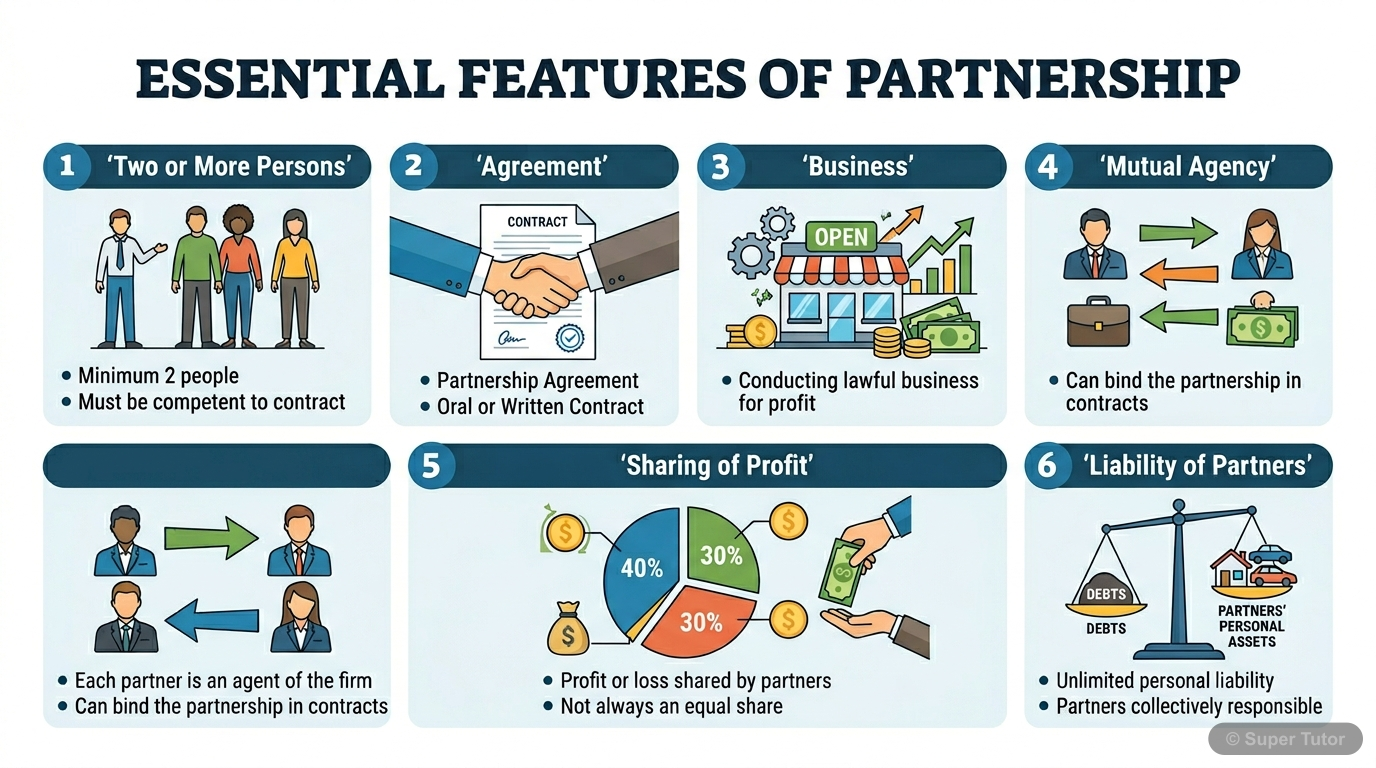
One of 10 illustrations for Partnership Accounts : Fundamentals of Partnership in Super Tutor — alongside flashcards, concept maps and practice questions.
Topics in Partnership Accounts : Fundamentals of Partnership
Meaning, Features, and Legal Position of Partnership
- A partnership is formed by agreement, not by status or law.
- The relation is between persons who agree to share profits of a business carried on by all or any of them acting for all.
- Minimum two persons are required to form a partnership.
Partnership Deed and Rules When No Deed Exists
- A partnership deed is a written, signed, and duly stamped agreement among partners.
- It is also called the Partnership Deed, Articles of Partnership, or Constitution of Partnership Firm.
- A deed is important because it regulates rights, duties, liabilities, and dispute resolution.
Profit and Loss Appropriation Account
- Profit and Loss Appropriation Account is an extension of the Profit and Loss Account.
- It is used to distribute net profit among partners after all appropriations such as interest on capital, salary, commission, bonus, interest on drawings, and reserve.
- It is a nominal account in nature.
Partners' Capital Accounts and Current Accounts
- Partners' capital can be maintained under two methods: fluctuating capital method and fixed capital method.
- Under fluctuating capital method, only one capital account is kept for each partner.
- Under fixed capital method, two accounts are kept for each partner: Capital Account and Current Account.
Key Concepts
Central concept: Partnership as a business relationship and its accounting treatment
Work through every topic in Partnership Accounts : Fundamentals of Partnership with notes and quizzes
Start This ChapterFrequently Asked Questions
What are the important topics in Partnership Accounts : Fundamentals of Partnership for ICSE Class 12 Accountancy?
How should I revise Partnership Accounts : Fundamentals of Partnership for the ICSE Class 12 board exam?
Sources & Official References
Content is aligned to the official syllabus. Refer to the board website for the latest curriculum.
More resources for Partnership Accounts : Fundamentals of Partnership
Practice Quiz
Test yourself with a quick quiz
Important Questions
Exam-style questions with answers
Revision Notes
Key points for last-minute revision
Chapter Summary
Understand the chapter at a glance
Concept Maps
See how topics connect
Study Plan
Step-by-step plan for this chapter
Flashcards
Quick-fire cards for active recall
For serious students
Get the full Partnership Accounts : Fundamentals of Partnership chapter — start free.
Quizzes, flashcards, an AI doubt solver and a study plan for ICSE Class 12 Accountancy. Free to start, no card needed.