Determination Of Income And Employment — Concept Maps
ICSE · Class 12 · Economics
4 concept maps of Determination Of Income And Employment for ICSE Class 12 Economics, each also written out as a text outline.
Interactive on Super Tutor
Studying Determination Of Income And Employment? Get the full interactive chapter.
Quizzes, flashcards, AI doubt-solver and a step-by-step study plan — built for concept maps and more.
Free trial, no card needed.
One of 4 illustrations for Determination Of Income And Employment in Super Tutor — alongside flashcards, concept maps and practice questions.
Chapter Overview: Determination of Income and Employment
The map in words
- Income and Employment Determination
- Aggregate Demand
- Components
- Consumption C
- Investment I
- Government G
- Net Exports X minus M
- Two Sector AD
- AD equals C plus I
- Behaviour
- Upward Sloping Curve
- Starts above origin
- Components
- Aggregate Supply
- Classical View
- Perfectly Inelastic
- Vertical Curve
- Always at Full Employment
- Keynesian View
- Perfectly Elastic
- AS equals Y
- 45 degree line
- AS equals C plus S
- Classical View
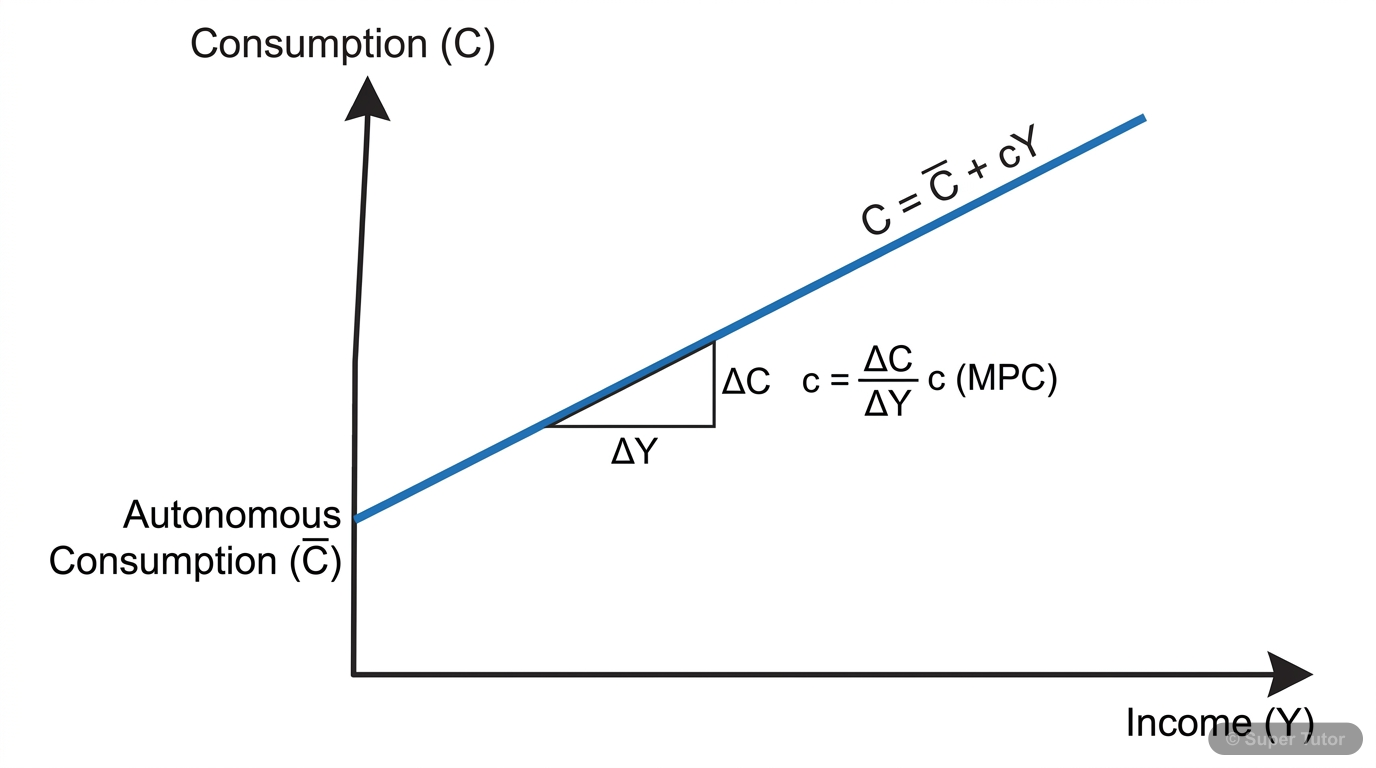
- Consumption Function
- C equals C-bar plus bY
- Autonomous Consumption
- Independent of income
- Minimum for survival
- Induced Consumption
- Depends on income
- bY component
- APC equals C divided Y
- MPC equals DeltaC divided DeltaY
- Saving Function
- S equals Y minus C
- S equals negative C-bar plus MPS times Y
- APS equals S divided Y
- MPS equals DeltaS divided DeltaY
- MPC plus MPS equals 1
- Investment
- Autonomous Investment
- Independent of income
- Horizontal curve
- Government sector
- Induced Investment
- Depends on income
- Private sector
- Determinants
- MEC
- Rate of Interest r
- Autonomous Investment
- Equilibrium Income
- AD-AS Approach
- AD equals AS
- Y equals C plus I
- S-I Approach
- Planned S equals Planned I
- Adjustment Mechanism
- Inventory changes
- AD-AS Approach
- Multiplier
- K equals DeltaY divided DeltaI
- K equals 1 divided 1 minus MPC
- K equals 1 divided MPS
- Forward Working
- Backward Working
- Employment Concepts
- Full Employment
- Zero involuntary unemployment
- Involuntary Unemployment
- Willing but jobless
- Frictional Unemployment
- Structural Unemployment
- Full Employment
- Aggregate Demand
Income Determination Framework - Central Concepts
The map in words
- Income Determination
- Aggregate Demand
- Consumption
- Autonomous
- Induced
- Investment
- Autonomous
- Induced
- Consumption
- Aggregate Supply
- 45-degree line
- AS = Y = C + S
- Keynesian view
- Equilibrium
- AD = AS
- S = I
- No pressure for change
- Multiplier Effect
- K = 1/(1-MPC)
- Income × Investment
- Rounds of spending
- Employment
- Full Employment
- Involuntary Unemployment
- Policy implications
- Aggregate Demand
Income and Employment Determination Process
The map in words
- Change in Investment or AD
- Compare AD with AS
- AD > AS: Shortage of Goods
- Undesired Inventory Decrease
- Firms Increase Output
- Income Increases
- Equilibrium
- No Tendency to Change
- At Equilibrium: AD = AS S = I ΔY = 0
- No Tendency to Change
- Equilibrium
- Income Increases
- Firms Increase Output
- Undesired Inventory Decrease
- AD < AS: Surplus of Goods
- Undesired Inventory Increase
- Firms Decrease Output
- Income Decreases
- Firms Decrease Output
- Undesired Inventory Increase
- AD > AS: Shortage of Goods
- Compare AD with AS
Determination of equilibrium income and employment in the economy
The map in words
- Determination of equilibrium income and employment in the economy
- Aggregate Demand
- Aggregate Supply
- Consumption Function
- Propensity to Consume
- Saving Function
- Propensity to Save
- Investment Function
- Ex-ante and Ex-post Saving and Investment
Explore these maps interactively
Explore DiagramsFrequently Asked Questions
What are the important topics in Determination Of Income And Employment for ICSE Class 12 Economics?
What do the concept maps for Determination Of Income And Employment show?
How should I revise Determination Of Income And Employment for the ICSE Class 12 board exam?
Sources & Official References
Content is aligned to the official syllabus. Refer to the board website for the latest curriculum.
More resources for Determination Of Income And Employment
Practice Quiz
Test yourself with a quick quiz
Important Questions
Exam-style questions with answers
Revision Notes
Key points for last-minute revision
Formula Sheet
The chapter's formulas in one place
Chapter Summary
Understand the chapter at a glance
Study Plan
Step-by-step plan for this chapter
Flashcards
Quick-fire cards for active recall
Syllabus
What topics to cover
For serious students
Get the full Determination Of Income And Employment chapter — start free.
Quizzes, flashcards, an AI doubt solver and a study plan for ICSE Class 12 Economics. Free to start, no card needed.