Determination Of Income And Employment — Syllabus
ICSE · Class 12 · Economics
What Determination Of Income And Employment covers in ICSE Class 12 Economics: 4 topics, for the 2026-27 session.
Interactive on Super Tutor
Studying Determination Of Income And Employment? Get the full interactive chapter.
Quizzes, flashcards, AI doubt-solver and a step-by-step study plan — built for syllabus and more.
Free trial, no card needed.
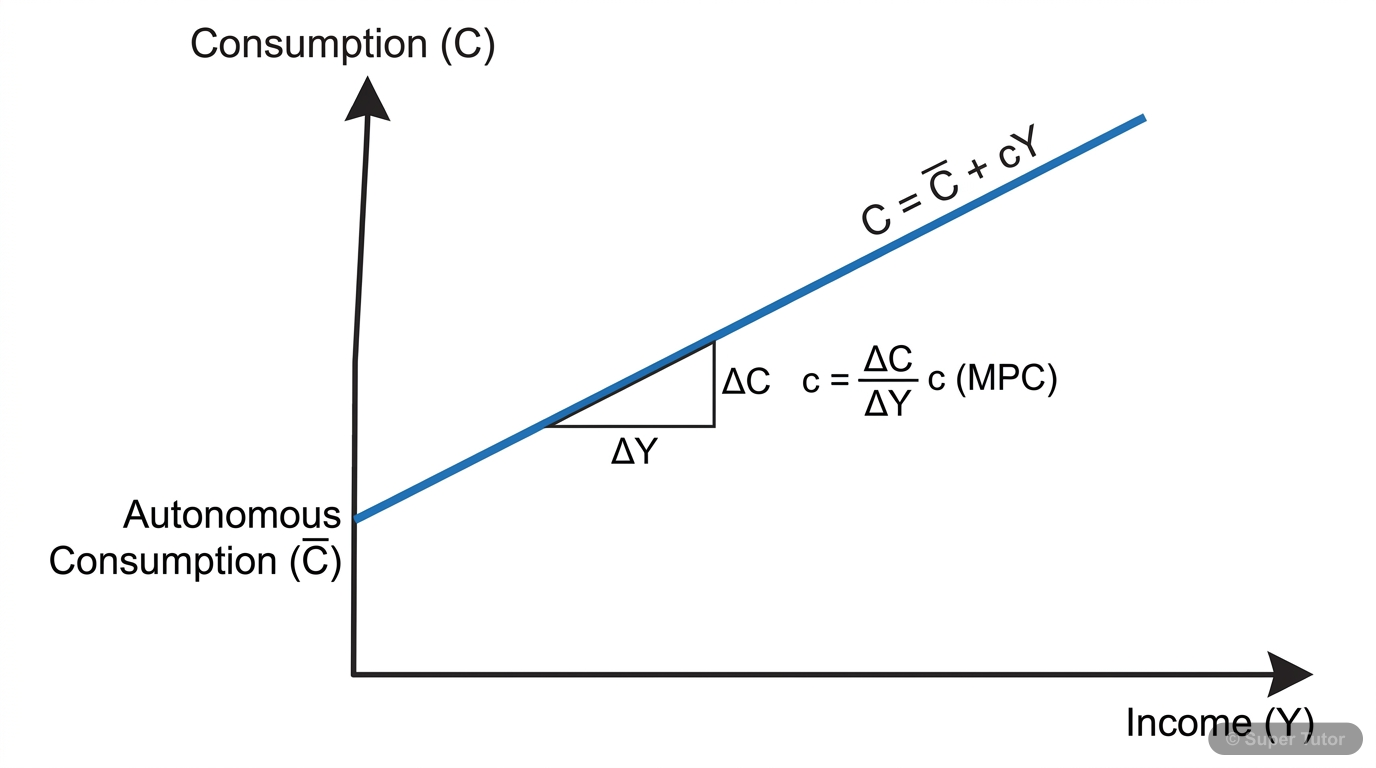
One of 4 illustrations for Determination Of Income And Employment in Super Tutor — alongside flashcards, concept maps and practice questions.
Topics in Determination Of Income And Employment
1. Aggregate Demand and Aggregate Supply
- Aggregate Demand refers to the total value of final goods and services demanded in an economy during a year.
- Aggregate demand and aggregate expenditure mean the same thing.
- In a two-sector economy, aggregate demand has two components: consumption demand and investment demand.
2. Consumption Function and Propensities to Consume
- The consumption function shows the relationship between income and consumption.
- Income here means disposable income, which is income after taxes.
- Keynes' Psychological Law of Consumption says consumption rises when income rises, but by less than income.
3. Saving Function and Propensities to Save
- Saving is the part of income not spent on current consumption.
- Saving is also the excess of income over consumption.
- Saving function shows the relationship between saving and income.
4. Investment Function and Investment Multiplier
- Investment means addition to the existing stock of capital.
- According to Keynes, investment depends on marginal efficiency of capital and the rate of interest.
- Firms invest as long as marginal efficiency of capital exceeds the rate of interest.
Key Concepts
Central concept: Determination of equilibrium income and employment in the economy
Work through every topic in Determination Of Income And Employment with notes and quizzes
Start This ChapterFrequently Asked Questions
What are the important topics in Determination Of Income And Employment for ICSE Class 12 Economics?
How should I revise Determination Of Income And Employment for the ICSE Class 12 board exam?
Sources & Official References
Content is aligned to the official syllabus. Refer to the board website for the latest curriculum.
More resources for Determination Of Income And Employment
Practice Quiz
Test yourself with a quick quiz
Important Questions
Exam-style questions with answers
Revision Notes
Key points for last-minute revision
Formula Sheet
The chapter's formulas in one place
Chapter Summary
Understand the chapter at a glance
Concept Maps
See how topics connect
Study Plan
Step-by-step plan for this chapter
Flashcards
Quick-fire cards for active recall
For serious students
Get the full Determination Of Income And Employment chapter — start free.
Quizzes, flashcards, an AI doubt solver and a study plan for ICSE Class 12 Economics. Free to start, no card needed.