Main Forms Of Market — Important Questions
ICSE · Class 12 · Economics
45 important questions from Main Forms Of Market for ICSE Class 12 Economics, with answers. Includes multiple choice questions.
Interactive on Super Tutor
Studying Main Forms Of Market? Get the full interactive chapter.
Quizzes, flashcards, AI doubt-solver and a step-by-step study plan — built for important questions and more.
Free trial, no card needed.
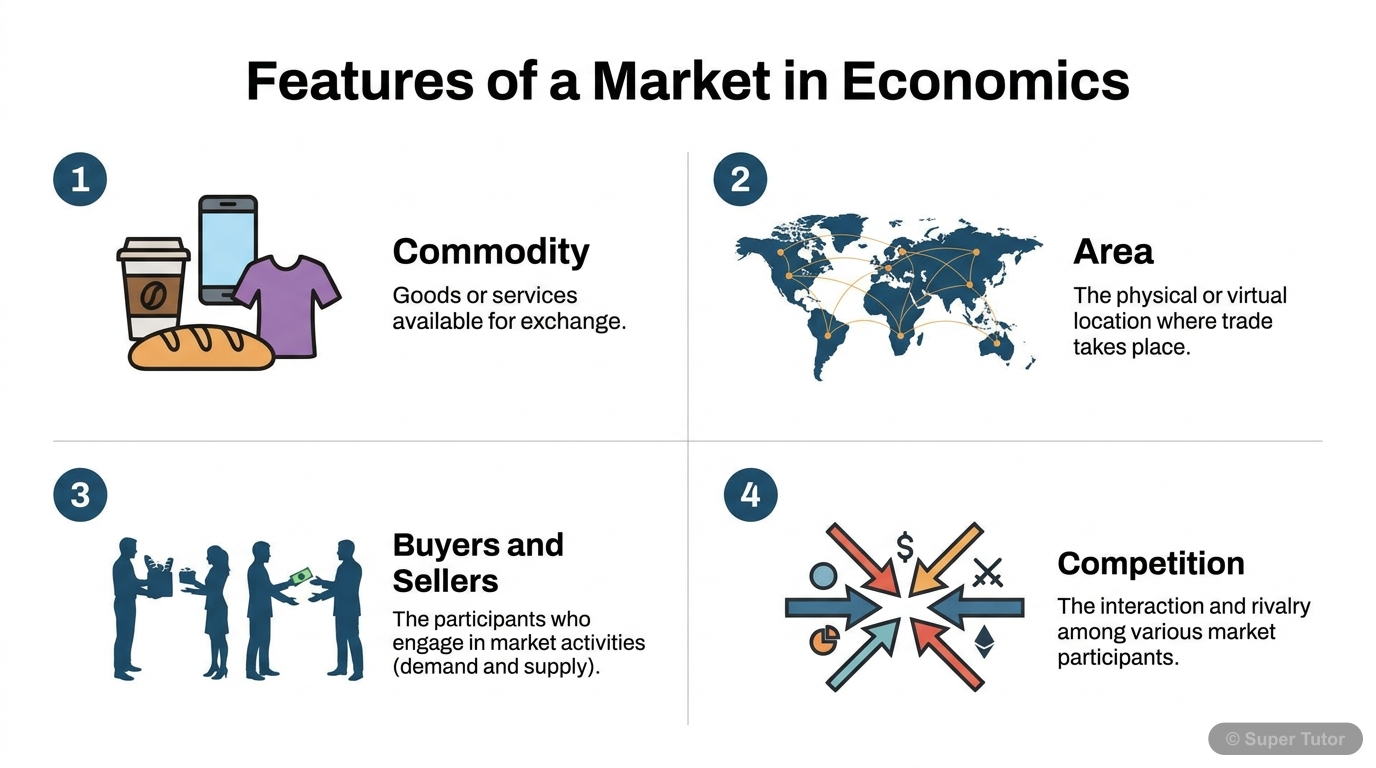
One of 7 illustrations for Main Forms Of Market in Super Tutor — alongside flashcards, concept maps and practice questions.
Important Questions from Main Forms Of Market
Under which market structure does interdependence among firms play the most critical role in decision-making?
Show answer
Oligopoly
Step 1: Interdependence in decision-making is the most important and distinguishing feature of oligopoly. Step 2: Under oligopoly, there are only a few large firms. Each firm controls a considerable portion of total market supply. Step 3: Therefore, when one firm changes its price or output, it directly affects the sales and profits of rival firms. Step 4: Rival firms then react by changing their own prices and output — this chain of reactions makes each firm's decision dependent on what others do. Step 5: Under perfect competition and monopolistic competition, the large number of firms means
The term 'shut-down point' in the context of a perfectly competitive firm refers to a situation where:
Show answer
Price is equal to Average Variable Cost
Step 1: In the short run, a firm has two types of costs — fixed costs and variable costs. Fixed costs must be paid even if output is zero. Step 2: A firm will continue production as long as it can at least cover its variable costs (AVC), because any revenue above AVC helps recover some fixed costs. Step 3: The shut-down point is the minimum price at which the firm is willing to produce. It is the point where Price (P) = AVC. Step 4: If price falls below AVC, the firm cannot even cover its variable costs — it is better off shutting down production since losses would exceed fixed costs. Step 5:
Which of the following correctly explains 'price discrimination' as practised by a monopolist?
Show answer
Charging different prices for the same product from different buyers, not due to cost differences
Step 1: Price discrimination is a pricing strategy that only a monopolist can effectively use due to complete market control. Step 2: It means charging different prices from different buyers for the same product, where the price difference is NOT due to any difference in the cost of supplying the product. Step 3: For example, Indian Railways charges lower fares from senior citizens compared to regular passengers for the same journey — this is price discrimination. Step 4: Another example is Electricity Boards charging lower rates for agricultural use versus domestic use, even though the electr
In which market structure do firms incur 'selling costs' such as advertisement expenditure most prominently?
Show answer
Monopolistic Competition
Step 1: Selling costs are expenses incurred on marketing, sales promotion, and advertisement to promote sales of a firm's product. Step 2: Under perfect competition, products are homogeneous — there is no need to advertise since all products are identical and buyers already know the price. Step 3: Under monopoly, there is only one seller — the firm does not need heavy advertising since buyers have no alternative choice. At most, only informative selling costs are incurred. Step 4: Under monopolistic competition, products are differentiated. Each firm must convince buyers that its product (its
+41 more questions on Main Forms Of Market (ICSE Class 12 Economics)
Practise AllFrequently Asked Questions
What are the important topics in Main Forms Of Market for ICSE Class 12 Economics?
How many important questions are there in Main Forms Of Market?
Sources & Official References
Content is aligned to the official syllabus. Refer to the board website for the latest curriculum.
More resources for Main Forms Of Market
Practice Quiz
Test yourself with a quick quiz
Revision Notes
Key points for last-minute revision
Formula Sheet
The chapter's formulas in one place
Chapter Summary
Understand the chapter at a glance
Concept Maps
See how topics connect
Study Plan
Step-by-step plan for this chapter
Flashcards
Quick-fire cards for active recall
Syllabus
What topics to cover
For serious students
Get the full Main Forms Of Market chapter — start free.
Quizzes, flashcards, an AI doubt solver and a study plan for ICSE Class 12 Economics. Free to start, no card needed.