Consumer Behaviour Cardinal And Ordinal Utility Analysis — Important Questions
ICSE · Class 12 · Economics
68 important questions from Consumer Behaviour Cardinal And Ordinal Utility Analysis for ICSE Class 12 Economics, with answers.
Interactive on Super Tutor
Studying Consumer Behaviour Cardinal And Ordinal Utility Analysis? Get the full interactive chapter.
Quizzes, flashcards, AI doubt-solver and a step-by-step study plan — built for important questions and more.
Free trial, no card needed.
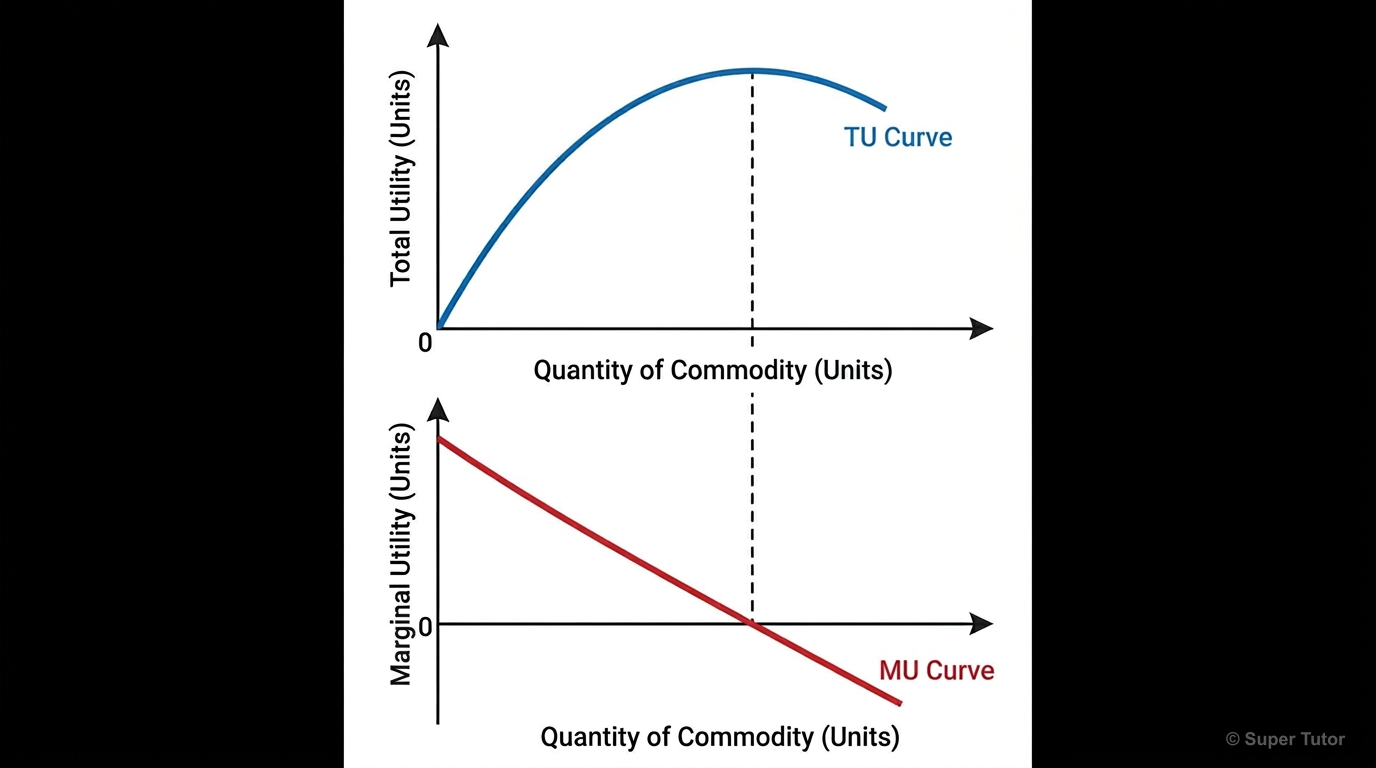
One of 10 illustrations for Consumer Behaviour Cardinal And Ordinal Utility Analysis in Super Tutor — alongside flashcards, concept maps and practice questions.
Important Questions from Consumer Behaviour Cardinal And Ordinal Utility Analysis
In an indifference schedule, Geeta has bundles: 1 food and 12 clothing; 2 food and 8 clothing; 3 food and 5 clothing. What is the total clothing given up to obtain the third unit of food, and what is the diminishing MRS pattern?
Show answer
7 clothing units in total; MRS falls from 4 to 3
From 1 to 2 food, Geeta gives up 4 clothing. From 2 to 3 food, she gives up 3 clothing. Total clothing given up to reach 3 food is 7 units, and MRS falls from 4 to 3.
For a good, TU is 10, 18, 24, 28, 30, 30, and 28 for the first seven units. What are the marginal utilities of the 2nd, 5th, 6th, and 7th units?
Show answer
8, 2, 0, and -2 units of utility
MU is the change in TU. So MU2 = 18 - 10 = 8, MU5 = 30 - 28 = 2, MU6 = 30 - 30 = 0, and MU7 = 28 - 30 = -2.
A consumer spends ₹24 on X and Y. Px = ₹2, Py = ₹3. The marginal utilities are MUx = 20, 18, 16, 14, 12, 10 for X and MUy = 24, 21, 18, 15, 12, 9 for Y. Which bundle gives equilibrium?
Show answer
6 units of X and 4 units of Y
Compute per rupee utility: MUx/Px = 10 at 1 unit, 9 at 2 units, ..., 5 at 6 units. MUy/Py = 8, 7, 6, 5, ... The equality occurs at MUx/Px = 5 for 6 units of X and MUy/Py = 5 for 4 units of Y.
A consumer's budget line shifts rightward when income rises from ₹100 to ₹120. If Px = ₹20 and Py = ₹10 remain unchanged, what are the new maximum quantities of X and Y, and why does the line remain parallel?
Show answer
6 units of X and 12 units of Y; because the price ratio stays the same
New maxima are 120/20 = 6 units of X and 120/10 = 12 units of Y. The budget line remains parallel because the price ratio Px/Py does not change.
+64 more questions on Consumer Behaviour Cardinal And Ordinal Utility Analysis (ICSE Class 12 Economics)
Practise AllFrequently Asked Questions
What are the important topics in Consumer Behaviour Cardinal And Ordinal Utility Analysis for ICSE Class 12 Economics?
How many important questions are there in Consumer Behaviour Cardinal And Ordinal Utility Analysis?
Sources & Official References
Content is aligned to the official syllabus. Refer to the board website for the latest curriculum.
More resources for Consumer Behaviour Cardinal And Ordinal Utility Analysis
Practice Quiz
Test yourself with a quick quiz
Revision Notes
Key points for last-minute revision
Formula Sheet
The chapter's formulas in one place
Chapter Summary
Understand the chapter at a glance
Concept Maps
See how topics connect
Study Plan
Step-by-step plan for this chapter
Flashcards
Quick-fire cards for active recall
Syllabus
What topics to cover
For serious students
Get the full Consumer Behaviour Cardinal And Ordinal Utility Analysis chapter — start free.
Quizzes, flashcards, an AI doubt solver and a study plan for ICSE Class 12 Economics. Free to start, no card needed.