Concept Of Production And Production Function — Important Questions
ICSE · Class 12 · Economics
44 important questions from Concept Of Production And Production Function for ICSE Class 12 Economics, with answers. Includes multiple choice questions.
Interactive on Super Tutor
Studying Concept Of Production And Production Function? Get the full interactive chapter.
Quizzes, flashcards, AI doubt-solver and a step-by-step study plan — built for important questions and more.
Free trial, no card needed.
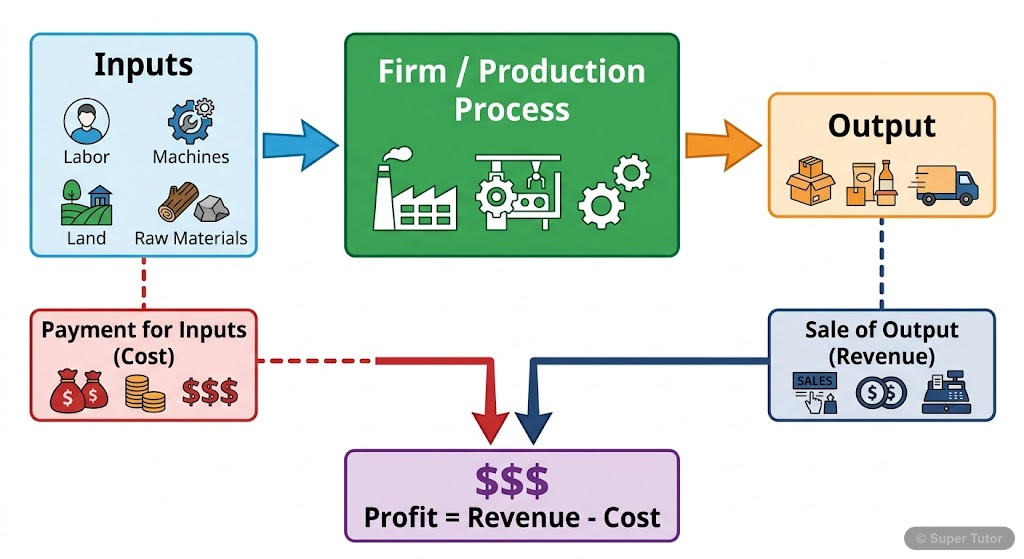
Learn better with visuals Super Tutor pairs illustrations like this with notes and quizzes for Concept Of Production And Production Function.
Important Questions from Concept Of Production And Production Function
When Total Product (TP) is at its maximum, the Marginal Product (MP) is:
Show answer
Zero
Step 1: Understand the relationship between MP and TP. MP measures the addition to TP when one more unit of variable factor is added. Step 2: When TP is rising, MP is positive. When TP is falling, MP is negative. At the exact peak (maximum) of TP, there is no increase or decrease — the change in TP is zero. Step 3: Therefore, when TP is at its maximum, MP = 0. This is a fundamental relationship in the Law of Variable Proportions. Step 4: Option A is wrong — MP equals AP at the maximum point of AP, not when TP is maximum. Step 5: Option C is wrong — MP reaches its maximum earlier (at the point
The 'Point of Inflexion' on the Total Product (TP) curve represents:
Show answer
The point where TP changes from increasing at an increasing rate to increasing at a diminishing rate.
Step 1: The Point of Inflexion is a specific point on the TP curve where the slope of the curve changes. Step 2: Before this point, TP increases at an increasing rate (Phase I — Increasing Returns). At this point, MP reaches its maximum. Step 3: After this point, TP still increases but now at a diminishing rate (Phase II — Diminishing Returns) because MP starts to fall. Step 4: Option A is wrong — TP becomes zero only when no variable factor is used, not at the inflexion point. Step 5: Option B is wrong — TP is maximum when MP = 0, which is a different (later) point on the curve. Option D is w
According to the Law of Variable Proportions, a rational producer will always operate in which phase of production?
Show answer
Phase II — Diminishing Returns
Step 1: Understand the three phases — Phase I (Increasing Returns), Phase II (Diminishing Returns), Phase III (Negative Returns). Step 2: In Phase I, MP is rising, which means the fixed factor is still being under-utilised. A rational producer would continue adding more variable factors because each addition still increases efficiency. So, a producer would NOT stop in Phase I. Step 3: In Phase III, MP becomes negative, meaning adding more variable factors actually reduces total output. No rational producer would ever operate here as it leads to a loss. Step 4: In Phase II, MP is declining but
When Average Product (AP) is at its maximum, what is the relationship between MP and AP?
Show answer
MP = AP
Step 1: Understand the mathematical relationship between AP and MP. Step 2: When the marginal value is greater than the average (MP > AP), the average rises. Think of a cricket analogy — if a batsman scores more than his current average, his average goes up. Step 3: When the marginal value is less than the average (MP < AP), the average falls. Similarly, if the batsman scores less than his average, his average falls. Step 4: At the exact maximum (peak) of the AP curve, AP is neither rising nor falling. This happens precisely when MP = AP — the marginal value exactly equals the average. Step 5:
+40 more questions on Concept Of Production And Production Function (ICSE Class 12 Economics)
Practise AllFrequently Asked Questions
What are the important topics in Concept Of Production And Production Function for ICSE Class 12 Economics?
How many important questions are there in Concept Of Production And Production Function?
Sources & Official References
Content is aligned to the official syllabus. Refer to the board website for the latest curriculum.
More resources for Concept Of Production And Production Function
Practice Quiz
Test yourself with a quick quiz
Revision Notes
Key points for last-minute revision
Formula Sheet
The chapter's formulas in one place
Chapter Summary
Understand the chapter at a glance
Concept Maps
See how topics connect
Study Plan
Step-by-step plan for this chapter
Flashcards
Quick-fire cards for active recall
Syllabus
What topics to cover
For serious students
Get the full Concept Of Production And Production Function chapter — start free.
Quizzes, flashcards, an AI doubt solver and a study plan for ICSE Class 12 Economics. Free to start, no card needed.