The First World War 1914-1918 — Practice Quiz
ICSE · Class 12 · History
Try a 4-question quiz on The First World War 1914-1918 for ICSE Class 12 History: tap an answer to check it and see why.
Interactive on Super Tutor
Studying The First World War 1914-1918? Get the full interactive chapter.
Quizzes, flashcards, AI doubt-solver and a step-by-step study plan — built for practice quiz and more.
Free trial, no card needed.
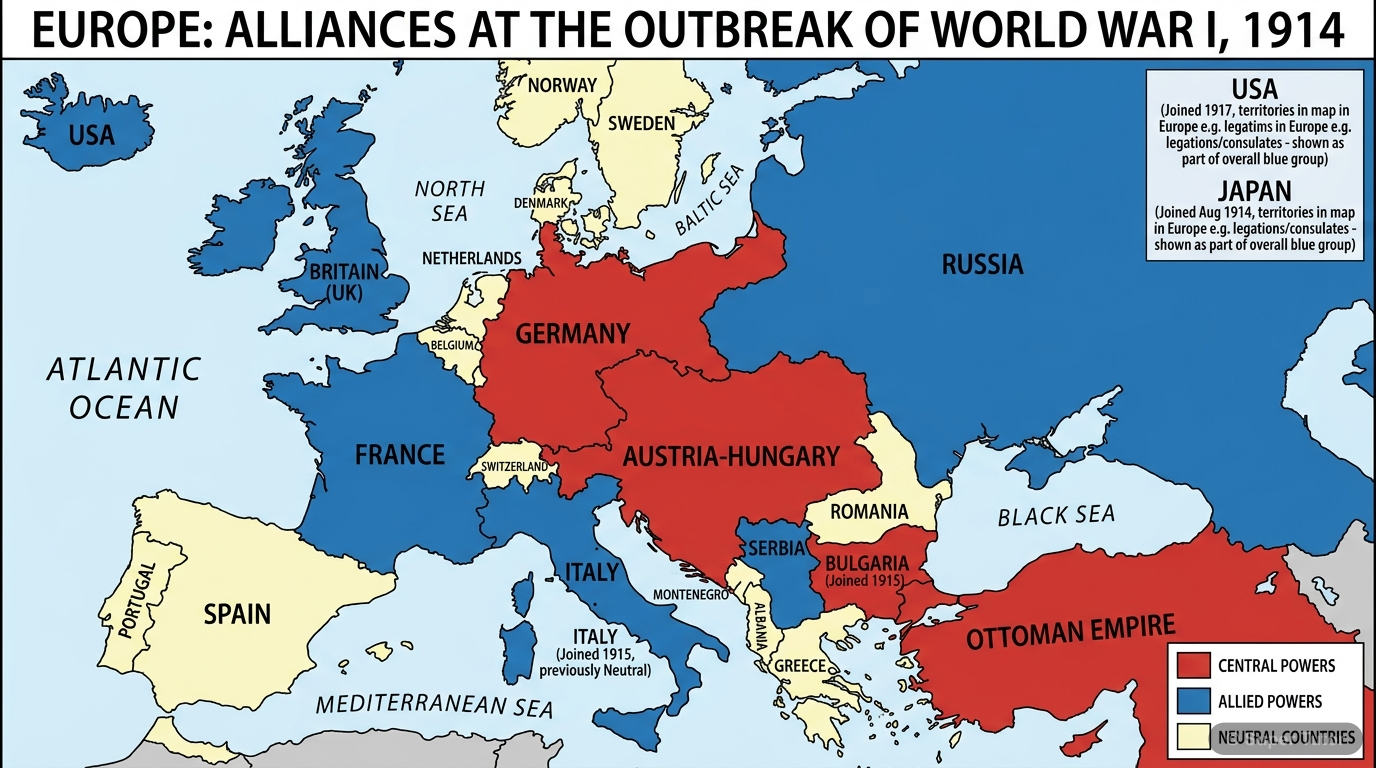
One of 2 illustrations for The First World War 1914-1918 in Super Tutor — alongside flashcards, concept maps and practice questions.
Quick Quiz: The First World War 1914-1918
0/4Tap an answer to check it instantly. No sign-up needed for these 4.
Which group of countries formed the Allied or Entente Powers during the First World War?
What was the Schlieffen Plan?
Which battle is considered one of the most decisive battles of the First World War because it ended all hopes of a short German victory?
Where did the famous trench warfare stalemate develop during the First World War?
Sample Questions
When did the armistice ending the First World War come into effect?
Show answer
11 November 1918
Step 1: By late summer 1918, Germany was nearing exhaustion after a series of Allied counter-offensives. Step 2: Germany's last major offensive in the spring of 1918 had failed, and Allied forces were pushing them back steadily. Step 3: Germany's General Ludendorff asked for an armistice (ceasefire) on 3 October 1918. Step 4: After five more weeks of negotiations, the armistice was finally signed on 11 November 1918, ending the fighting. Step 5: 28 June 1919 is the date of the Treaty of Versailles (the peace treaty), and 4 August 1914 was when Britain entered the war.
What was the main purpose of the Gallipoli Campaign launched by the Allies in 1915?
Show answer
To clear the Dardanelles and open a supply route to Russia via the Black Sea
Step 1: Russia was running short of arms and ammunition by 1915, and the Turkish control of the Dardanelles (the strait connecting the Black Sea to the Mediterranean) was blocking the main supply route to Russia. Step 2: Winston Churchill strongly proposed the Gallipoli Campaign to eliminate Turkey — considered the weakest Central Power — and open this vital supply route. Step 3: The campaign was also hoped to bring neutral countries like Bulgaria, Greece, and Romania onto the Allied side. Step 4: The campaign failed completely — Allied troops could not advance past the beaches and were eventu
Which two major battles on the Western Front made 1916 especially horrific in terms of casualties?
Show answer
The Battle of Verdun and the Battle of the Somme
Step 1: The year 1916 is remembered for two terrible battles on the Western Front. Step 2: The Battle of Verdun began in February 1916 when Germans launched a massive attack on the French fortress town. The French lost about 315,000 men and Germany lost over 280,000. Step 3: The Battle of the Somme was a series of British-led attacks beginning 1 July 1916. On the very first day alone, 20,000 British soldiers were killed and 60,000 wounded. Step 4: Total losses at the Somme were enormous — Germans 650,000, British 418,000, French 194,000. Step 5: Marne and Tannenberg were 1914 battles; Passchen
What was the result of the Battle of Jutland (1916)?
Show answer
The result was indecisive, but Germany never challenged British sea power again
Step 1: The Battle of Jutland in May 1916 was the only major naval engagement between the main battle fleets during the entire war. Step 2: In terms of ships lost, Germany could claim a tactical victory — they lost 11 ships while Britain lost 14. Step 3: However, the real outcome was that the German High Seas Fleet retreated to Kiel harbour and never came out again to challenge British dominance of the seas. Step 4: This meant Britain remained in control of the surface of the seas for the rest of the war, which was strategically very important. Step 5: Options B, C, and D are all inaccurate —
+41 more questions on The First World War 1914-1918 (ICSE Class 12 History)
Practise AllFrequently Asked Questions
What are the important topics in The First World War 1914-1918 for ICSE Class 12 History?
How many practice questions are there for The First World War 1914-1918?
Sources & Official References
Content is aligned to the official syllabus. Refer to the board website for the latest curriculum.
More resources for The First World War 1914-1918
Important Questions
Exam-style questions with answers
Revision Notes
Key points for last-minute revision
Chapter Summary
Understand the chapter at a glance
Concept Maps
See how topics connect
Study Plan
Step-by-step plan for this chapter
Flashcards
Quick-fire cards for active recall
Syllabus
What topics to cover
For serious students
Get the full The First World War 1914-1918 chapter — start free.
Quizzes, flashcards, an AI doubt solver and a study plan for ICSE Class 12 History. Free to start, no card needed.