Chapter 2 of 28
Revision Notes
The First World War 1914-1918 — Revision Notes
ICSE · Class 12 · History
The First World War 1914-1918 revision notes for ICSE Class 12 History: 4 topics in quick points. Part of the ICSE Class 12 History syllabus.
45 questions36 flashcards5 concepts
Interactive on Super Tutor
Studying The First World War 1914-1918? Get the full interactive chapter.
Quizzes, flashcards, AI doubt-solver and a step-by-step study plan — built for revision notes and more.
Free trial, no card needed.
Super Tutor
One of 2 illustrations for The First World War 1914-1918 in Super Tutor — alongside flashcards, concept maps and practice questions.
Key Topics to Revise
1
1. Main Sides and the Global Nature of the War
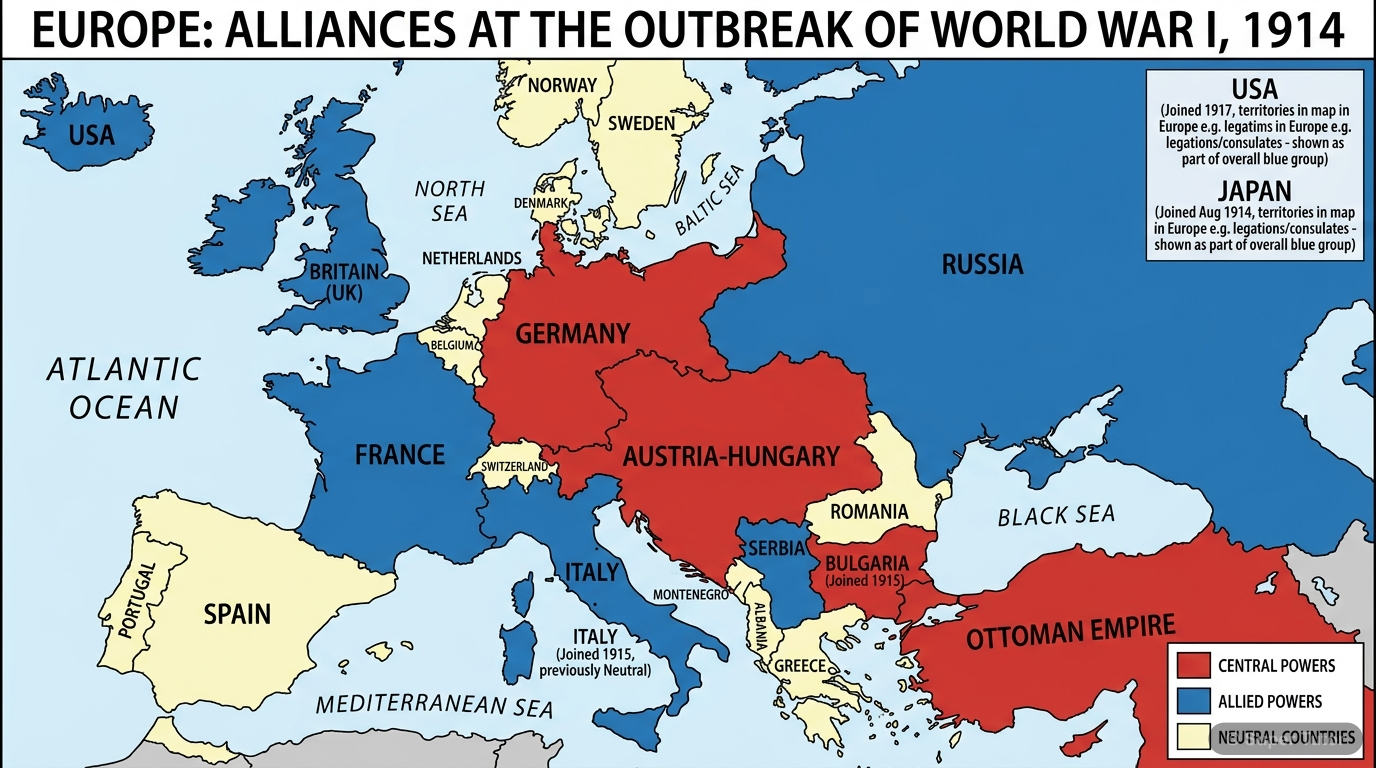
- The Allied or Entente Powers were Britain, France, Russia, Italy, Serbia, Belgium, Romania, the United States, and Japan.
- Britain also fought with troops from its empire, including Australia, Canada, India, New Zealand, and South Africa.
- The Central Powers were Germany, Austria-Hungary, Turkey, and Bulgaria.
2
2. Why the War Lasted So Long
- Many people expected a short war, but that expectation failed quickly.
- German military planners understood that the war could become long and wider than expected.
- The great powers were evenly balanced, so quick victory was difficult.
3
3. The Western Front in 1914
- Germany's advance was slowed by unexpectedly strong Belgian resistance.
- It took the Germans over two weeks to capture Brussels.
- This delay gave Britain time to organize and kept the Channel ports open for the British Expeditionary Force.
4
4. The Eastern Front and the Balkans
- Russia mobilized quickly but attacked both Austria and Germany at the same time.
- The Germans brought Hindenburg out of retirement and defeated Russia at Tannenberg in August 1914 and at the Masurian Lakes in September 1914.
- By the end of 1914, Russia had six and a quarter million men mobilized, but a third were without rifles.
Get complete notes with diagrams and examples
Full NotesKey Concepts
BritainGermanyGermany tried to move quickly throughAfter the first rapid movementsThe war in the east
Frequently Asked Questions
What are the important topics in The First World War 1914-1918 for ICSE Class 12 History?
Key topics in The First World War 1914-1918 include Main Sides and the Global Nature of the War, Why the War Lasted So Long, The Western Front in 1914, The Eastern Front and the Balkans. Study these first, then practise questions on each for the ICSE Class 12 board exam.
How should I revise The First World War 1914-1918 for the ICSE Class 12 board exam?
Learn the core ideas first, then work through the 45 practice questions on The First World War 1914-1918. Revise definitions regularly and use flashcards for quick recall before the exam.
Sources & Official References
Content is aligned to the official syllabus. Refer to the board website for the latest curriculum.
More resources for The First World War 1914-1918
For serious students
Get the full The First World War 1914-1918 chapter — start free.
Quizzes, flashcards, an AI doubt solver and a study plan for ICSE Class 12 History. Free to start, no card needed.