Applications of Derivatives - I — Chapter Summary
ICSE · Class 12 · Mathematics
Summary of Applications of Derivatives - I for ICSE Class 12 Mathematics. Key concepts: For y = f(x), For small Delta x and Absolute error in x is Delta.
Interactive on Super Tutor
Studying Applications of Derivatives - I? Get the full interactive chapter.
Quizzes, flashcards, AI doubt-solver and a step-by-step study plan — built for chapter summary and more.
Free trial, no card needed.
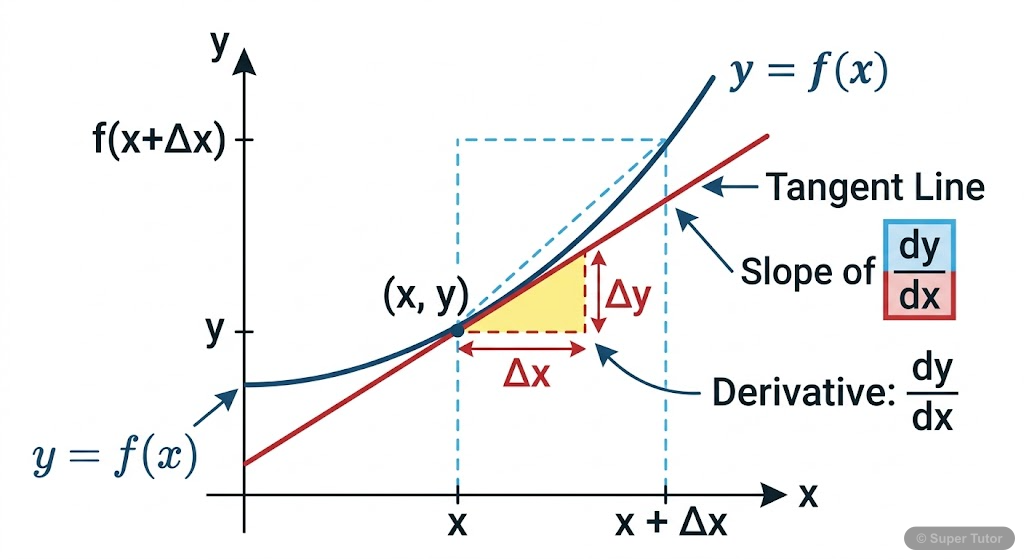
Learn better with visuals Super Tutor pairs illustrations like this with notes and quizzes for Applications of Derivatives - I.
Overview
Applications of derivatives connect differentiation with rate of change, approximation, monotonicity, and the geometry of curves. The derivative dy/dx gives the instantaneous rate of change of y with respect to x, while differentials provide a quick approximation for small changes. Derivatives also
Key Concepts
For y = f(x)
For y = f(x), average rate of change is (Delta y)/(Delta x), and instantaneous rate of change is dy/dx = lim as Delta x approaches 0 of (Delta y)/(Del
For small Delta x
For small Delta x, Delta y is approximately equal to (dy/dx)Delta x. This gives a fast method for estimating values such as roots, powers, trigonometr
Absolute error in x is Delta
Absolute error in x is Delta x. Relative error in x is (Delta x)/x. Percentage error in x is ((Delta x)/x times 100)%. Similar definitions apply for y
A function is strictly increasing if
A function is strictly increasing if x1 < x2 implies f(x1) < f(x2). It is increasing if x1 < x2 implies f(x1) <= f(x2). A function is strictly decreas
If f is continuous on [a
If f is continuous on [a,b] and differentiable on (a,b), then f'(x) > 0 on (a,b) implies f is strictly increasing on [a,b]; f'(x) < 0 implies strictly
Learning Objectives
- Understand dy/dx as instantaneous rate of change and distinguish it from average rate of change.
- Use differentials to estimate values and approximate small changes in quantities.
- Apply the first derivative test to identify increasing, strictly increasing, decreasing, and strictly decreasing intervals.
- Find equations of tangent and normal lines to curves at a point.
- Determine angles of intersection of curves and test whether two curves cut orthogonally.
Frequently Asked Questions
What are the important topics in Applications of Derivatives - I for ICSE Class 12 Mathematics?
How should I revise Applications of Derivatives - I for the ICSE Class 12 board exam?
Sources & Official References
Content is aligned to the official syllabus. Refer to the board website for the latest curriculum.
More resources for Applications of Derivatives - I
Practice Quiz
Test yourself with a quick quiz
Important Questions
Exam-style questions with answers
Revision Notes
Key points for last-minute revision
Formula Sheet
The chapter's formulas in one place
Concept Maps
See how topics connect
Study Plan
Step-by-step plan for this chapter
Flashcards
Quick-fire cards for active recall
Syllabus
What topics to cover
For serious students
Get the full Applications of Derivatives - I chapter — start free.
Quizzes, flashcards, an AI doubt solver and a study plan for ICSE Class 12 Mathematics. Free to start, no card needed.