Psychological Disorders and Psychotherapy — Practice Quiz
ICSE · Class 12 · Psychology
Try a 4-question quiz on Psychological Disorders and Psychotherapy for ICSE Class 12 Psychology: tap an answer to check it and see why.
Interactive on Super Tutor
Studying Psychological Disorders and Psychotherapy? Get the full interactive chapter.
Quizzes, flashcards, AI doubt-solver and a step-by-step study plan — built for practice quiz and more.
Free trial, no card needed.
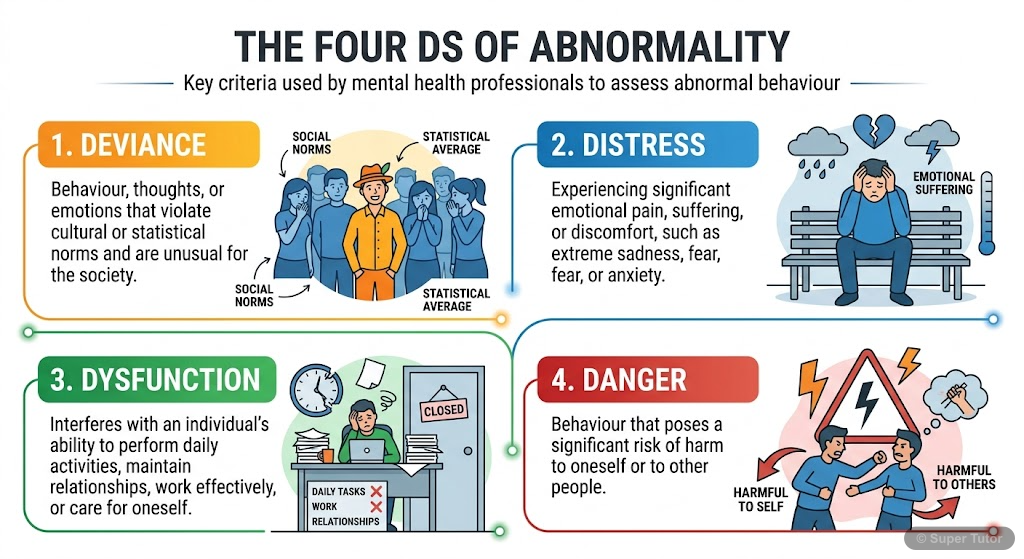
One of 7 illustrations for Psychological Disorders and Psychotherapy in Super Tutor — alongside flashcards, concept maps and practice questions.
Quick Quiz: Psychological Disorders and Psychotherapy
0/4Tap an answer to check it instantly. No sign-up needed for these 4.
Which of the following best describes 'abnormal behaviour'?
The 'Four Ds' of abnormality include which of the following?
Which perspective explains abnormal behaviour as a result of faulty genes, brain damage, or chemical imbalances in the body?
DSM-IV is published by which organisation?
Sample Questions
Generalised Anxiety Disorder (GAD) is characterised by excessive worry that persists for more than how many months?
Show answer
6 months
Step 1: The chapter specifically states that GAD can be diagnosed when uncontrollable, excessive anxiety and worry persist for more than 6 months about a number of events or activities. Step 2: The 6-month criterion is an important diagnostic guideline from DSM-IV. Step 3: 3 months and 1 month are too short — everyone experiences worry at some point, so a longer duration is needed to confirm the disorder. Step 4: 12 months is too long — it would delay diagnosis unnecessarily. Step 5: 6 months is the correct and specific duration mentioned in the chapter for GAD diagnosis.
Which type of phobia involves an extreme and irrational fear of public or crowded places where escape seems difficult?
Show answer
Agoraphobia
Step 1: The chapter describes agoraphobia as the fear of public places like shopping malls, crowded streets, and movie halls where the person feels trapped or where escape seems difficult or embarrassing. Step 2: The word 'agoraphobia' comes from the Greek word 'agora' meaning public places. Step 3: Social phobia is the fear of social situations where one may be judged negatively — not specifically about escape from places. Step 4: Specific phobia is a fear of a particular object or situation like snakes or heights — not public spaces in general. Step 5: Panic disorder involves sudden unexpect
In Obsessive Compulsive Disorder (OCD), which neurotransmitter is most strongly implicated?
Show answer
Serotonin
Step 1: The chapter clearly states that serotonin, a neurotransmitter, has been highly implicated in OCD. Step 2: Increased levels of serotonin activity are associated with OCD, and medications that affect serotonin levels may provide relief to OCD patients. Step 3: GABA is linked to Generalised Anxiety Disorder (GAD) — not OCD specifically. Step 4: Dopamine and norepinephrine are linked to mood disorders like bipolar disorder, not primarily to OCD. Step 5: A helpful trick: Serotonin is strongly linked to OCD. Also, the brain areas caudate nucleus and orbital frontal cortex are involved in OCD
Which of the following is a symptom of a manic episode in Bipolar Disorder?
Show answer
Inflated self-esteem and decreased need for sleep
Step 1: The chapter describes manic episodes as a period of persistently elevated or irritable mood lasting at least one week. Step 2: Key symptoms of mania include inflated self-esteem (unrealistic belief about one's power), decreased need for sleep, and high levels of energy. Step 3: Option B describes symptoms of a depressive episode, which is the other pole in Bipolar Disorder — not the manic phase. Step 4: Option C describes symptoms of anxiety disorders, not mood disorders. Step 5: Option D describes OCD symptoms (repetitive compulsive behaviour and intrusive obsessive thoughts) — comple
+41 more questions on Psychological Disorders and Psychotherapy (ICSE Class 12 Psychology)
Practise AllFrequently Asked Questions
What are the important topics in Psychological Disorders and Psychotherapy for ICSE Class 12 Psychology?
How many practice questions are there for Psychological Disorders and Psychotherapy?
Sources & Official References
Content is aligned to the official syllabus. Refer to the board website for the latest curriculum.
More resources for Psychological Disorders and Psychotherapy
Important Questions
Exam-style questions with answers
Revision Notes
Key points for last-minute revision
Chapter Summary
Understand the chapter at a glance
Concept Maps
See how topics connect
Study Plan
Step-by-step plan for this chapter
Flashcards
Quick-fire cards for active recall
Syllabus
What topics to cover
For serious students
Get the full Psychological Disorders and Psychotherapy chapter — start free.
Quizzes, flashcards, an AI doubt solver and a study plan for ICSE Class 12 Psychology. Free to start, no card needed.