Stress and Stress Management — Practice Quiz
ICSE · Class 12 · Psychology
Try a 4-question quiz on Stress and Stress Management for ICSE Class 12 Psychology: tap an answer to check it and see why.
Interactive on Super Tutor
Studying Stress and Stress Management? Get the full interactive chapter.
Quizzes, flashcards, AI doubt-solver and a step-by-step study plan — built for practice quiz and more.
Free trial, no card needed.
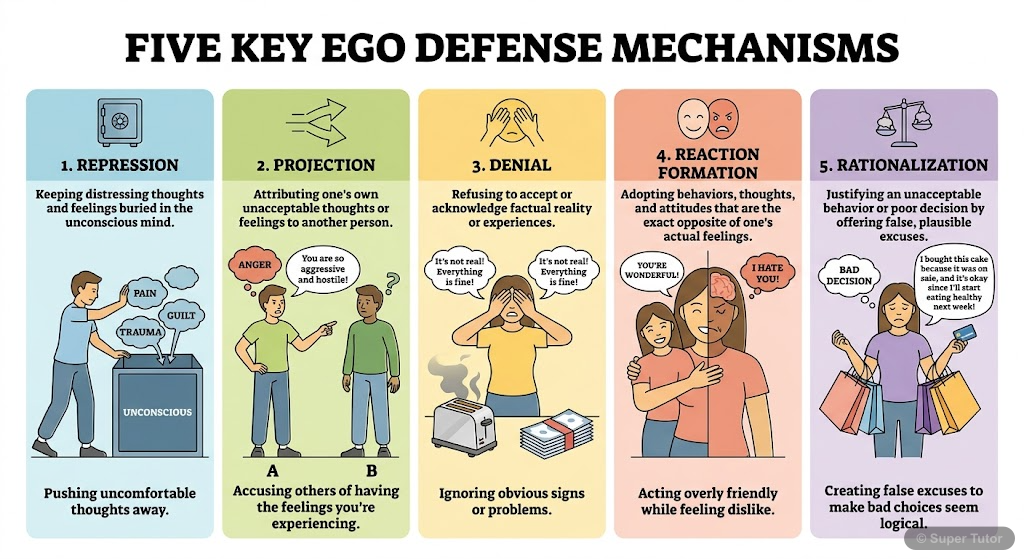
One of 8 illustrations for Stress and Stress Management in Super Tutor — alongside flashcards, concept maps and practice questions.
Quick Quiz: Stress and Stress Management
0/4Tap an answer to check it instantly. No sign-up needed for these 4.
During the Resistance Stage of GAS, the body releases corticotropin-releasing factor (CRF) which triggers a hormonal cascade. What is the CORRECT sequence of this hormonal pathway?
Excess cortisol secreted during prolonged stress makes the body vulnerable to infections. What is the precise physiological reason for this?
According to Lazarus and Folkman's Cognitive Appraisal Model, which of the following CORRECTLY describes the relationship between Primary and Secondary Appraisal?
A person with an Internal Locus of Control is generally MORE susceptible to stress compared to someone with an External Locus of Control. What is the most accurate reason for this?
Sample Questions
Nixon's (1979) inverted 'U' curve of stress and performance identifies a specific zone where stress is optimal and manageable. What is this zone called, and what happens BEYOND the fatigue point?
Show answer
Comfort zone; beyond the fatigue point, performance declines and ultimately leads to burnout.
Step 1: Nixon's inverted-U curve shows that some stress is necessary for good performance. Step 2: The area on the curve before the fatigue point where stress is manageable and performance is optimal is called the Comfort Zone. Step 3: As stress increases beyond the comfort zone, the person reaches the Fatigue Point, after which performance begins to decline. Step 4: If stress continues to increase or remains unmanaged, the person reaches burnout – characterised by exhaustion, ill health and breakdown. Step 5: Effective stress management can raise the performance level even under stress. Optio
Which of the following CORRECTLY explains why Type-C personality is particularly vulnerable to serious illness like cancer, unlike Type-A personality?
Show answer
Type-C individuals suppress negative emotions like anger and hostility, disrupting their immune system and making them prone to diseases like cancer.
Step 1: Type-C personality is often confused with Type-A because both are susceptible to serious health issues, but for different reasons. Step 2: Type-A individuals are competitive, ambitious and time-pressured – their stress primarily leads to cardiac problems and hypertension. Step 3: Type-C individuals suppress all negative feelings like anger, rage and hostility rather than expressing them. Step 4: This emotional suppression disrupts the equilibrium and weakens the immune system, making the body less resistant to diseases. Step 5: Research (Mohanty, 2015) shows this links Type-C personali
In the context of defense mechanisms, 'Sublimation' is considered a MATURE defense mechanism. What makes it qualitatively different from other defense mechanisms like displacement or regression?
Show answer
Sublimation transforms socially disapproved impulses into socially approved and constructive actions, making it productive unlike other mechanisms.
Step 1: Defense mechanisms are unconscious processes used to protect the ego from anxiety-provoking thoughts. Step 2: Most defense mechanisms simply redirect or hide the unacceptable impulse without resolving it – for example, displacement channels aggression to a safer target and regression reverts to childish behaviour. Step 3: Sublimation is unique because it TRANSFORMS the socially unacceptable impulse into something socially constructive and valuable – like art, sport, science, or ideological efforts. Step 4: For example, a woman who cannot have children may channel that energy into becom
According to Veninga and Spradley's five stages of burnout, at which stage does a person first start becoming aware of job dissatisfaction, accompanied by vague fatigue and sleep disturbances?
Show answer
Fuel Shortage Stage
Step 1: Veninga and Spradley (1981) described five sequential stages of burnout. Step 2: The Honeymoon Stage is the first stage – marked by high excitement, enthusiasm, satisfaction and commitment towards the new job. There is NO awareness of dissatisfaction here. Step 3: The Fuel Shortage Stage is the second stage – where the person first starts experiencing vague fatigue, sleep disturbances, confusion and begins to become somewhat aware of job dissatisfaction. Unhealthy habits like eating, smoking and drinking may also begin. Step 4: The Chronic Symptom Stage is the third stage – where exhau
+41 more questions on Stress and Stress Management (ICSE Class 12 Psychology)
Practise AllFrequently Asked Questions
What are the important topics in Stress and Stress Management for ICSE Class 12 Psychology?
How many practice questions are there for Stress and Stress Management?
Sources & Official References
Content is aligned to the official syllabus. Refer to the board website for the latest curriculum.
More resources for Stress and Stress Management
Important Questions
Exam-style questions with answers
Revision Notes
Key points for last-minute revision
Chapter Summary
Understand the chapter at a glance
Concept Maps
See how topics connect
Study Plan
Step-by-step plan for this chapter
Flashcards
Quick-fire cards for active recall
Syllabus
What topics to cover
For serious students
Get the full Stress and Stress Management chapter — start free.
Quizzes, flashcards, an AI doubt solver and a study plan for ICSE Class 12 Psychology. Free to start, no card needed.