Human Body: Digestive System
ICSE · Class 6 · Biology
Most important questions from Human Body: Digestive System for ICSE Class 6 Biology board exam 2026. MCQs, short answer, and long answer questions with marks.
Interactive on Super Tutor
Studying Human Body: Digestive System? Get the full interactive chapter.
Quizzes, flashcards, AI doubt-solver and a step-by-step study plan — built for important questions and more.
1,000+ Class 6 students started this chapter today
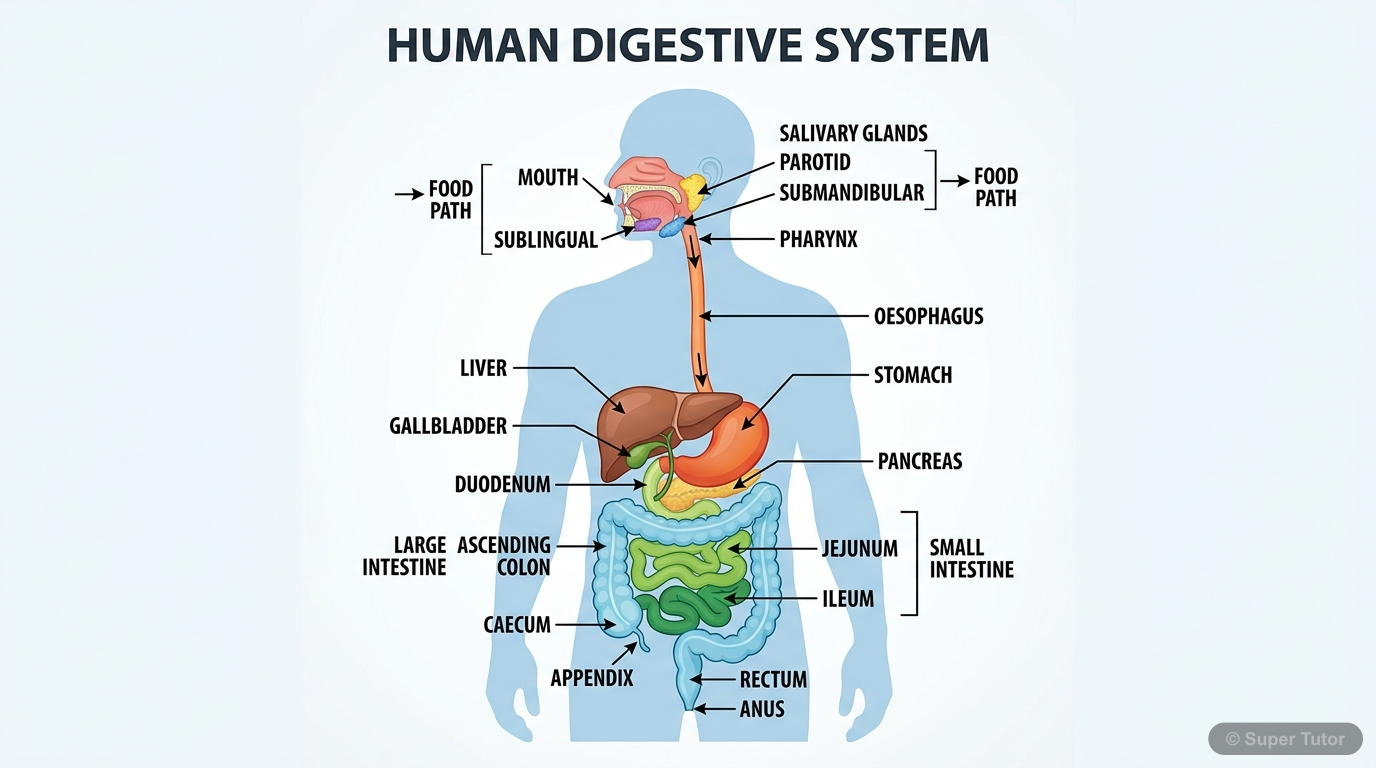
Learn better with visuals Super Tutor has hundreds of illustrations like this across every chapter — all free to try.
Get startedSample Questions
Rennin is an enzyme found in the stomach. What is its SPECIFIC function?
Show answer
It converts the milk protein casein into curd
Step 1: The stomach secretes gastric juice which contains several components including HCl, pepsin, and rennin. Step 2: Rennin is a special enzyme that acts specifically on the milk protein called casein. Step 3: Rennin converts liquid casein (dissolved in milk) into a semi-solid curd, which stays in the stomach longer and can be digested more effectively. Step 4: This enzyme is particularly important in babies and young children who drink a lot of milk. Step 5: Option A is wrong — starch is converted to maltose by salivary amylase. Option C is wrong — pepsin converts proteins into peptones. O
What are the FINAL end products of the complete digestion of proteins in the human digestive system?
Show answer
Amino acids
Step 1: Protein digestion is a multi-step process. Let us trace it carefully. Step 2: In the stomach, pepsin breaks down proteins into simpler compounds called peptones. This is partial digestion. Step 3: In the duodenum, the pancreatic enzyme trypsin converts proteins and peptones into even simpler compounds called peptides. Step 4: Finally, in the ileum, the intestinal enzyme erepsin converts peptides into amino acids — the final, simplest form of proteins. Step 5: Amino acids are then absorbed by the villi into the blood. Option A (peptones and peptides) are intermediate products, not final
The pancreas secretes pancreatic juice containing three enzymes. Which combination correctly matches each enzyme with its function?
Show answer
Amylase → digests starch; Trypsin → digests proteins/peptones; Lipase → digests emulsified fats
Step 1: The pancreas is a large gland below the stomach that secretes pancreatic juice into the duodenum. Step 2: Pancreatic amylase acts on starch (a carbohydrate) and converts it into maltose — just like salivary amylase but in the small intestine. Step 3: Trypsin acts on proteins and peptones (which were partially digested in the stomach) and converts them into peptides. Step 4: Lipase acts on emulsified fats (fats that have already been broken into tiny droplets by bile) and converts them into fatty acids and glycerol. Step 5: All other options incorrectly assign the enzymes to wrong subst
What is the correct order of regions in the large intestine from where undigested food enters to where it exits the body?
Show answer
Caecum → Colon → Rectum → Anus
Step 1: After the small intestine completes digestion and absorption, the remaining undigested material passes into the large intestine. Step 2: The large intestine has three regions. The first region is the caecum, which receives the undigested food from the small intestine. Step 3: From the caecum, the material moves into the colon. The colon's main job is to absorb water from the undigested material, making it semi-solid. Step 4: The now semi-solid waste (called faeces) moves into the rectum, the last part of the large intestine (about 15 cm long), where it is stored temporarily. Step 5: Fi
+89 more questions available
Practice AllFrequently Asked Questions
What are the important topics in Human Body: Digestive System for ICSE Class 6 Biology?
How to score full marks in Human Body: Digestive System — ICSE Class 6 Biology?
How many important questions are there in Human Body: Digestive System?
Sources & Official References
Content is aligned to the official syllabus. Refer to the board website for the latest curriculum.
More resources for Human Body: Digestive System
Practice Quiz
Test yourself with a quick quiz
Revision Notes
Key points for last-minute revision
Formula Sheet
All formulas in one place
Chapter Summary
Understand the chapter at a glance
Concept Maps
See how topics connect visually
Study Plan
Step-by-step plan to ace this chapter
Flashcards
Quick-fire cards for active recall
Syllabus
What topics to cover
NCERT Solutions
Every textbook question solved step by step
For serious students
Get the full Human Body: Digestive System chapter — for free.
Quizzes, flashcards, AI doubt-solver and a step-by-step study plan for ICSE Class 6 Biology.