Cell - The Structure and Functions — Important Questions
ICSE · Class 6 · Biology
94 important questions from Cell - The Structure and Functions for ICSE Class 6 Biology, with answers. Part of the ICSE Class 6 Biology syllabus.
Interactive on Super Tutor
Studying Cell - The Structure and Functions? Get the full interactive chapter.
Quizzes, flashcards, AI doubt-solver and a step-by-step study plan — built for important questions and more.
Free trial, no card needed.
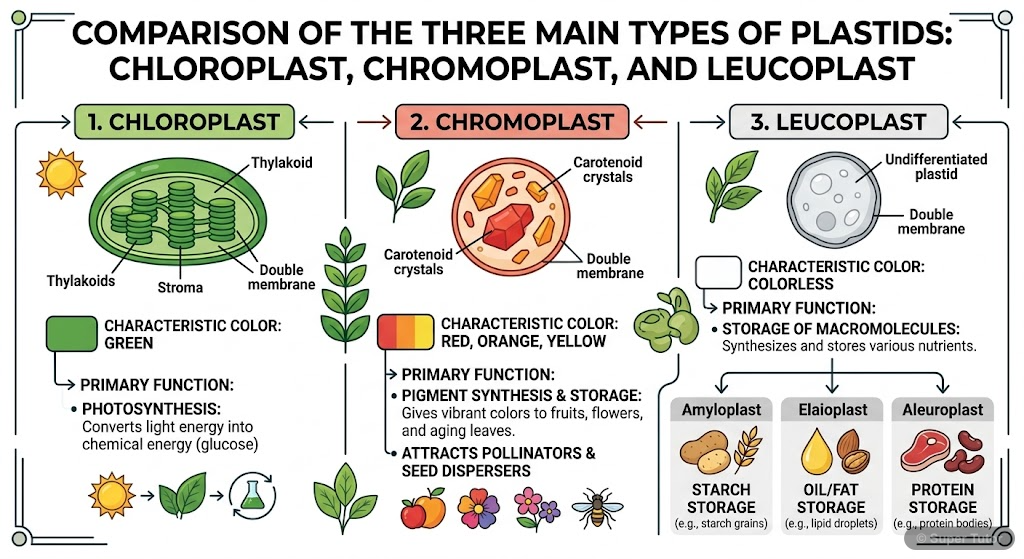
One of 2 illustrations for Cell - The Structure and Functions in Super Tutor — alongside flashcards, concept maps and practice questions.
Important Questions from Cell - The Structure and Functions
Which of the following correctly describes the relationship between the cell wall and cell membrane in a plant cell?
Show answer
The cell wall lies outside the cell membrane; cell wall is freely permeable and non-living, while cell membrane is selectively permeable and living
Step 1: In a plant cell, starting from the outside, the CELL WALL is the outermost boundary. Step 2: Just inside the cell wall lies the CELL MEMBRANE (plasma membrane). Step 3: The cell wall is made of CELLULOSE, is NON-LIVING, and is FREELY PERMEABLE (allows all dissolved substances to pass). Step 4: The cell membrane is a LIVING structure, present in both plant and animal cells, and is SELECTIVELY PERMEABLE (controls what enters and exits). Step 5: These are TWO SEPARATE structures with different compositions and functions. Option A reverses their positions. Option C reverses their positions
Chromosomes are found inside the nucleus. What is the correct hierarchical relationship between chromosomes and the inheritance of traits?
Show answer
Chromosomes contain genes, and genes are responsible for transmitting characteristics from parents to offspring
Step 1: Inside the nucleus, there is nucleoplasm (the fluid inside the nucleus). Step 2: Within the nucleoplasm, there are thread-like structures called CHROMOSOMES. Step 3: Each chromosome contains smaller units called GENES. Step 4: These GENES carry the genetic information — they are responsible for transmitting characteristics (like eye colour, height, skin colour) from PARENTS to their OFFSPRING. Step 5: The hierarchy is: Nucleus → Nucleoplasm → Chromosomes → Genes → Traits. Option A is wrong because nucleoli are separate structures in the nucleoplasm and do NOT contain genes. Option C is
Human body cells contain 46 chromosomes in 23 pairs, while pea plant cells contain 14 chromosomes in 7 pairs. If a scientist discovers a new species where one body cell has 20 chromosomes, how many chromosomes would be in EVERY other body cell of that same organism?
Show answer
20 chromosomes, because the number of chromosomes is definite and the same in every cell of the same species
Step 1: The chapter clearly states that 'the number of chromosomes is definite in each species'. Step 2: For example, EVERY cell in the human body (whether it is a skin cell, muscle cell, or nerve cell) has 46 chromosomes. Step 3: Similarly, EVERY cell in a pea plant has 14 chromosomes. Step 4: This is a fundamental biological rule — the chromosome number is SPECIES-SPECIFIC and CONSTANT across all body cells of the same organism. Step 5: Therefore, if one body cell of the new species has 20 chromosomes, every other body cell of that organism will ALSO have 20 chromosomes. Option A is wrong —
Three types of plastids exist in plant cells. Which of the following correctly matches ALL three types with their correct colour/content and function?
Show answer
Chloroplasts (green, photosynthesis), Chromoplasts (yellow/red, attract insects for pollination), Leukoplasts (colourless, store starch/fats/proteins)
Step 1: CHLOROPLASTS are GREEN plastids that contain the green pigment chlorophyll. Their function is to TRAP SOLAR ENERGY for PHOTOSYNTHESIS — making food for the plant. Step 2: CHROMOPLASTS contain YELLOW and RED pigments. They give varied colours to FLOWERS and FRUITS. In petals, they ATTRACT INSECTS for pollination. Step 3: LEUKOPLASTS are COLOURLESS (leuco = white/colourless) plastids found mainly in SEEDS. Their function is to STORE starch, fats, and proteins. Step 4: All three types are found ONLY in plant cells — animal cells do NOT have plastids. Step 5: Options B, C, and D all mix up
+90 more questions on Cell - The Structure and Functions (ICSE Class 6 Biology)
Practise AllFrequently Asked Questions
What are the important topics in Cell - The Structure and Functions for ICSE Class 6 Biology?
How many important questions are there in Cell - The Structure and Functions?
Sources & Official References
Content is aligned to the official syllabus. Refer to the board website for the latest curriculum.
More resources for Cell - The Structure and Functions
For serious students
Get the full Cell - The Structure and Functions chapter — start free.
Quizzes, flashcards, an AI doubt solver and a study plan for ICSE Class 6 Biology. Free to start, no card needed.