Human Body: Respiratory System — Practice Quiz
ICSE · Class 6 · Biology
Try a 4-question quiz on Human Body: Respiratory System for ICSE Class 6 Biology: tap an answer to check it and see why.
Interactive on Super Tutor
Studying Human Body: Respiratory System? Get the full interactive chapter.
Quizzes, flashcards, AI doubt-solver and a step-by-step study plan — built for practice quiz and more.
Free trial, no card needed.
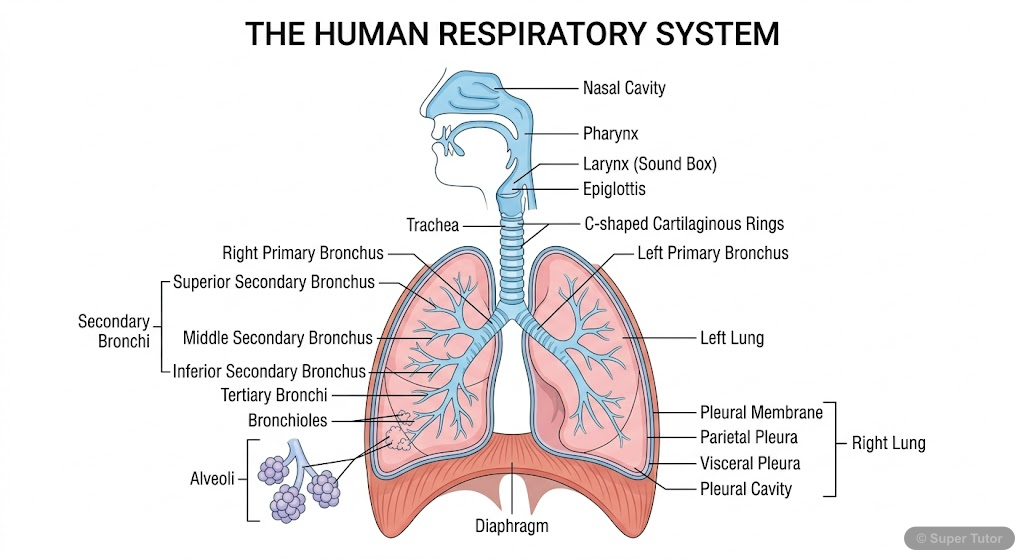
Learn better with visuals Super Tutor pairs illustrations like this with notes and quizzes for Human Body: Respiratory System.
Quick Quiz: Human Body: Respiratory System
0/4Tap an answer to check it instantly. No sign-up needed for these 4.
Which of the following is the point of entry for air into the human body?
What is the common passage for both air and food in the human body?
What is the function of the epiglottis?
The voice box in the human respiratory system is called:
Sample Questions
The trachea (windpipe) is kept from collapsing by:
Show answer
C-shaped rings of cartilage
Step 1: The trachea is a tube that carries air from the larynx to the bronchi. Step 2: It needs to stay open all the time so that air can flow freely. Step 3: The wall of the trachea is strengthened by C-shaped rings of cartilage, which are firm but flexible. Step 4: These rings prevent the trachea from collapsing or being squeezed shut. Step 5: Muscles, mucus, and pleural fluid are not the structures that provide this structural support to the trachea.
Where does the exchange of oxygen and carbon dioxide take place in the lungs?
Show answer
Alveoli
Step 1: Air travels from the nose through the trachea and bronchi into millions of tiny air sacs in the lungs. Step 2: These tiny air sacs are called alveoli (singular: alveolus). Step 3: The walls of the alveoli are very thin and surrounded by blood capillaries. Step 4: Oxygen from the air in the alveoli diffuses into the blood, and carbon dioxide from the blood diffuses into the alveoli to be breathed out. Step 5: The trachea, bronchi, and larynx are all passageways for air — they do not perform gas exchange.
Respiration is best defined as:
Show answer
The process of releasing energy by breaking down food (glucose)
Step 1: Many students confuse breathing with respiration, but they are different. Step 2: Breathing is just a physical process of inhaling and exhaling air. Step 3: Respiration is a biochemical process that happens inside every cell of the body. Step 4: In respiration, glucose (food) is broken down using oxygen to release energy that the body can use. Step 5: Transporting oxygen is called gaseous transport, and filtering dust is done by the nose — neither of these is the definition of respiration.
During inhalation, what happens to the diaphragm?
Show answer
It pushes downward and flattens
Step 1: The diaphragm is a muscular sheet below the lungs that separates the chest cavity from the abdominal cavity. Step 2: During inhalation (breathing in), the diaphragm contracts and pushes downward, becoming flat. Step 3: At the same time, the ribs move upward and outward. Step 4: Together, these movements increase the volume of the chest cavity, causing air pressure inside to drop. Step 5: Lower pressure inside the lungs causes outside air (at higher pressure) to rush in. Moving upward and becoming dome-shaped is what happens during exhalation.
+90 more questions on Human Body: Respiratory System (ICSE Class 6 Biology)
Practise AllFrequently Asked Questions
What are the important topics in Human Body: Respiratory System for ICSE Class 6 Biology?
How many practice questions are there for Human Body: Respiratory System?
Sources & Official References
Content is aligned to the official syllabus. Refer to the board website for the latest curriculum.
More resources for Human Body: Respiratory System
Important Questions
Exam-style questions with answers
Revision Notes
Key points for last-minute revision
Chapter Summary
Understand the chapter at a glance
Concept Maps
See how topics connect
Study Plan
Step-by-step plan for this chapter
Flashcards
Quick-fire cards for active recall
Syllabus
What topics to cover
For serious students
Get the full Human Body: Respiratory System chapter — start free.
Quizzes, flashcards, an AI doubt solver and a study plan for ICSE Class 6 Biology. Free to start, no card needed.