Plant Life : The Leaf — Practice Quiz
ICSE · Class 6 · Biology
Try a 4-question quiz on Plant Life : The Leaf for ICSE Class 6 Biology: tap an answer to check it and see why. 100 questions in the full chapter test.
Interactive on Super Tutor
Studying Plant Life : The Leaf? Get the full interactive chapter.
Quizzes, flashcards, AI doubt-solver and a step-by-step study plan — built for practice quiz and more.
Free trial, no card needed.
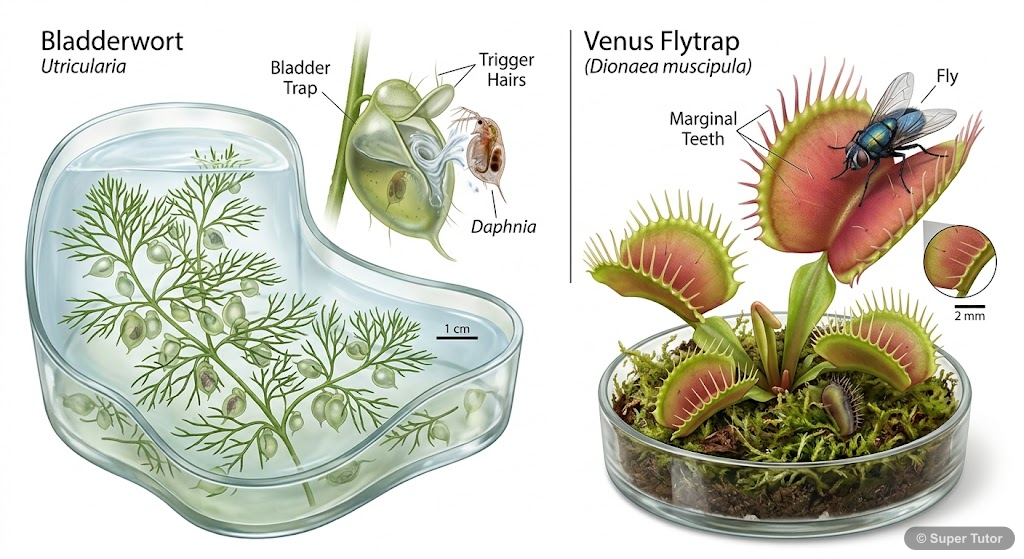
Learn better with visuals Super Tutor pairs illustrations like this with notes and quizzes for Plant Life : The Leaf.
Quick Quiz: Plant Life : The Leaf
0/4Tap an answer to check it instantly. No sign-up needed for these 4.
Which part of the leaf connects it to the stem at the node?
A leaf whose lamina is divided into smaller units called leaflets is known as a:
In which type of venation do the veins form a network pattern in the lamina?
Which of the following plants shows parallel venation?
Sample Questions
What are the two raw materials required by a leaf for photosynthesis?
Show answer
Water and carbon dioxide
Step 1: Photosynthesis is the process by which green plants make their own food. Step 2: The equation for photosynthesis is: Carbon dioxide + Water → Glucose + Oxygen (in the presence of chlorophyll and sunlight). Step 3: So the two raw materials (inputs) are carbon dioxide (from air) and water (from soil). Step 4: Oxygen and glucose are the products of photosynthesis, not the raw materials. Step 5: Nitrogen is used by plants for growth but is not a raw material for photosynthesis. Therefore, Water and Carbon dioxide is correct.
The process by which plants lose water in the form of water vapour from their leaf surface is called:
Show answer
Transpiration
Step 1: Plants absorb large amounts of water through their roots. Step 2: Only a small amount is used in photosynthesis; the rest evaporates from the surface of leaves. Step 3: This loss of water in the form of water vapour from leaves and other aerial parts is called Transpiration. Step 4: Photosynthesis is food-making; Respiration is energy release; Absorption is the uptake of water by roots – none of these match the definition given. Step 5: Therefore, Transpiration is the correct answer.
In which plant are the leaves modified into tendrils for support and climbing?
Show answer
Sweet pea
Step 1: Some leaves are modified to perform special functions other than photosynthesis. Step 2: In Sweet pea, the upper leaflets are modified into thin, coiled, wiry structures called tendrils. Step 3: These tendrils are sensitive to touch and coil around nearby objects to help the weak-stemmed plant climb and support itself. Step 4: Cactus leaves are modified into spines to reduce water loss. Onion has scale leaves to store food. Pitcher plant has its lamina modified into a pitcher to trap insects. Step 5: Therefore, Sweet pea is the correct answer.
Why are the leaves of cactus modified into spines?
Show answer
To reduce water loss from the plant
Step 1: Cactus plants grow in desert regions where water is very scarce. Step 2: Leaves have a large surface area, which leads to a lot of water loss through transpiration. Step 3: To survive in dry conditions, cactus leaves are modified into sharp spines, which have a very small surface area. Step 4: This greatly reduces the loss of water from the plant, helping it survive in the desert. Step 5: Trapping insects is a function of insectivorous plants; storing food is the function of scale leaves; climbing is the function of tendrils. So the correct answer is to reduce water loss.
+96 more questions on Plant Life : The Leaf (ICSE Class 6 Biology)
Practise AllFrequently Asked Questions
What are the important topics in Plant Life : The Leaf for ICSE Class 6 Biology?
How many practice questions are there for Plant Life : The Leaf?
Sources & Official References
Content is aligned to the official syllabus. Refer to the board website for the latest curriculum.
More resources for Plant Life : The Leaf
Important Questions
Exam-style questions with answers
Revision Notes
Key points for last-minute revision
Chapter Summary
Understand the chapter at a glance
Concept Maps
See how topics connect
Study Plan
Step-by-step plan for this chapter
Flashcards
Quick-fire cards for active recall
Syllabus
What topics to cover
For serious students
Get the full Plant Life : The Leaf chapter — start free.
Quizzes, flashcards, an AI doubt solver and a study plan for ICSE Class 6 Biology. Free to start, no card needed.