Plant Life : The Flower — Practice Quiz
ICSE · Class 6 · Biology
Try a 4-question quiz on Plant Life : The Flower for ICSE Class 6 Biology: tap an answer to check it and see why. 92 questions in the full chapter test.
Interactive on Super Tutor
Studying Plant Life : The Flower? Get the full interactive chapter.
Quizzes, flashcards, AI doubt-solver and a step-by-step study plan — built for practice quiz and more.
Free trial, no card needed.
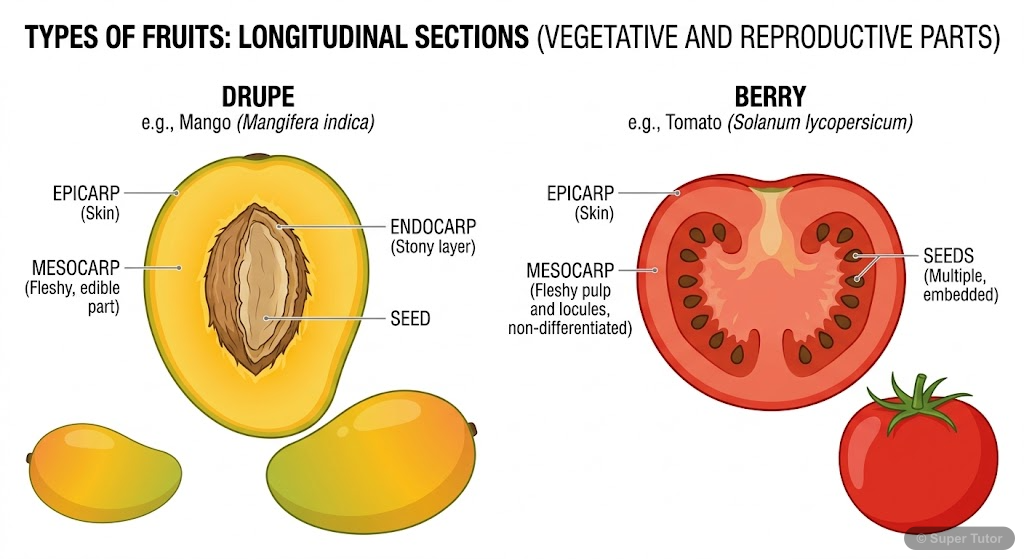
Learn better with visuals Super Tutor pairs illustrations like this with notes and quizzes for Plant Life : The Flower.
Quick Quiz: Plant Life : The Flower
0/4Tap an answer to check it instantly. No sign-up needed for these 4.
Which is the outermost whorl of a flower?
The male reproductive part of a flower is called:
Pollen grains are produced in which part of the stamen?
Which part of the pistil receives the pollen grains?
Sample Questions
What is pollination?
Show answer
Transfer of pollen grains from anther to stigma
Step 1: Pollination and fertilization are two different processes — a common source of confusion. Step 2: Pollination is specifically the transfer of pollen grains from the anthers (male part) to the stigma (female part) of a flower. Step 3: Fusion of gametes is called Fertilization, not pollination. Step 4: Growth of seed into plant is Germination. Step 5: Formation of fruit happens after fertilization. So pollination is only the transfer of pollen — the correct answer is option B.
When pollen grains from a flower fall on the stigma of the same flower, it is called:
Show answer
Self pollination
Step 1: There are two main types of pollination — self pollination and cross pollination. Step 2: Self pollination occurs when pollen from the anther falls on the stigma of the same flower or another flower on the same plant. Step 3: Cross pollination occurs between flowers of two different plants of the same kind. Step 4: Wind and water pollination are agents of cross pollination, not separate types. Step 5: Since the question says 'same flower', the answer is Self pollination.
Which of the following is an example of an insect-pollinated flower?
Show answer
Marigold
Step 1: Insects are attracted to flowers that are brightly coloured, fragrant, and produce nectar. Step 2: Marigold is a brightly coloured, fragrant flower that produces nectar — it is a classic example of insect-pollinated flowers. Step 3: Maize and Pine produce dry, light pollen in large quantities — they are wind-pollinated. Step 4: Vallisneria is an aquatic plant pollinated by water. Step 5: Therefore, Marigold is the correct answer for insect pollination.
The fusion of male and female gametes is called:
Show answer
Fertilization
Step 1: After pollination, pollen grains land on the stigma and germinate to form pollen tubes. Step 2: The pollen tube grows down through the style and reaches the ovary. Step 3: Inside the ovary, the male gamete from the pollen tube fuses with the female gamete (egg cell) inside the ovule. Step 4: This fusion of male and female sex cells (gametes) is called Fertilization. Step 5: Pollination is only the transfer of pollen; fertilization is the actual union of gametes — so Fertilization is the correct answer.
+88 more questions on Plant Life : The Flower (ICSE Class 6 Biology)
Practise AllFrequently Asked Questions
What are the important topics in Plant Life : The Flower for ICSE Class 6 Biology?
How many practice questions are there for Plant Life : The Flower?
Sources & Official References
Content is aligned to the official syllabus. Refer to the board website for the latest curriculum.
More resources for Plant Life : The Flower
Important Questions
Exam-style questions with answers
Revision Notes
Key points for last-minute revision
Chapter Summary
Understand the chapter at a glance
Concept Maps
See how topics connect
Study Plan
Step-by-step plan for this chapter
Flashcards
Quick-fire cards for active recall
Syllabus
What topics to cover
For serious students
Get the full Plant Life : The Flower chapter — start free.
Quizzes, flashcards, an AI doubt solver and a study plan for ICSE Class 6 Biology. Free to start, no card needed.