Plant Life : The Leaf — Flashcards
ICSE · Class 6 · Biology
25 flashcards for Plant Life : The Leaf (ICSE Class 6 Biology) to test yourself on key terms and facts. Sample: "What are the main parts of a leaf?"
Interactive on Super Tutor
Studying Plant Life : The Leaf? Get the full interactive chapter.
Quizzes, flashcards, AI doubt-solver and a step-by-step study plan — built for flashcards and more.
Free trial, no card needed.
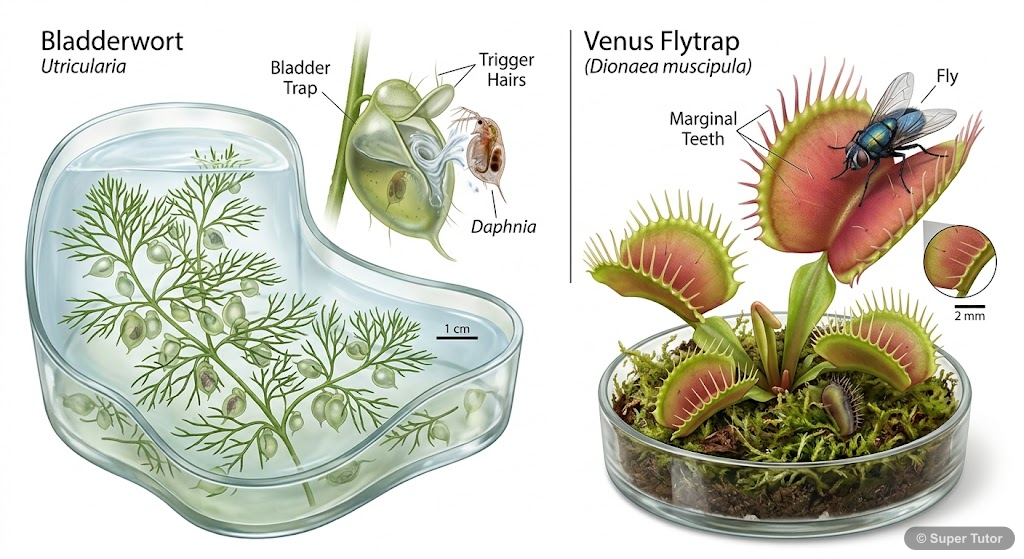
Learn better with visuals Super Tutor pairs illustrations like this with notes and quizzes for Plant Life : The Leaf.
What are the main parts of a leaf?
Answer
The main parts of a leaf are: 1. **Petiole** – the stalk that attaches the leaf to the stem. 2. **Lamina (Leaf Blade)** – the flat, green part where photosynthesis occurs. 3. **Midrib** – the central …
What is a sessile leaf? Give an example.
Answer
A sessile leaf is a leaf that is directly attached to the stem without a petiole (leaf stalk). Example: Grass, wheat.
What is the function of the midrib and veins in a leaf?
Answer
The midrib and veins: - Transport water and minerals to the leaf. - Carry prepared food (glucose) from the leaf to other parts of the plant. - Provide structural support to the leaf, acting like a ske…
Differentiate between simple and compound leaves.
Answer
**Simple Leaf**: The lamina is undivided or has shallow cuts that do not reach the midrib. Example: Mango, banana. **Compound Leaf**: The lamina is divided into separate leaflets. Example: Rose, silk…
Give two examples each of plants with simple and compound leaves.
Answer
- **Simple leaves**: Mango, banana, banyan, peepal. - **Compound leaves**: Rose, sweet pea, silk cotton tree.
What is venation? Name the two main types.
Answer
**Venation** is the arrangement of veins in the leaf lamina. The two main types are: 1. **Reticulate venation** – veins form a network (e.g., mango, peepal). 2. **Parallel venation** – veins run para…
Which type of venation is found in monocots and dicots?
Answer
- **Monocot plants** (like grass, maize, wheat) have **parallel venation**. - **Dicot plants** (like mango, peepal, rose) have **reticulate venation**.
How can you identify whether a plant is a monocot or dicot by looking at its leaf?
Answer
You can identify by observing the venation: - If the veins run **parallel** to each other → likely a **monocot** (e.g., grass, maize). - If the veins form a **network** → likely a **dicot** (e.g., man…
+17 more flashcards
Practise AllFrequently Asked Questions
What are the important topics in Plant Life : The Leaf for ICSE Class 6 Biology?
How many flashcards are available for Plant Life : The Leaf?
How should I revise Plant Life : The Leaf for Class 6 exams?
Sources & Official References
Content is aligned to the official syllabus. Refer to the board website for the latest curriculum.
More resources for Plant Life : The Leaf
Practice Quiz
Test yourself with a quick quiz
Important Questions
Exam-style questions with answers
Revision Notes
Key points for last-minute revision
Chapter Summary
Understand the chapter at a glance
Concept Maps
See how topics connect
Study Plan
Step-by-step plan for this chapter
Syllabus
What topics to cover
For serious students
Get the full Plant Life : The Leaf chapter — start free.
Quizzes, flashcards, an AI doubt solver and a study plan for ICSE Class 6 Biology. Free to start, no card needed.