Matter — Chapter Summary
ICSE · Class 6 · Chemistry
Summary of Matter for ICSE Class 6 Chemistry. Key concepts: Matter is anything that has, Matter exists in three forms and Matter can change from one.
Interactive on Super Tutor
Studying Matter? Get the full interactive chapter.
Quizzes, flashcards, AI doubt-solver and a step-by-step study plan — built for chapter summary and more.
Free trial, no card needed.
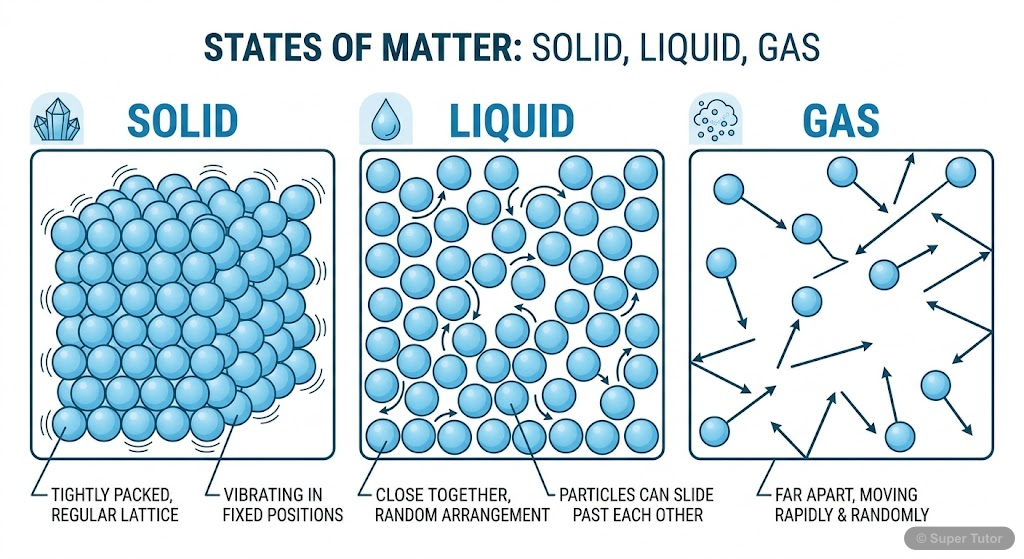
One of 2 illustrations for Matter in Super Tutor — alongside flashcards, concept maps and practice questions.
Overview
Everything around us — from the air we breathe to the water we drink, the books we read, and even our own bodies — is made up of matter. In this chapter, we explore what matter is, how it exists in different states, and how it changes when heated or cooled. We also learn about the tiny particles tha
Key Concepts
Matter is anything that has mass
Matter is anything that has mass and occupies space. Examples include water, air, wood, and iron. Even things we cannot see, like air, are matter beca
Matter exists in three forms
Matter exists in three forms: solids (fixed shape and volume), liquids (fixed volume but no fixed shape), and gases (no fixed shape or volume). These
Matter can change from one state
Matter can change from one state to another when heated or cooled. For example, ice (solid) melts into water (liquid), which can then boil into steam
When matter is heated
When matter is heated, it can expand (thermal expansion), change its state (like melting or boiling), or undergo a chemical change (like burning paper
All matter is made up
All matter is made up of tiny particles called atoms and molecules. These particles are always moving and have space between them. The force between t
Learning Objectives
- Define matter and identify examples in daily life
- Explain the three states of matter: solid, liquid, and gas
- Describe the interconversion of states of matter
- Understand the effect of heat on matter: expansion, change of state, and chemical change
- Recognize the particle nature of matter and its properties
Frequently Asked Questions
What are the important topics in Matter for ICSE Class 6 Chemistry?
How should I revise Matter for Class 6 exams?
Sources & Official References
Content is aligned to the official syllabus. Refer to the board website for the latest curriculum.
More resources for Matter
For serious students
Get the full Matter chapter — start free.
Quizzes, flashcards, an AI doubt solver and a study plan for ICSE Class 6 Chemistry. Free to start, no card needed.