Chapter 3 of 7
Revision Notes
Matter — Revision Notes
ICSE · Class 6 · Chemistry
Matter revision notes for ICSE Class 6 Chemistry: 4 topics in quick points. Includes What is Matter?, Composition of Matter: Atoms and States of Matter.
91 questions30 flashcards5 concepts
Interactive on Super Tutor
Studying Matter? Get the full interactive chapter.
Quizzes, flashcards, AI doubt-solver and a step-by-step study plan — built for revision notes and more.
Free trial, no card needed.
Super Tutor
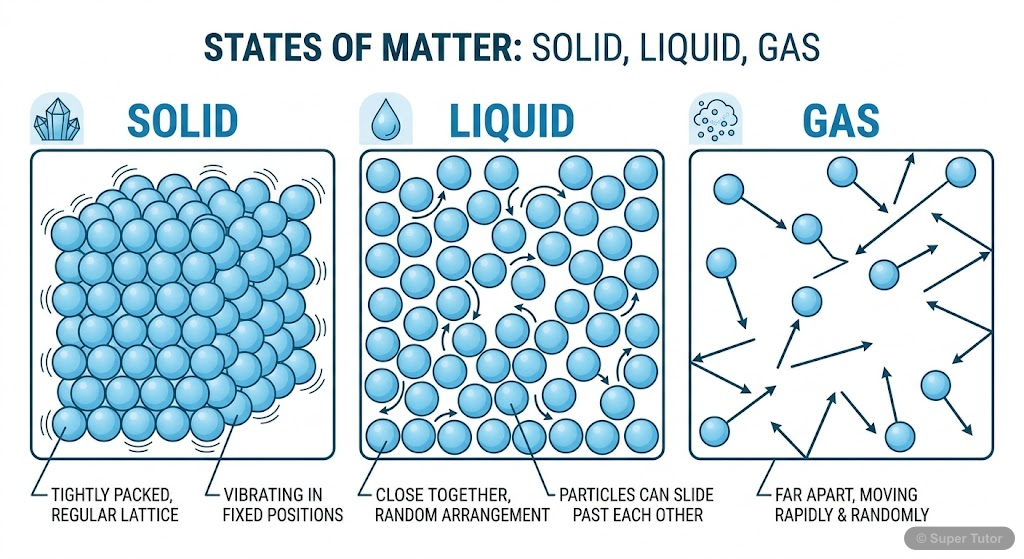
One of 2 illustrations for Matter in Super Tutor — alongside flashcards, concept maps and practice questions.
Key Topics to Revise
1
What is Matter?
- Matter is anything that has mass and occupies space.
- Examples: book, water, air, chair, plants, animals.
- Even air is matter, though we cannot see it. We can feel it when the wind blows.
2
Composition of Matter: Atoms and Molecules
- Matter is made up of very tiny particles called atoms.
- Atoms combine to form molecules. A molecule is the smallest unit of matter that can exist independently.
- Example: A water molecule (H₂O) has 2 hydrogen atoms and 1 oxygen atom.
3
States of Matter
- Matter exists in three states: solid, liquid, and gas.
- Solids have fixed shape and volume. Example: ice, wood.
- Liquids have fixed volume but no fixed shape. They take the shape of the container. Example: water, milk.
4
Interconversion of States of Matter
- Matter can change from one state to another by changing temperature or pressure.
- Melting: Solid → Liquid (e.g., ice to water).
- Freezing: Liquid → Solid (e.g., water to ice).
Get complete notes with diagrams and examples
Full NotesKey Concepts
Matter is anything that has massMatter exists in three formsMatter can change from one stateWhen matter is heatedAll matter is made up
Frequently Asked Questions
What are the important topics in Matter for ICSE Class 6 Chemistry?
Key topics in Matter include What is Matter?, Composition of Matter: Atoms and Molecules, States of Matter, Interconversion of States of Matter. Study these first, then practise questions on each for Class 6 exams.
How should I revise Matter for Class 6 exams?
Learn the core ideas first, then work through the 91 practice questions on Matter. Revise definitions regularly and use flashcards for quick recall before the exam.
Sources & Official References
Content is aligned to the official syllabus. Refer to the board website for the latest curriculum.
More resources for Matter
For serious students
Get the full Matter chapter — start free.
Quizzes, flashcards, an AI doubt solver and a study plan for ICSE Class 6 Chemistry. Free to start, no card needed.