Matter — Practice Quiz
ICSE · Class 6 · Chemistry
Try a 4-question quiz on Matter for ICSE Class 6 Chemistry: tap an answer to check it and see why. 91 questions in the full chapter test.
Interactive on Super Tutor
Studying Matter? Get the full interactive chapter.
Quizzes, flashcards, AI doubt-solver and a step-by-step study plan — built for practice quiz and more.
Free trial, no card needed.
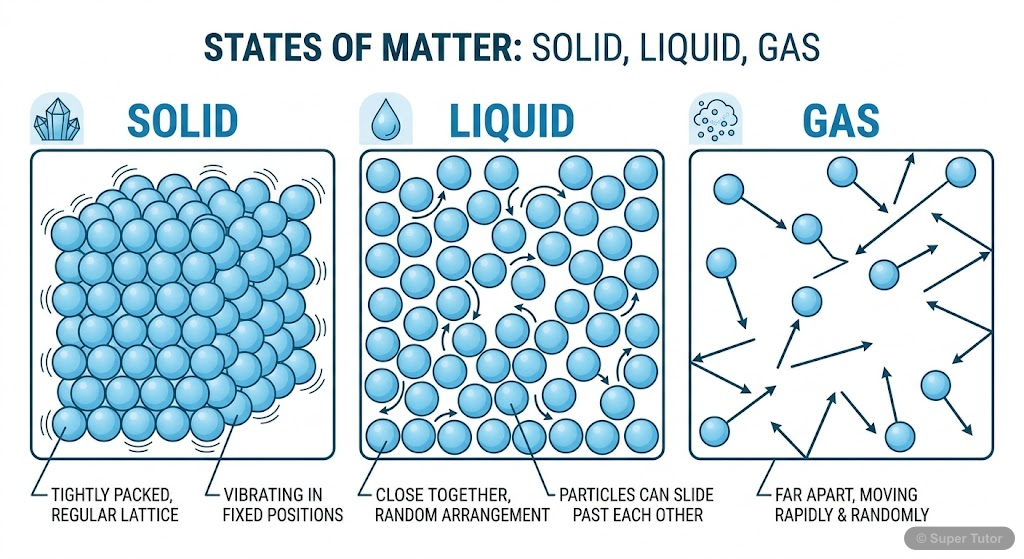
One of 2 illustrations for Matter in Super Tutor — alongside flashcards, concept maps and practice questions.
Quick Quiz: Matter
0/4Tap an answer to check it instantly. No sign-up needed for these 4.
A student adds a teaspoon of sugar to half a glass of water and stirs it. She notices the water level does NOT rise. Which of the following BEST explains this observation?
Which of the following correctly explains WHY gases can be compressed much more easily than solids?
LPG (cooking gas) is stored in cylinders as a liquid, but it comes out as a gas when the valve is opened. Which combination of conditions is used to keep LPG in liquid state inside the cylinder?
During the ball-and-ring experiment, a metal ball that just passes through a ring is heated strongly. It no longer passes through. What happens when the hot ball is dipped in cold water immediately?
Sample Questions
Naphthalene balls kept in a wardrobe disappear over time without leaving any liquid behind. What process is responsible, and what is the correct sequence of change?
Show answer
Sublimation – Solid → Gas (directly, without passing through liquid state)
Step 1: Most substances change from solid to liquid (melting) and then from liquid to gas (vaporisation) when heated. Step 2: However, certain substances like naphthalene, camphor, iodine, and dry ice (solid CO₂) directly convert from solid to gaseous (vapour) state on heating without forming a liquid. This is called sublimation. Step 3: Since naphthalene undergoes sublimation at room temperature slowly, the balls gradually turn into vapour and diffuse into the air, which is why no liquid is ever seen. Step 4: Option A is wrong – evaporation requires a liquid stage. Option C is wrong – condens
The odour of an incense stick lit in one corner of a room spreads throughout the room quickly. Which property of matter is PRIMARILY responsible for this, and why does it happen faster in gases than in liquids?
Show answer
Diffusion – because gas molecules have large intermolecular spaces and move freely at high speed
Step 1: Diffusion is the process by which particles of one substance mix with particles of another substance due to their random motion. Step 2: Gas molecules have very large intermolecular spaces and very weak intermolecular forces, allowing them to move freely in all directions at high speed. Step 3: In liquids, molecules are more closely packed and intermolecular forces are stronger, so particles cannot move as freely – diffusion is slower. Step 4: This is why the fragrance from an incense stick (a gas/vapour) spreads across the whole room rapidly. Step 5: Option A is wrong – cohesion refer
A thermometer works on a specific property of liquids. When you place it under your tongue, the mercury rises. When you remove it, the mercury stays at that level. Which combination of properties explains this behaviour?
Show answer
Liquids expand on heating and contract on cooling; the constriction traps mercury at the reading
Step 1: A thermometer is based on the principle that liquids expand on heating and contract on cooling. Step 2: When the thermometer is placed under the tongue, body heat causes mercury to expand and rise up the narrow capillary tube. Step 3: The thermometer has a tiny constriction (narrow point) near the bulb that prevents mercury from flowing back immediately when removed. Step 4: This lets us read the temperature even after removal. The mercury is later pushed back by shaking. Step 5: Option B is wrong – mercury does not change its state (freeze or boil) at body temperature. Option C is wro
When a candle burns, it shows BOTH a physical change and a chemical change. Which of the following CORRECTLY identifies these two changes?
Show answer
Melting of wax = physical change; burning of wax vapour to produce CO₂ and water = chemical change
Step 1: A physical change is temporary, reversible, and does not produce any new substance. Step 2: When a candle is lit, wax near the flame melts (solid → liquid) and then vaporises (liquid → gas). This is a physical change – no new substance is formed and the wax can in theory be recovered. Step 3: The wax vapour then reacts with oxygen in air and burns. This produces two completely new substances – carbon dioxide (CO₂) and water (H₂O). This is a chemical change. Step 4: Chemical changes are permanent and irreversible – the burnt wax cannot be turned back into candle wax. Step 5: Option A in
+87 more questions on Matter (ICSE Class 6 Chemistry)
Practise AllFrequently Asked Questions
What are the important topics in Matter for ICSE Class 6 Chemistry?
How many practice questions are there for Matter?
Sources & Official References
Content is aligned to the official syllabus. Refer to the board website for the latest curriculum.
More resources for Matter
Important Questions
Exam-style questions with answers
Revision Notes
Key points for last-minute revision
Chapter Summary
Understand the chapter at a glance
Concept Maps
See how topics connect
Study Plan
Step-by-step plan for this chapter
Flashcards
Quick-fire cards for active recall
Syllabus
What topics to cover
For serious students
Get the full Matter chapter — start free.
Quizzes, flashcards, an AI doubt solver and a study plan for ICSE Class 6 Chemistry. Free to start, no card needed.