Matter — Flashcards
ICSE · Class 6 · Chemistry
30 flashcards for Matter (ICSE Class 6 Chemistry) to test yourself on key terms and facts. Sample: "What is matter?"
Interactive on Super Tutor
Studying Matter? Get the full interactive chapter.
Quizzes, flashcards, AI doubt-solver and a step-by-step study plan — built for flashcards and more.
Free trial, no card needed.
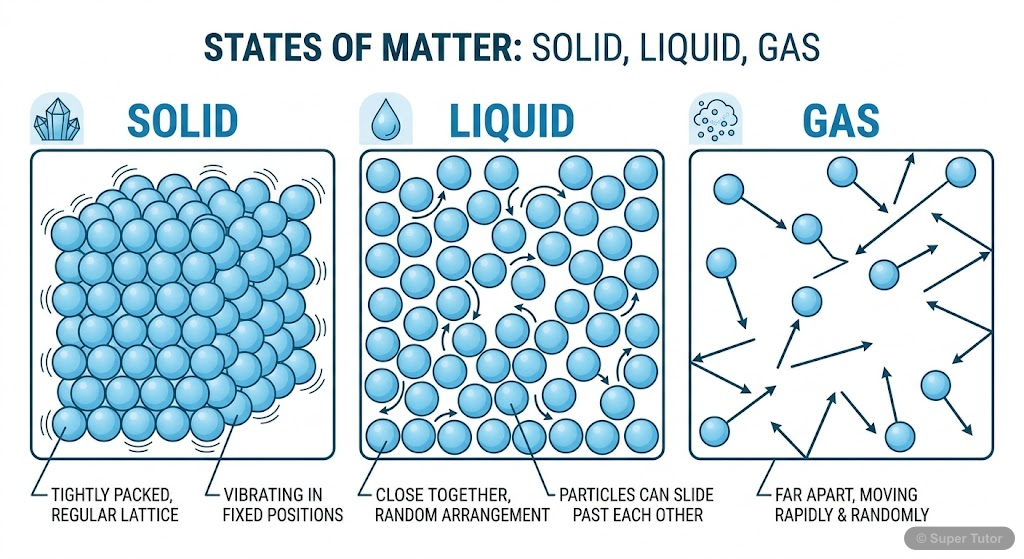
One of 2 illustrations for Matter in Super Tutor — alongside flashcards, concept maps and practice questions.
What is matter?
Answer
Anything that has mass and occupies space is called matter. For example, book, water, air, and even the food we eat are all made of matter.
Give two examples of living matter and two of non-living matter.
Answer
Living matter: Plants, animals. Non-living matter: Chair, water. Living things can grow and reproduce; non-living things cannot.
Why is air considered matter even though we can't see it?
Answer
Air is matter because it has mass and occupies space. We can feel wind (moving air), and if you inflate a balloon, it expands — proving air takes up space.
What are atoms and molecules?
Answer
Atoms are the smallest particles of matter. Molecules are formed when two or more atoms combine. A molecule can exist independently, but atoms usually do not.
How do molecules behave in solids, liquids, and gases?
Answer
In solids, molecules are tightly packed and vibrate in place. In liquids, they are less tightly packed and can move around. In gases, they are far apart and move freely in all directions.
List three properties of solids.
Answer
1. Definite shape and volume. 2. Almost incompressible. 3. High density and do not diffuse.
Why do liquids take the shape of their container?
Answer
Because the molecules in a liquid are not tightly packed and can flow past one another. They have enough space and movement to adjust to the container’s shape.
Why can gases be compressed easily?
Answer
Gases have very large intermolecular spaces. When pressure is applied, the molecules come closer, reducing the volume — hence gases are highly compressible.
+22 more flashcards
Practise AllFrequently Asked Questions
What are the important topics in Matter for ICSE Class 6 Chemistry?
How many flashcards are available for Matter?
How should I revise Matter for Class 6 exams?
Sources & Official References
Content is aligned to the official syllabus. Refer to the board website for the latest curriculum.
More resources for Matter
Practice Quiz
Test yourself with a quick quiz
Important Questions
Exam-style questions with answers
Revision Notes
Key points for last-minute revision
Chapter Summary
Understand the chapter at a glance
Concept Maps
See how topics connect
Study Plan
Step-by-step plan for this chapter
Syllabus
What topics to cover
For serious students
Get the full Matter chapter — start free.
Quizzes, flashcards, an AI doubt solver and a study plan for ICSE Class 6 Chemistry. Free to start, no card needed.