The River Valley Civilisation: Chinese Civilisation — Practice Quiz
ICSE · Class 6 · History & Civics
Try a 4-question quiz on The River Valley Civilisation: Chinese Civilisation for ICSE Class 6 History & Civics: tap an answer to check it and see why.
Interactive on Super Tutor
Studying The River Valley Civilisation: Chinese Civilisation? Get the full interactive chapter.
Quizzes, flashcards, AI doubt-solver and a step-by-step study plan — built for practice quiz and more.
Free trial, no card needed.
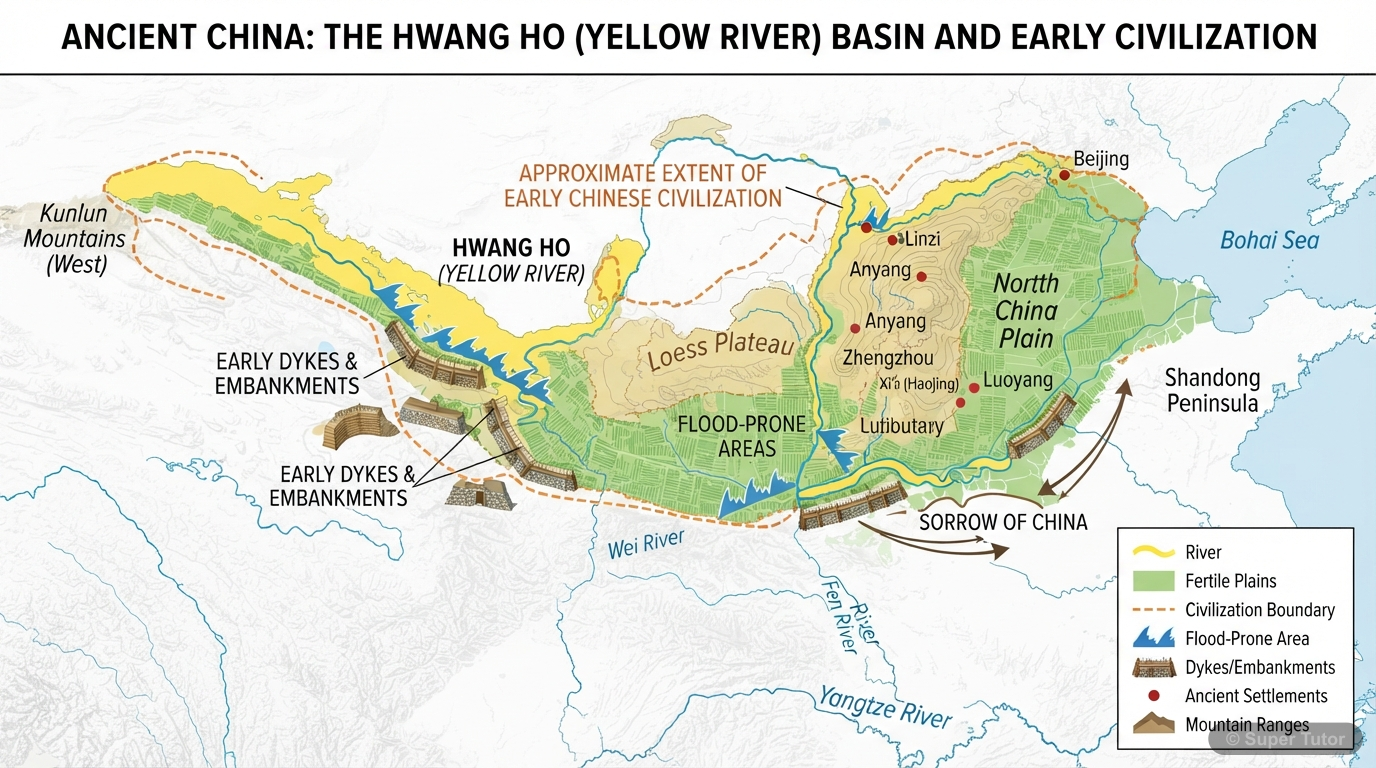
Learn better with visuals Super Tutor pairs illustrations like this with notes and quizzes for The River Valley Civilisation: Chinese Civilisation.
Get startedQuick Quiz: The River Valley Civilisation: Chinese Civilisation
0/4Tap an answer to check it instantly. No sign-up needed for these 4.
On the banks of which river did the Chinese Civilisation flourish?
Why is the Hwang Ho river called the 'Sorrow of China'?
Which dynasty is known as the 'classical period' of China because culture developed to great heights during this time?
During which years did the Shang Dynasty rule China?
Sample Questions
What was the position of women in ancient Chinese society?
Show answer
Women worked only within the house
Step 1: Ancient Chinese society was structured in a strict hierarchy. Step 2: The king was at the top, followed by noblemen, merchants, craftsmen, farmers, and slaves. Step 3: Family was considered a sacred unit and the head of the family was given great respect. Step 4: As described in the textbook, women in ancient China worked only within the house. Step 5: They did not hold public roles, government positions, or work as merchants. This reflects the traditional and patriarchal nature of ancient Chinese society.
Which god did the Chinese worship and call the 'Lord of Heaven'?
Show answer
Shang Ti
Step 1: Like other ancient civilisations, the Chinese worshipped forces of nature. Step 2: They also worshipped a supreme god. Step 3: This god was called 'Shang Ti', which means 'Lord of Heaven'. Step 4: Confucius and Lao-tze were great thinkers and founders of philosophical systems, not gods worshipped as Lord of Heaven. Step 5: Buddha was the founder of Buddhism, a separate religion. Therefore, Shang Ti is the correct answer.
Who founded the philosophy of Taoism?
Show answer
Lao-tze
Step 1: Two important philosophical and religious systems developed in ancient China. Step 2: These were Taoism and Confucianism. Step 3: Taoism emphasises a natural and simple way of life and was founded by Lao-tze. Step 4: Confucianism is a system of ethical teachings founded by Confucius — a different philosopher. Step 5: Shang Ti was a god, and Emperor Qin was a ruler — neither founded Taoism. So the correct answer is Lao-tze.
Which crop did the Chinese cultivate FIRST in the world, a practice that spread to other countries only in the 18th century?
Show answer
Tea
Step 1: Agriculture was the main occupation of the Chinese, and they grew many crops. Step 2: Among all their crops, one was grown first in China and spread to other countries much later. Step 3: The Chinese were the first in the world to cultivate tea. Step 4: The cultivation of tea in other countries began only in the 18th century, thousands of years after China started. Step 5: Rice, wheat, and soyabean were also grown in China, but none of these are specifically noted as being cultivated first by China in this context.
+84 more questions on The River Valley Civilisation: Chinese Civilisation (ICSE Class 6 History & Civics)
Practise AllFrequently Asked Questions
What are the important topics in The River Valley Civilisation: Chinese Civilisation for ICSE Class 6 History & Civics?
How many practice questions are there for The River Valley Civilisation: Chinese Civilisation?
Sources & Official References
Content is aligned to the official syllabus. Refer to the board website for the latest curriculum.
More resources for The River Valley Civilisation: Chinese Civilisation
Important Questions
Exam-style questions with answers
Revision Notes
Key points for last-minute revision
Chapter Summary
Understand the chapter at a glance
Concept Maps
See how topics connect
Study Plan
Step-by-step plan for this chapter
Flashcards
Quick-fire cards for active recall
Syllabus
What topics to cover
For serious students
Get the full The River Valley Civilisation: Chinese Civilisation chapter — start free.
Quizzes, flashcards, an AI doubt solver and a study plan for ICSE Class 6 History & Civics. Free to start, no card needed.