Rural Local Self-Government — Practice Quiz
ICSE · Class 6 · History & Civics
Try a 4-question quiz on Rural Local Self-Government for ICSE Class 6 History & Civics: tap an answer to check it and see why.
Interactive on Super Tutor
Studying Rural Local Self-Government? Get the full interactive chapter.
Quizzes, flashcards, AI doubt-solver and a step-by-step study plan — built for practice quiz and more.
Free trial, no card needed.
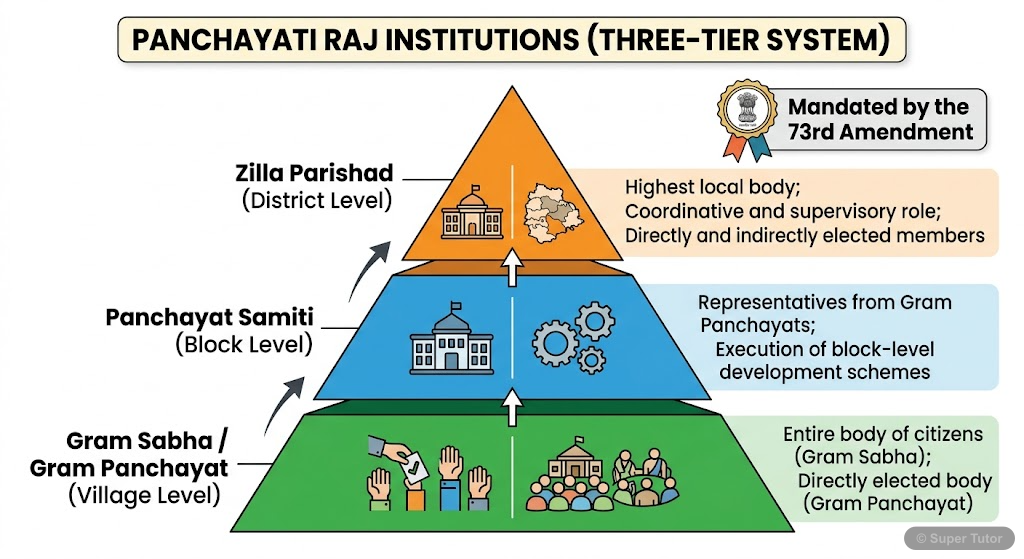
An illustration from Super Tutor's Rural Local Self-Government chapter — alongside flashcards, concept maps and practice questions.
Quick Quiz: Rural Local Self-Government
0/4Tap an answer to check it instantly. No sign-up needed for these 4.
What percentage of India's population lives in villages?
The Panchayati Raj System is a three-tier system. Which of the following is the CORRECT order from the lowest to the highest level?
The word 'Panchayat' literally means:
Who is the head of the Gram Panchayat?
Sample Questions
According to the Constitution (73rd Amendment) Act, 1992, what percentage of seats in Gram Panchayats are reserved for women?
Show answer
33%
Step 1: The Constitution (73rd Amendment) Act was passed in 1992 and gave major powers to Panchayati Raj institutions. Step 2: One of its most important provisions was the reservation of seats for women. Step 3: Exactly 33% (one-third) of total seats in Gram Panchayats were reserved for women. Step 4: 25% is too low and 50% would mean half — both are incorrect. Step 5: 33% is the correct figure as stated clearly in the chapter, ensuring women's participation in local governance.
Which body is the HIGHEST institution of the Panchayati Raj System in India?
Show answer
Zila Parishad
Step 1: The Panchayati Raj has three tiers — village, block, and district. Step 2: The Zila Parishad functions at the district level, which is the highest level in the three-tier system. Step 3: Gram Sabha is the general body of villagers at the lowest level. Step 4: Panchayat Samiti works at the middle (block) level. Step 5: Nyaya Panchayat is a body for resolving minor disputes — it is not a tier in the Panchayati Raj hierarchy.
What is the term (duration) of a Gram Panchayat as fixed by the 73rd Amendment Act?
Show answer
5 years
Step 1: The 73rd Constitutional Amendment Act of 1992 brought many important changes to the Panchayati Raj System. Step 2: One key change was fixing a uniform term for all Gram Panchayats. Step 3: The term was fixed at 5 years, meaning elections must be held every 5 years. Step 4: This is similar to the term of the Lok Sabha and State Assemblies — also 5 years. Step 5: Options of 3, 4, or 6 years are all incorrect as the uniform term is clearly stated as 5 years.
Which of the following is a function of the Nyaya Panchayat?
Show answer
Resolving minor disputes and providing speedy justice
Step 1: The Nyaya Panchayat is a special type of panchayat created for a specific purpose. Step 2: Its main function is to resolve minor disputes and provide speedy justice to villagers. Step 3: They can hear simple civil and criminal cases and impose fines. Step 4: However, they do NOT have the power to send a person to jail — that option is incorrect. Step 5: Collecting taxes is a function of Gram Panchayat, and supervising funds is a function of Zila Parishad, making those options wrong.
+87 more questions on Rural Local Self-Government (ICSE Class 6 History & Civics)
Practise AllFrequently Asked Questions
What are the important topics in Rural Local Self-Government for ICSE Class 6 History & Civics?
How many practice questions are there for Rural Local Self-Government?
Sources & Official References
Content is aligned to the official syllabus. Refer to the board website for the latest curriculum.
More resources for Rural Local Self-Government
Important Questions
Exam-style questions with answers
Revision Notes
Key points for last-minute revision
Chapter Summary
Understand the chapter at a glance
Concept Maps
See how topics connect
Study Plan
Step-by-step plan for this chapter
Flashcards
Quick-fire cards for active recall
Syllabus
What topics to cover
For serious students
Get the full Rural Local Self-Government chapter — start free.
Quizzes, flashcards, an AI doubt solver and a study plan for ICSE Class 6 History & Civics. Free to start, no card needed.