Negative Numbers and Integers — Chapter Summary
ICSE · Class 6 · Mathematics
Summary of Negative Numbers and Integers for ICSE Class 6 Mathematics. Part of the ICSE Class 6 Mathematics syllabus.
Interactive on Super Tutor
Studying Negative Numbers and Integers? Get the full interactive chapter.
Quizzes, flashcards, AI doubt-solver and a step-by-step study plan — built for chapter summary and more.
Free trial, no card needed.
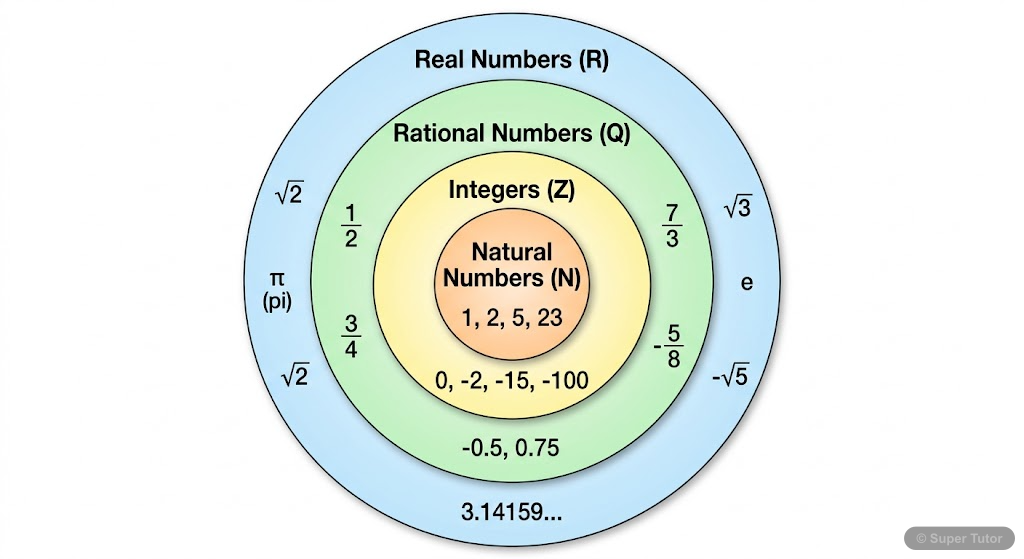
Learn better with visuals Super Tutor pairs illustrations like this with notes and quizzes for Negative Numbers and Integers.
Overview
In this chapter, we explore a new set of numbers called integers, which include both positive and negative numbers along with zero. While we are familiar with positive numbers like 1, 2, 3, etc., negative numbers like -1, -2, -3 help us represent situations such as loss, temperature below zero, or g
Key Concepts
When a larger number is subtracted
When a larger number is subtracted from a smaller number, the result is not a whole number. For example, 5 - 8 = -3. This requires the introduction of
Integers include all positive numbers (1
Integers include all positive numbers (1, 2, 3...), negative numbers (-1, -2, -3...), and zero. Zero is neither positive nor negative.
Integers can be shown on
Integers can be shown on a number line where zero is in the middle, positive numbers go to the right, and negative numbers go to the left. Each point
On a number line
On a number line, numbers increase from left to right. So, -5 < -2, and 0 > -3. Every positive integer is greater than every negative integer.
Addition and subtraction of integers can
Addition and subtraction of integers can be done using the number line. For example, (+3) + (-5) means move 3 right, then 5 left, ending at -2.
Learning Objectives
- Understand the need for negative numbers
- Define integers and identify positive, negative, and zero
- Represent integers on a number line
- Compare and order integers
- Apply integers in real-life situations
Frequently Asked Questions
What are the important topics in Negative Numbers and Integers for ICSE Class 6 Mathematics?
How should I revise Negative Numbers and Integers for Class 6 exams?
Sources & Official References
Content is aligned to the official syllabus. Refer to the board website for the latest curriculum.
More resources for Negative Numbers and Integers
Practice Quiz
Test yourself with a quick quiz
Important Questions
Exam-style questions with answers
Revision Notes
Key points for last-minute revision
Formula Sheet
The chapter's formulas in one place
Concept Maps
See how topics connect
Study Plan
Step-by-step plan for this chapter
Flashcards
Quick-fire cards for active recall
Syllabus
What topics to cover
For serious students
Get the full Negative Numbers and Integers chapter — start free.
Quizzes, flashcards, an AI doubt solver and a study plan for ICSE Class 6 Mathematics. Free to start, no card needed.