Atomic Structure — Important Questions
ICSE · Class 7 · Chemistry
43 important questions from Atomic Structure for ICSE Class 7 Chemistry, with answers. Includes multiple choice questions.
Interactive on Super Tutor
Studying Atomic Structure? Get the full interactive chapter.
Quizzes, flashcards, AI doubt-solver and a step-by-step study plan — built for important questions and more.
Free trial, no card needed.
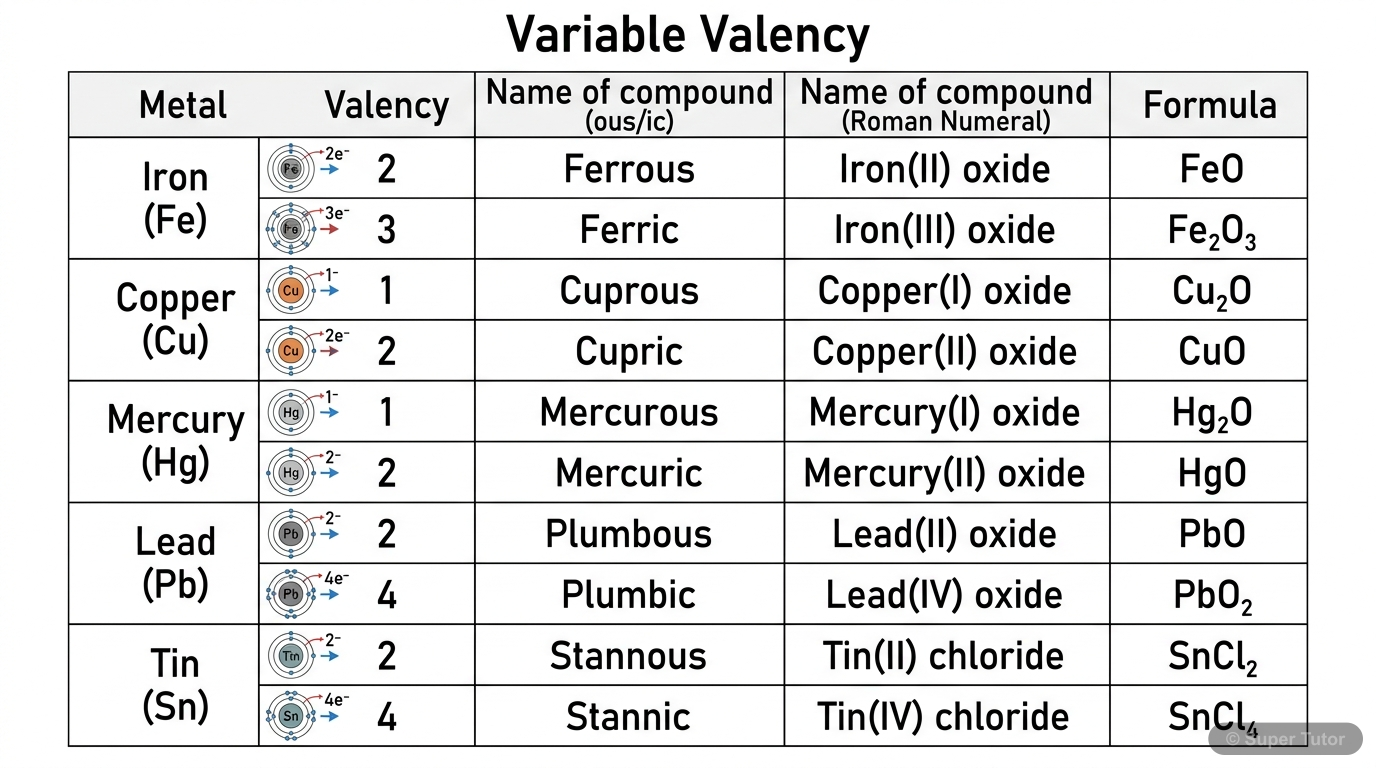
An illustration from Super Tutor's Atomic Structure chapter — alongside flashcards, concept maps and practice questions.
Important Questions from Atomic Structure
What is the valency of nitrogen in ammonia (NH₃)?
Show answer
3
Valency is defined as the number of hydrogen atoms that combine with one atom of an element. In ammonia (NH₃), one nitrogen atom combines with 3 hydrogen atoms. Therefore, the valency of nitrogen is 3. Carbon in methane (CH₄) has valency 4, oxygen in water (H₂O) has valency 2, and chlorine in HCl has valency 1. This concept helps us understand how atoms bond together.
Which of the following is the correct molecular formula for calcium chloride?
Show answer
CaCl₂
To find the formula: Calcium (Ca) has valency 2 and Chloride (Cl) has valency 1. Using the cross-multiplication method, we interchange the valencies: Ca gets subscript 1 (ignored) and Cl gets subscript 2. So the formula is CaCl₂. CaCl is wrong because it does not balance the valencies. Ca₂Cl₂ is incorrect because it can be simplified to CaCl₂. Ca₂Cl reverses the subscripts incorrectly.
Which of the following elements has a valency of zero?
Show answer
Argon
Argon (Ar) is a noble gas (inert gas) present in Group Zero of the Periodic Table. Noble gases have completely filled electron shells, which means they do not need to combine with other atoms. Hence their valency (combining capacity) is zero. Oxygen has valency 2, Nitrogen has valency 3, and Fluorine has valency 1. Noble gases like Helium, Neon, and Argon all have zero valency.
A radical with a positive charge is called a:
Show answer
Cation
Radicals (ions) are of two types based on their charge. A radical with a positive charge is called a cation (also known as a basic radical). Cations are formed when an atom loses electrons. For example, Na⁺ (sodium ion) is a cation. An anion (or acid radical) carries a negative charge and is formed when an atom gains electrons. For example, Cl⁻ is an anion. Neutron is a subatomic particle, not a type of radical.
+39 more questions on Atomic Structure (ICSE Class 7 Chemistry)
Practise AllFrequently Asked Questions
What are the important topics in Atomic Structure for ICSE Class 7 Chemistry?
How many important questions are there in Atomic Structure?
Sources & Official References
Content is aligned to the official syllabus. Refer to the board website for the latest curriculum.
More resources for Atomic Structure
Practice Quiz
Test yourself with a quick quiz
Revision Notes
Key points for last-minute revision
Formula Sheet
The chapter's formulas in one place
Chapter Summary
Understand the chapter at a glance
Concept Maps
See how topics connect
Study Plan
Step-by-step plan for this chapter
Flashcards
Quick-fire cards for active recall
Syllabus
What topics to cover
For serious students
Get the full Atomic Structure chapter — start free.
Quizzes, flashcards, an AI doubt solver and a study plan for ICSE Class 7 Chemistry. Free to start, no card needed.