Atomic Structure — Revision Notes
ICSE · Class 7 · Chemistry
Atomic Structure revision notes for ICSE Class 7 Chemistry: 4 topics in quick points. Part of the ICSE Class 7 Chemistry syllabus.
Interactive on Super Tutor
Studying Atomic Structure? Get the full interactive chapter.
Quizzes, flashcards, AI doubt-solver and a step-by-step study plan — built for revision notes and more.
Free trial, no card needed.
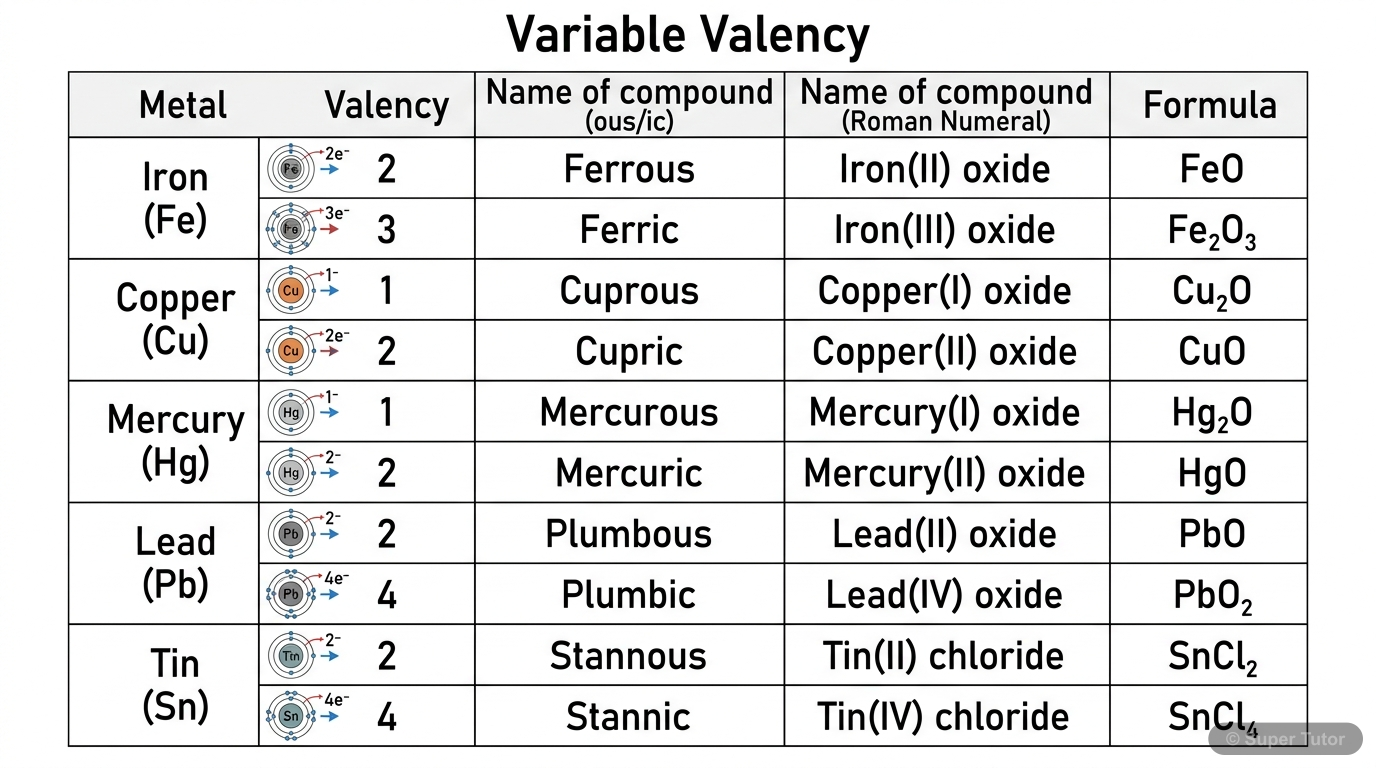
An illustration from Super Tutor's Atomic Structure chapter — alongside flashcards, concept maps and practice questions.
Key Topics to Revise
1. Atom and Subatomic Particles
- The word atom comes from atomos, meaning indivisible, coined by Democritus.
- Maharishi Kannada proposed that matter consists of indestructible particles called Paramanus.
- John Dalton suggested in 1808 that the atom is the basic unit of matter.
2. Molecules and Atomicity
- A molecule is the smallest particle of a pure substance that has independent existence.
- A molecule is formed when two or more atoms of the same element or different elements chemically combine.
- Atoms always join in whole numbers to form molecules.
3. Radicals and Their Types
- A radical is an atom of an element or a group of atoms of different elements that behaves as a single unit with a positive or negative charge on it.
- Radicals are also called ions.
- Ions are electrically charged atoms or groups of atoms formed by losing or gaining electrons.
4. Valency and Formula Writing
- Valency is the combining capacity of an element or of a radical.
- Valency can be defined as the number of hydrogen atoms that will combine with or displace one atom of that element or radical.
- Valency of hydrogen is taken as 1.
Get complete notes with diagrams and examples
Full NotesKey Concepts
Frequently Asked Questions
What are the important topics in Atomic Structure for ICSE Class 7 Chemistry?
How should I revise Atomic Structure for Class 7 exams?
Sources & Official References
Content is aligned to the official syllabus. Refer to the board website for the latest curriculum.
More resources for Atomic Structure
Practice Quiz
Test yourself with a quick quiz
Important Questions
Exam-style questions with answers
Formula Sheet
The chapter's formulas in one place
Chapter Summary
Understand the chapter at a glance
Concept Maps
See how topics connect
Study Plan
Step-by-step plan for this chapter
Flashcards
Quick-fire cards for active recall
Syllabus
What topics to cover
For serious students
Get the full Atomic Structure chapter — start free.
Quizzes, flashcards, an AI doubt solver and a study plan for ICSE Class 7 Chemistry. Free to start, no card needed.