Atomic Structure — Chapter Summary
ICSE · Class 7 · Chemistry
Summary of Atomic Structure for ICSE Class 7 Chemistry. Key concepts: An atom is the smallest, An atom contains electrons and The number of protons in.
Interactive on Super Tutor
Studying Atomic Structure? Get the full interactive chapter.
Quizzes, flashcards, AI doubt-solver and a step-by-step study plan — built for chapter summary and more.
Free trial, no card needed.
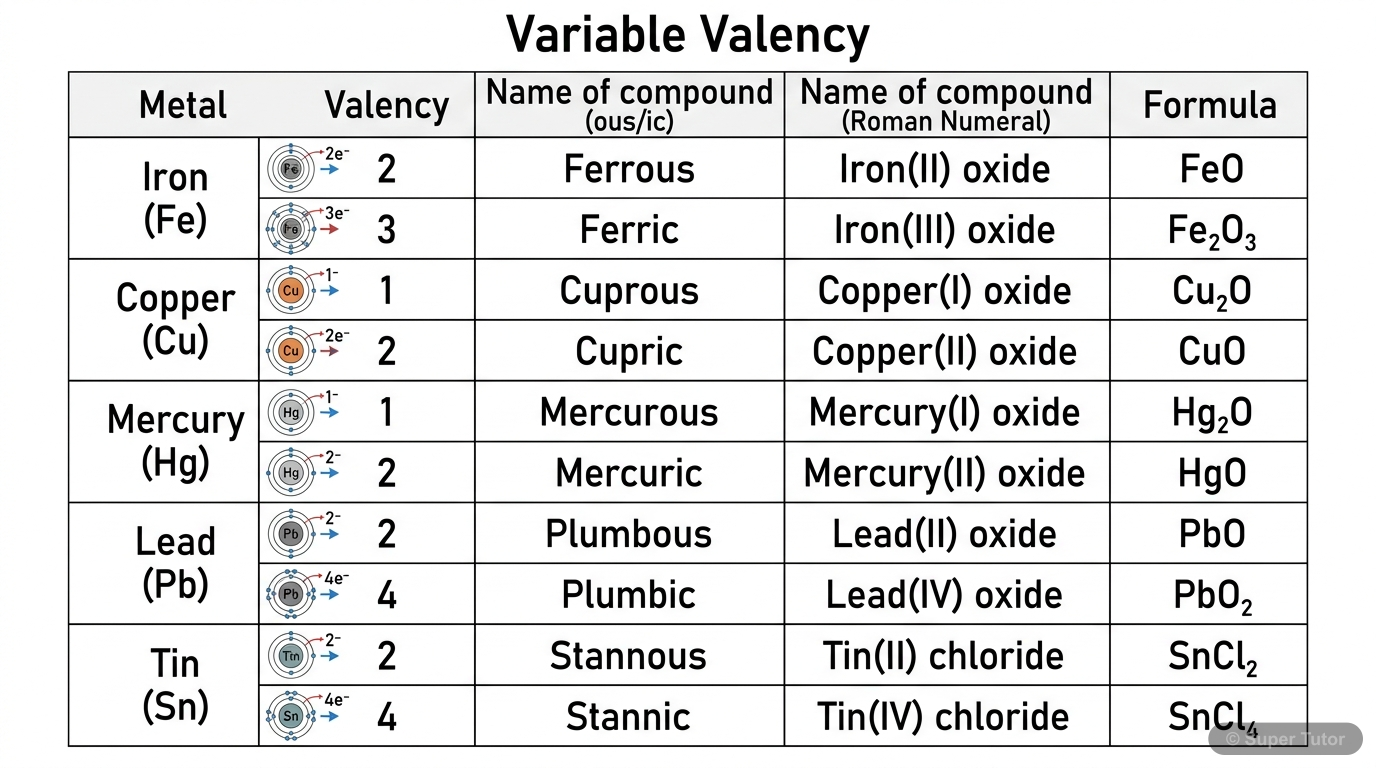
An illustration from Super Tutor's Atomic Structure chapter — alongside flashcards, concept maps and practice questions.
Overview
Atomic structure explains that matter is made of tiny particles called atoms. Atoms join to form molecules, and charged particles called radicals help form compounds. The chapter also shows how valency helps in writing chemical formulae and how the periodic table is connected with the combining capa
Key Concepts
An atom is the smallest particle
An atom is the smallest particle of an element that exhibits all the properties of that element. Atoms may or may not exist independently, but they ta
An atom contains electrons
An atom contains electrons, protons, and neutrons. Electrons are negatively charged and are found in orbits or shells outside the nucleus. Protons are
The number of protons in
The number of protons in the nucleus is called the atomic number. The sum of protons and neutrons in the nucleus is called the mass number. In a neutr
A molecule is the smallest particle
A molecule is the smallest particle of a pure substance that has independent existence. Molecules are formed when two or more atoms combine chemically
Atomicity is the number of atoms
Atomicity is the number of atoms present in one molecule of an element. Helium is monatomic, hydrogen is diatomic, ozone is triatomic, and phosphorus
Learning Objectives
- Define atom, molecule, radical, and valency
- Describe the basic particles inside an atom
- Explain atomic number and mass number
- Classify molecules as monatomic, diatomic, triatomic, and polyatomic
- Understand radicals as positive or negative charged particles
Frequently Asked Questions
What are the important topics in Atomic Structure for ICSE Class 7 Chemistry?
How should I revise Atomic Structure for Class 7 exams?
Sources & Official References
Content is aligned to the official syllabus. Refer to the board website for the latest curriculum.
More resources for Atomic Structure
Practice Quiz
Test yourself with a quick quiz
Important Questions
Exam-style questions with answers
Revision Notes
Key points for last-minute revision
Formula Sheet
The chapter's formulas in one place
Concept Maps
See how topics connect
Study Plan
Step-by-step plan for this chapter
Flashcards
Quick-fire cards for active recall
Syllabus
What topics to cover
For serious students
Get the full Atomic Structure chapter — start free.
Quizzes, flashcards, an AI doubt solver and a study plan for ICSE Class 7 Chemistry. Free to start, no card needed.