Matter and Its Composition
ICSE · Class 7 · Chemistry
Most important questions from Matter and Its Composition for ICSE Class 7 Chemistry board exam 2026. MCQs, short answer, and long answer questions with marks.
Interactive on Super Tutor
Studying Matter and Its Composition? Get the full interactive chapter.
Quizzes, flashcards, AI doubt-solver and a step-by-step study plan — built for important questions and more.
1,000+ Class 7 students started this chapter today
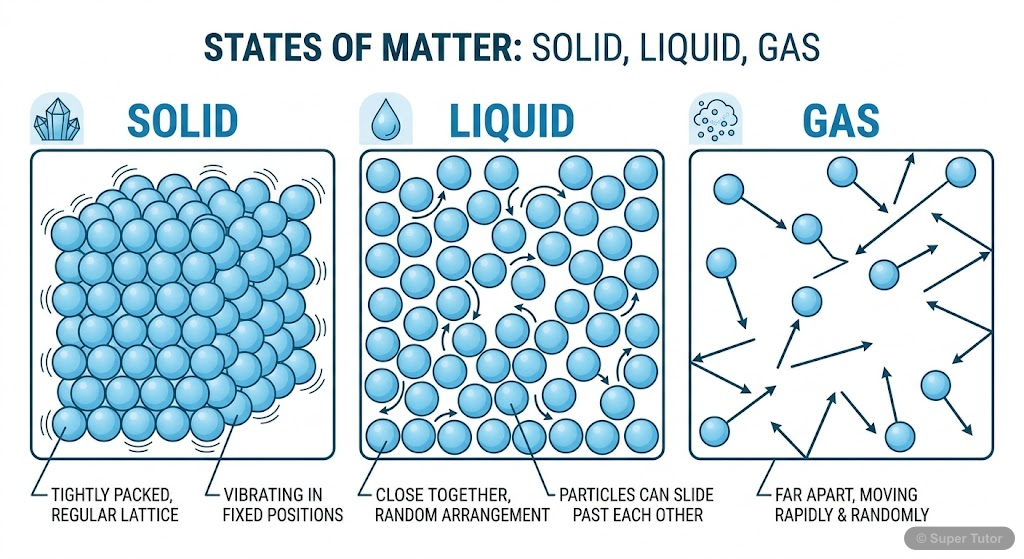
Super Tutor has 5+ illustrations like this for Matter and Its Composition alone — flashcards, concept maps, and step-by-step visuals.
See them allSample Questions
Which property distinguishes a solid from a liquid?
Show answer
Solids have a definite shape while liquids do not
Solids have both a definite shape and a definite volume because their particles are tightly packed with strong intermolecular forces. Liquids have a definite volume but NO definite shape – they take the shape of their container. Option B is wrong because it is gases (not solids) that have no definite volume. Option C is wrong because it is the reverse – liquids flow but solids generally do not. Option D is wrong because solids typically have HIGHER density than liquids.
The energy that particles of matter possess due to their motion is called:
Show answer
Kinetic energy
Kinetic energy is the energy an object has due to its motion. Particles of matter are always in random motion and possess kinetic energy. This energy increases with increase in temperature, which is why particles move faster when heated. Option B (Potential energy) is stored energy due to position, not motion. Option C (Chemical energy) is energy stored in chemical bonds. Option D (Thermal energy) is related to heat, which is a result of kinetic energy but is not the specific term used here.
The cooking gas (LPG) is stored in cylinders in liquid form. This is achieved by:
Show answer
Applying high pressure to the gas
The state of a substance can be changed by applying pressure. Gases, when subjected to high pressure, get compressed – their molecules are pushed closer together, intermolecular forces increase, and the gas converts to liquid. LPG stands for Liquefied Petroleum Gas. When the regulator valve is opened, pressure is released and LPG comes out as gas for burning. Option B is wrong – cooling reduces temperature, and 'cooling to high temperature' is contradictory. Option C is wrong – water is not added to LPG cylinders. Option D is wrong – the size of molecules does not change; it is the SPACE betwe
In Activity 3 (balloon experiment), when one balloon is punctured, the metre scale tilts towards the inflated balloon. What does this prove?
Show answer
Air has mass
The metre scale tilts towards the inflated balloon because the inflated balloon contains air, which has mass. The deflated balloon lost its air, so it became lighter. The heavier side (with more mass) tilts down. This experiment specifically proves that air has mass – a key property of matter. Option B is wrong because this experiment proves air DOES have mass. Option C is wrong because the experiment compares two identical balloons – one with air and one without. Option D is wrong because the experiment uses equally inflated balloons before puncturing.
+40 more questions available
Practice AllFrequently Asked Questions
What are the important topics in Matter and Its Composition for ICSE Class 7 Chemistry?
How to score full marks in Matter and Its Composition — ICSE Class 7 Chemistry?
How many important questions are there in Matter and Its Composition?
Sources & Official References
Content is aligned to the official syllabus. Refer to the board website for the latest curriculum.
More resources for Matter and Its Composition
Practice Quiz
Test yourself with a quick quiz
Revision Notes
Key points for last-minute revision
Formula Sheet
All formulas in one place
Chapter Summary
Understand the chapter at a glance
Concept Maps
See how topics connect visually
Study Plan
Step-by-step plan to ace this chapter
Flashcards
Quick-fire cards for active recall
Syllabus
What topics to cover
NCERT Solutions
Every textbook question solved step by step
For serious students
Get the full Matter and Its Composition chapter — for free.
Quizzes, flashcards, AI doubt-solver and a step-by-step study plan for ICSE Class 7 Chemistry.