Atmosphere
ICSE · Class 7 · Geography
Most important questions from Atmosphere for ICSE Class 7 Geography board exam 2026. MCQs, short answer, and long answer questions with marks.
Interactive on Super Tutor
Studying Atmosphere? Get the full interactive chapter.
Quizzes, flashcards, AI doubt-solver and a step-by-step study plan — built for important questions and more.
1,000+ Class 7 students started this chapter today
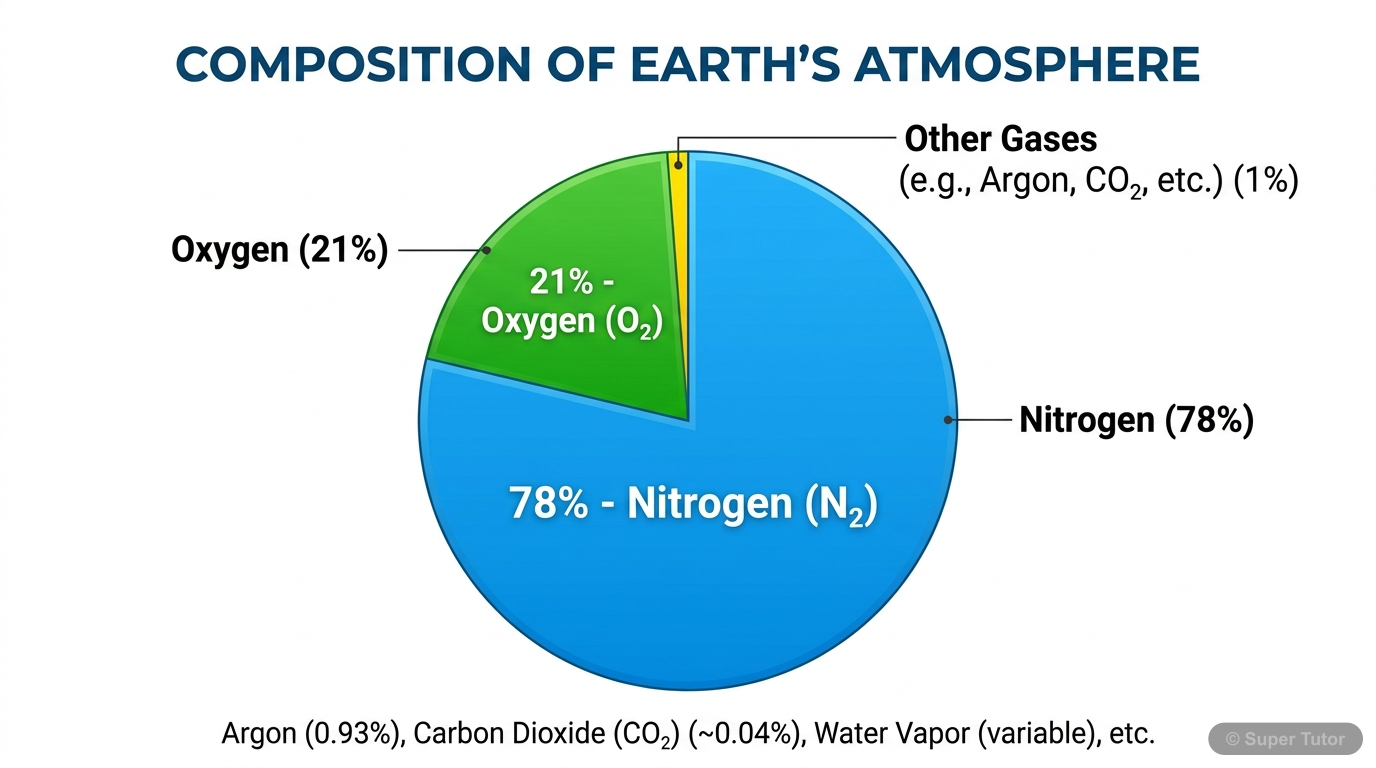
Learn better with visuals Super Tutor has hundreds of illustrations like this across every chapter — all free to try.
Get startedSample Questions
According to the IPCC report, carbon dioxide, methane and nitrous oxide together contribute 72% of global warming. If CO₂ contributes the largest share among greenhouse gases, which of the following activities would MOST directly reduce CO₂ concentration in the atmosphere?
Show answer
Switching from fossil fuels to solar, wind and hydroelectric energy sources.
Step 1: Carbon dioxide (CO₂) is the largest contributor to global warming among greenhouse gases. Step 2: The burning of fossil fuels (coal, oil, natural gas) is the primary source of CO₂ emissions into the atmosphere. Step 3: Switching to renewable energy sources like solar, wind, and hydroelectric power produces electricity without burning fossil fuels, directly reducing CO₂ emissions. Step 4: Option A targets CFCs which deplete ozone but are not the largest contributor to CO₂. Option B reduces nitrous oxide, not CO₂. Option D addresses methane, not CO₂. The question asks specifically about
Meteors from outer space mostly burn up before reaching the Earth's surface. In which layer of the atmosphere does this burning occur, and why is this layer sometimes called the 'Ignorosphere'?
Show answer
Mesosphere – because it is difficult to study directly as jets cannot reach it and satellites fly too high.
Step 1: The Mesosphere lies from 50 to 80 km above the Earth's surface. Step 2: This is the layer where most meteors from space burn up due to friction with air molecules, creating the phenomenon we call 'shooting stars'. Step 3: The Mesosphere is nicknamed the 'Ignorosphere' because it is very hard to study – jets and weather balloons cannot fly high enough to reach it, and satellites orbit too high above it. Step 4: The Stratosphere contains the ozone layer and is well-studied. The Ionosphere reflects radio waves and is monitored. The Exosphere still has some gases (hydrogen and helium). Onl
The greenhouse effect is described as the Earth's atmosphere behaving like a greenhouse roof. Which sequence CORRECTLY describes the greenhouse effect process?
Show answer
Sun's radiation reaches Earth → Earth absorbs it and radiates heat outward → Greenhouse gases trap some outgoing heat → Earth warms up.
Step 1: Solar radiation (sunlight) passes through the atmosphere and reaches the Earth's surface. Step 2: The Earth absorbs this energy and then radiates it back outward as infrared (heat) radiation. Step 3: Greenhouse gases like CO₂, methane and nitrous oxide in the atmosphere absorb and trap some of this outgoing heat, preventing it from escaping into space. Step 4: This trapped heat warms the Earth — similar to how a greenhouse traps warmth for plants. Step 5: Option A incorrectly says greenhouse gases absorb UV rays (they trap outgoing heat, not incoming UV). Option C is the opposite of wh
CFCs (Chlorofluorocarbons) are described as 'totally man-made greenhouse gases'. Which of the following statements about CFCs is INCORRECT?
Show answer
CFCs are naturally occurring gases released by wetlands and oceans.
Step 1: The question asks for the INCORRECT statement — so we need to find the wrong fact about CFCs. Step 2: According to the chapter, CFCs are described as 'totally man-made greenhouse gases' — they do NOT occur naturally. Step 3: Wetlands and oceans release methane, not CFCs. Nitrous oxide is released by oceans and soils. CFCs have no natural source. Step 4: Options A, B and D are all correct facts stated in the chapter — CFCs do come from foam in old fridges, are released when fridges are discarded, and are found in aerosol sprays. Step 5: Therefore Option C is the INCORRECT statement beca
+38 more questions available
Practice AllFrequently Asked Questions
What are the important topics in Atmosphere for ICSE Class 7 Geography?
How to score full marks in Atmosphere — ICSE Class 7 Geography?
How many important questions are there in Atmosphere?
Sources & Official References
Content is aligned to the official syllabus. Refer to the board website for the latest curriculum.
More resources for Atmosphere
Practice Quiz
Test yourself with a quick quiz
Revision Notes
Key points for last-minute revision
Formula Sheet
All formulas in one place
Chapter Summary
Understand the chapter at a glance
Concept Maps
See how topics connect visually
Study Plan
Step-by-step plan to ace this chapter
Flashcards
Quick-fire cards for active recall
Syllabus
What topics to cover
NCERT Solutions
Every textbook question solved step by step
For serious students
Get the full Atmosphere chapter — for free.
Quizzes, flashcards, AI doubt-solver and a step-by-step study plan for ICSE Class 7 Geography.