The Delhi Sultanate — Flashcards
ICSE · Class 7 · History & Civics
44 flashcards for The Delhi Sultanate (ICSE Class 7 History & Civics) to test yourself on key terms and facts.
Interactive on Super Tutor
Studying The Delhi Sultanate? Get the full interactive chapter.
Quizzes, flashcards, AI doubt-solver and a step-by-step study plan — built for flashcards and more.
Free trial, no card needed.
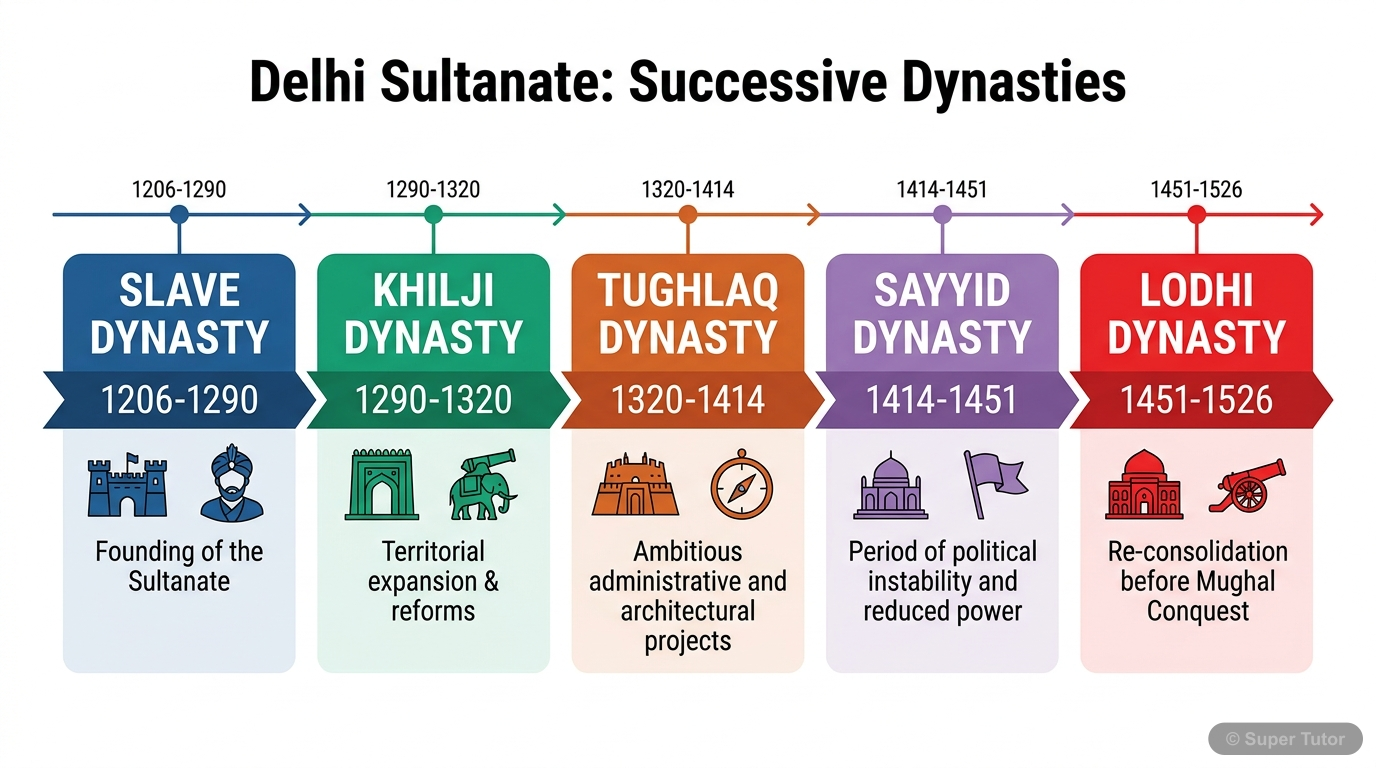
Learn better with visuals Super Tutor pairs illustrations like this with notes and quizzes for The Delhi Sultanate.
What is meant by the Sultanate period in Indian history?
Answer
The Sultanate period lasted from CE 1206 to CE 1526. It was a long period of 320 years when north India was ruled by Turkish Sultans from Delhi.
Which five dynasties ruled during the Delhi Sultanate?
Answer
The five dynasties were the Slave Dynasty, the Khalji Dynasty, the Tughlaq Dynasty, the Sayyid Dynasty, and the Lodi Dynasty. They ruled one after another from CE 1206 to CE 1526.
What is a sultanate?
Answer
A sultanate is a territory or kingdom ruled by a sultan. In this period, Delhi was the centre of such a kingdom.
Why was the Slave Dynasty also called the Mamluk Dynasty?
Answer
It was called the Mamluk Dynasty because Iltutmish and Balban were originally slaves of Qutubuddin Aibak, and Aibak himself had been a slave of Ghori.
Who was Qutubuddin Aibak?
Answer
Qutubuddin Aibak was the founder of the Slave Dynasty. He began as a slave of Muhammad Ghori, rose to become a general, and later became ruler after Ghori’s death. He was called Lakh Baksh because he …
What important buildings were started by Qutubuddin Aibak?
Answer
Qutubuddin Aibak started the construction of the Qutub Minar and built the Quwwat-ul-Islam mosque in Delhi. He was also known as a great builder.
Who was Iltutmish and why is he important?
Answer
Iltutmish was the son-in-law of Qutubuddin Aibak and became ruler in CE 1210. He is called the Real founder of the Delhi Sultanate because he strengthened and organised the empire properly.
How did Iltutmish make his rule stronger?
Answer
Iltutmish shifted his capital from Lahore to Delhi, got his claim approved by the Khalifa, divided his empire into Iqtas, and introduced the Tanka and Jital coins. He also protected India from Mongol …
+36 more flashcards
Practise AllFrequently Asked Questions
What are the important topics in The Delhi Sultanate for ICSE Class 7 History & Civics?
How many flashcards are available for The Delhi Sultanate?
How should I revise The Delhi Sultanate for Class 7 exams?
Sources & Official References
Content is aligned to the official syllabus. Refer to the board website for the latest curriculum.
More resources for The Delhi Sultanate
Practice Quiz
Test yourself with a quick quiz
Important Questions
Exam-style questions with answers
Revision Notes
Key points for last-minute revision
Chapter Summary
Understand the chapter at a glance
Concept Maps
See how topics connect
Study Plan
Step-by-step plan for this chapter
Syllabus
What topics to cover
For serious students
Get the full The Delhi Sultanate chapter — start free.
Quizzes, flashcards, an AI doubt solver and a study plan for ICSE Class 7 History & Civics. Free to start, no card needed.