The Delhi Sultanate — Practice Quiz
ICSE · Class 7 · History & Civics
Try a 4-question quiz on The Delhi Sultanate for ICSE Class 7 History & Civics: tap an answer to check it and see why.
Interactive on Super Tutor
Studying The Delhi Sultanate? Get the full interactive chapter.
Quizzes, flashcards, AI doubt-solver and a step-by-step study plan — built for practice quiz and more.
Free trial, no card needed.
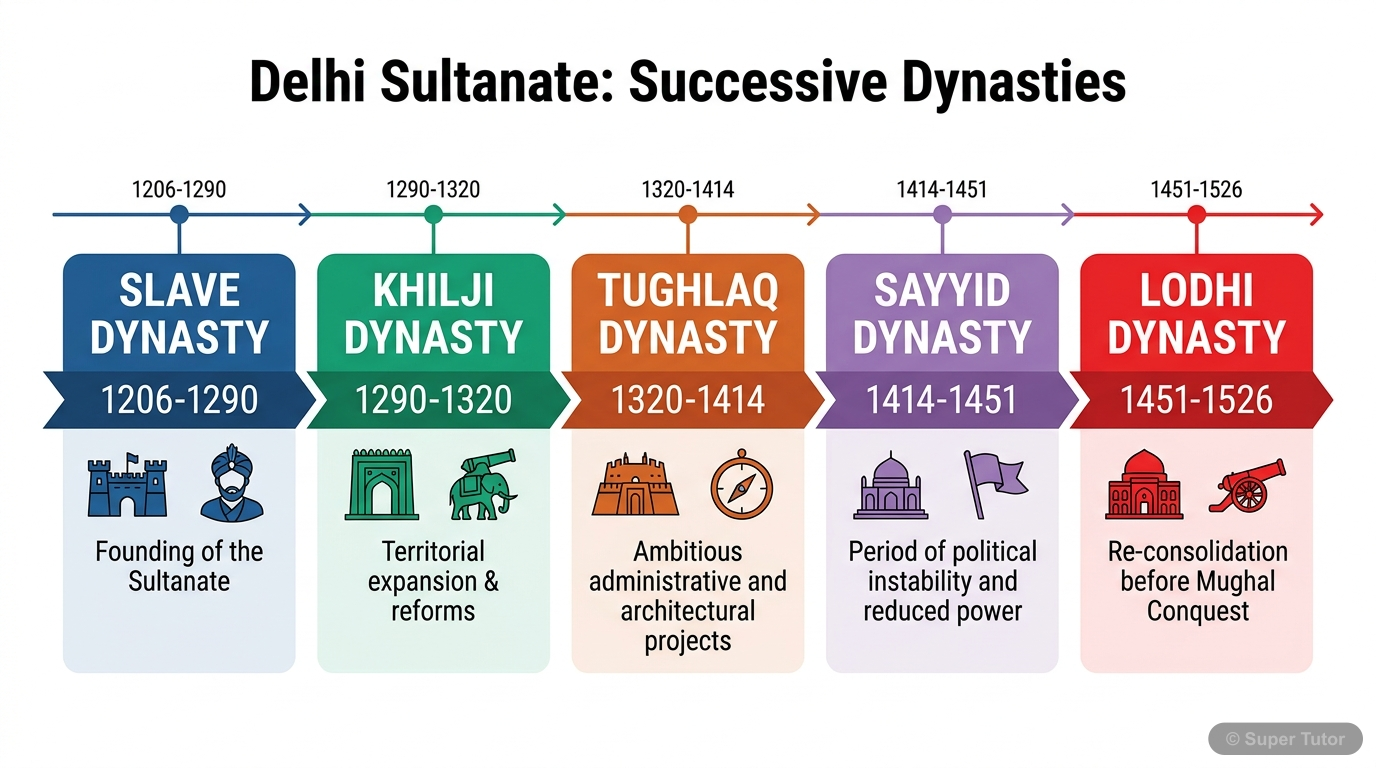
Learn better with visuals Super Tutor pairs illustrations like this with notes and quizzes for The Delhi Sultanate.
Quick Quiz: The Delhi Sultanate
0/4Tap an answer to check it instantly. No sign-up needed for these 4.
Who is considered the 'Real Founder' of the Delhi Sultanate?
Why was Qutubuddin Aibak called 'Lakh Baksh'?
What was the name of the silver coin introduced by Iltutmish?
The group of forty powerful Turkish nobles in the Slave Dynasty period was called:
Sample Questions
Which policy did Balban follow to deal firmly with his enemies and maintain power?
Show answer
Policy of Blood and Iron
Step 1: Balban came to power after years of weak rulers and wanted to assert royal authority firmly. Step 2: He followed the 'Policy of Blood and Iron' — meaning he was absolutely ruthless and harsh with those who opposed him or the crown. Step 3: He believed that to maintain order, the king must be feared. He also believed in the 'Divine Theory of Kingship' — that the king is God's representative on Earth. Step 4: Diplomacy or appeasement would mean being soft, which was the opposite of Balban's approach. 'Divide and Rule' was a British colonial strategy, not Balban's. Step 5: 'Blood and Iron
Who was Malik Kafur, and how did Alauddin Khalji acquire him?
Show answer
A slave bought for a thousand dinars from the port of Cambay during the Gujarat campaign
Step 1: During Alauddin Khalji's Gujarat campaign, his generals Ulugh Khan and Nasrat Khan defeated King Karan Dev and plundered the state. Step 2: During this campaign, they acquired a slave named Malik Kafur from the port of Cambay for a thousand dinars. Step 3: Because of this price, he was nicknamed 'Hazar Dinari' (meaning 'one worth a thousand dinars'). Step 4: Malik Kafur later became one of Alauddin's most trusted generals and led successful campaigns to Dwarasamudra and Madurai in South India. Step 5: The other options are completely fabricated and have no historical basis.
Alauddin Khalji introduced the system of 'dagh' and 'chehra' for his army. What did 'dagh' refer to?
Show answer
Branding of horses to ensure quality
Step 1: Alauddin Khalji maintained a large, well-organized army and introduced specific measures to improve its quality. Step 2: 'Dagh' meant the branding (marking) of horses. This was done to stop the practice of soldiers substituting good thoroughbred horses with ordinary or low-quality ones. Step 3: 'Chehra' was the system of issuing descriptive identity cards to every soldier, so that soldiers could not be replaced by others. Step 4: Option A describes 'chehra,' not 'dagh.' Options C and D are unrelated to either system. Step 5: Together, dagh and chehra made the army more accountable and
Which famous monument near the Qutub Minar was built by Alauddin Khalji?
Show answer
Alai Darwaza
Step 1: Alauddin Khalji was a great patron of art and architecture and constructed several important structures. Step 2: The Alai Darwaza is a magnificent gateway located near the Qutub Minar complex in Delhi, built by Alauddin Khalji. Step 3: The Quwwat-ul-Islam Mosque was built by Qutubuddin Aibak, not Alauddin — so that option is wrong. Step 4: Firoz Shah Kotla was a palace-fort complex built by Firuz Shah Tughlaq. Step 5: Hauz-i-Khas (Hauz Khas) was indeed built by Alauddin Khalji, but it is described as a big tank, not as a monument near Qutub Minar. The Alai Darwaza is specifically locat
+41 more questions on The Delhi Sultanate (ICSE Class 7 History & Civics)
Practise AllFrequently Asked Questions
What are the important topics in The Delhi Sultanate for ICSE Class 7 History & Civics?
How many practice questions are there for The Delhi Sultanate?
Sources & Official References
Content is aligned to the official syllabus. Refer to the board website for the latest curriculum.
More resources for The Delhi Sultanate
Important Questions
Exam-style questions with answers
Revision Notes
Key points for last-minute revision
Chapter Summary
Understand the chapter at a glance
Concept Maps
See how topics connect
Study Plan
Step-by-step plan for this chapter
Flashcards
Quick-fire cards for active recall
Syllabus
What topics to cover
For serious students
Get the full The Delhi Sultanate chapter — start free.
Quizzes, flashcards, an AI doubt solver and a study plan for ICSE Class 7 History & Civics. Free to start, no card needed.