The Constitution of India — Practice Quiz
ICSE · Class 7 · History & Civics
Try a 4-question quiz on The Constitution of India for ICSE Class 7 History & Civics: tap an answer to check it and see why.
Interactive on Super Tutor
Studying The Constitution of India? Get the full interactive chapter.
Quizzes, flashcards, AI doubt-solver and a step-by-step study plan — built for practice quiz and more.
Free trial, no card needed.
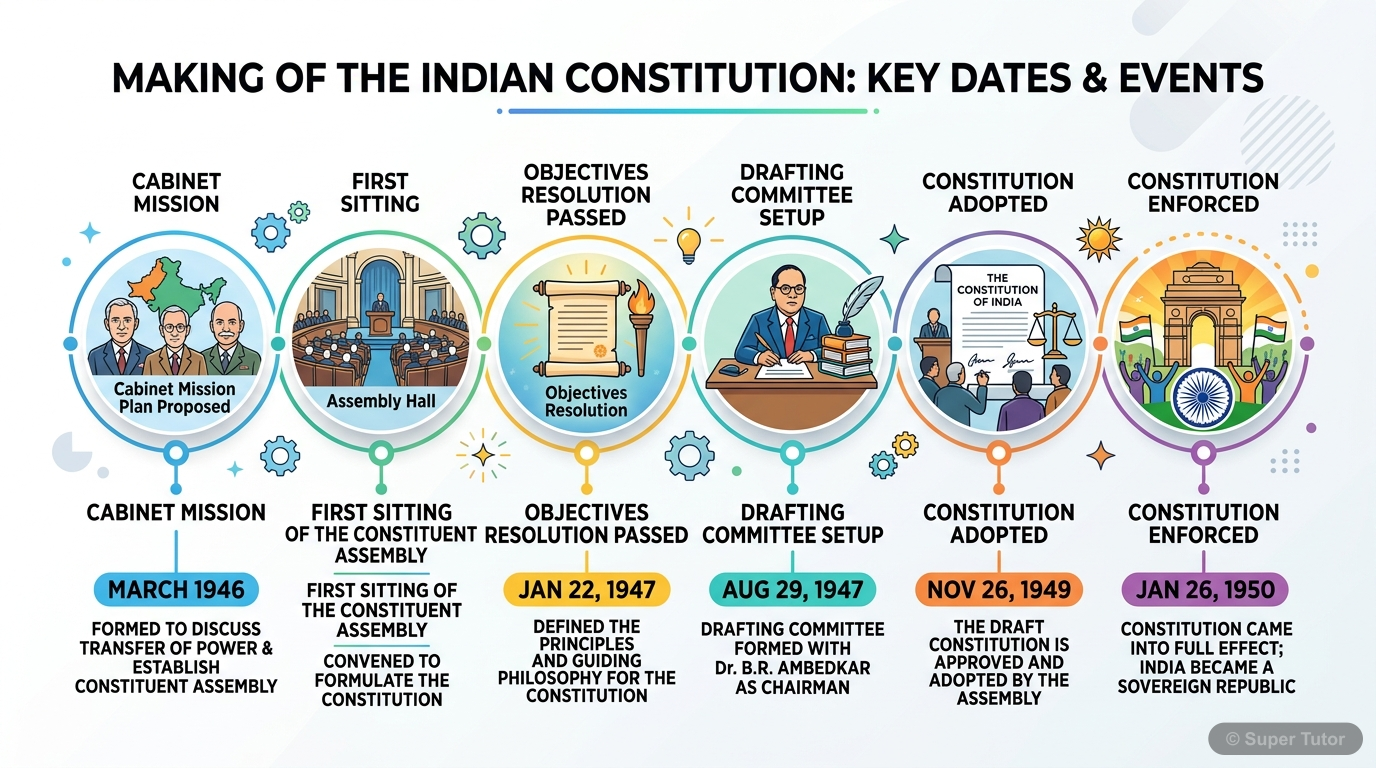
Learn better with visuals Super Tutor pairs illustrations like this with notes and quizzes for The Constitution of India.
Quick Quiz: The Constitution of India
0/4Tap an answer to check it instantly. No sign-up needed for these 4.
The Constituent Assembly held its first meeting in December 1946. Under which chairmanship was the Drafting Committee of the Constitution formed, and how many days did the members deliberate?
Which of the following correctly describes the significance of the phrase 'We, the People of India' in the Preamble?
The 42nd Constitutional Amendment of 1976 added two important words to the Preamble. Which pair correctly identifies those words AND the concept they represent?
Which Article of the Indian Constitution is described as the 'heart and soul' of the Constitution by Dr B. R. Ambedkar himself?
Sample Questions
C. Rajagopalachari became significant in Indian history in the context of the Constitution coming into force. What was his exact role and when did he hold it?
Show answer
He was the first Indian Governor General of India and held office till January 26, 1950.
Step 1: When India became independent, Lord Mountbatten was the Governor General. Step 2: C. Rajagopalachari (also called Rajaji) took over from Lord Mountbatten and became the first Indian to hold the position of Governor General of India. Step 3: He held this office until January 26, 1950, when the Constitution came into force. Step 4: On January 26, 1950, Dr Rajendra Prasad became the first President of India, replacing the Governor General position. Step 5: Options A, C, and D are factually incorrect — Nehru was the first PM, Rajendra Prasad presided the Constituent Assembly, and Ambedkar
Under the Right Against Exploitation, which two specific protections are provided by Articles 23 and 24 of the Indian Constitution?
Show answer
Freedom from bonded labour and protection of children below 14 from hazardous jobs
Step 1: The Right Against Exploitation is covered under Articles 23 and 24. Step 2: Article 23 prohibits bonded labour (also called begar — labour without wages) and human trafficking. Step 3: Article 24 specifically protects children below 14 years of age from being employed in hazardous jobs that could harm their growth and development. Step 4: Option A describes features of Right to Equality (abolition of untouchability is in Article 17, equal opportunity in Article 16). Step 5: Options C and D describe features of Right to Freedom (Article 19) and Right to Freedom of Religion (Articles 25-
The Constitution (86th Amendment) Act 2002 introduced Article 21A. What does this article specifically provide, and for which age group?
Show answer
Free and compulsory education for all children between 6 to 14 years of age.
Step 1: Article 21A was added to the Constitution by the 86th Amendment Act of 2002 — it was not in the original Constitution. Step 2: This article provides for free and compulsory education specifically for all children between the ages of 6 to 14 years. Step 3: The age group 6 to 14 years is very specific and must be remembered correctly — it is NOT 6-18 years as some students mistakenly believe. Step 4: Options C and D describe rights not present in the Constitution regarding higher education and vocational training age groups. Step 5: This amendment later formed the legal basis for the Rig
Which of the following statements CORRECTLY distinguishes between a 'Democratic' state and a 'Republic' state as described in the Preamble of the Indian Constitution?
Show answer
Democratic means people choose the government and hold it accountable; Republic means the head of state is an elected person and not hereditary.
Step 1: 'Democratic' and 'Republic' are two different concepts and must not be confused. Step 2: Democracy (Democratic) means a government of the people, by the people, and for the people. In democracy, people elect their representatives, enjoy equal political rights, and can hold the government accountable. Step 3: A Republic means the head of state is not a hereditary position (like a king or queen) but is an elected person. In India, the President is elected — making India a Republic. Step 4: Option A reverses the two definitions incorrectly. Option C confuses these with 'Sovereign' and 'So
+39 more questions on The Constitution of India (ICSE Class 7 History & Civics)
Practise AllFrequently Asked Questions
What are the important topics in The Constitution of India for ICSE Class 7 History & Civics?
How many practice questions are there for The Constitution of India?
Sources & Official References
Content is aligned to the official syllabus. Refer to the board website for the latest curriculum.
More resources for The Constitution of India
Important Questions
Exam-style questions with answers
Revision Notes
Key points for last-minute revision
Chapter Summary
Understand the chapter at a glance
Concept Maps
See how topics connect
Study Plan
Step-by-step plan for this chapter
Flashcards
Quick-fire cards for active recall
Syllabus
What topics to cover
For serious students
Get the full The Constitution of India chapter — start free.
Quizzes, flashcards, an AI doubt solver and a study plan for ICSE Class 7 History & Civics. Free to start, no card needed.