Transport In Plants — Important Questions
ICSE · Class 8 · Biology
45 important questions from Transport In Plants for ICSE Class 8 Biology, with answers. Includes multiple choice questions.
Interactive on Super Tutor
Studying Transport In Plants? Get the full interactive chapter.
Quizzes, flashcards, AI doubt-solver and a step-by-step study plan — built for important questions and more.
Free trial, no card needed.
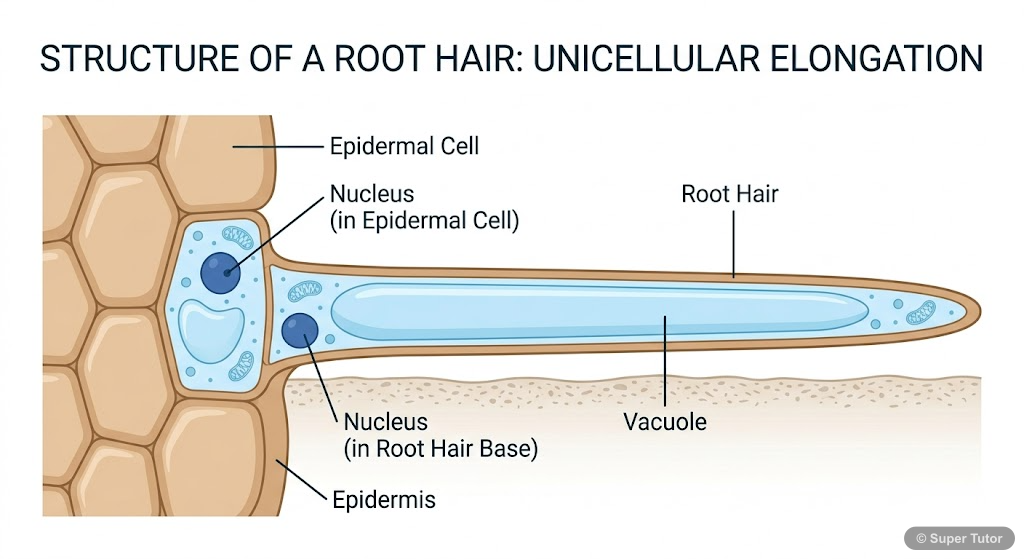
One of 2 illustrations for Transport In Plants in Super Tutor — alongside flashcards, concept maps and practice questions.
Important Questions from Transport In Plants
A student places fresh grapes in a concentrated sugar solution. What will happen to the grapes after a few hours?
Show answer
The grapes will shrink as water moves out of them
Step 1: The grape cells contain cell sap at a certain concentration. The surrounding sugar solution is highly concentrated (has less water). Step 2: In osmosis, water moves from higher water concentration to lower water concentration through the semi-permeable membrane of grape cells. Step 3: The sugar solution outside has a LOWER water concentration than inside the grape cells. Step 4: Therefore, water will move OUT of the grape cells into the surrounding sugar solution — this is called exosmosis. Step 5: As water leaves the cells, the grapes shrink and become wrinkled. This is the opposite o
The upward movement of water and minerals from roots through the stem to leaves is called:
Show answer
Ascent of sap
Step 1: 'Sap' refers to the solution of water and dissolved minerals that moves through the xylem. Step 2: The upward movement of this sap from roots through the stem to the leaves is specifically called the 'ascent of sap'. Step 3: Transpiration is the loss of water vapour from leaves — not the upward movement of water. Step 4: Translocation refers to the movement of food (sucrose) through the phloem — not water through xylem. Step 5: Active transport is the movement of molecules against their concentration gradient using energy — it is a mechanism, not the name of this overall upward water m
Which macronutrient deficiency causes yellowing of leaves and wrinkling of cereal grains in plants?
Show answer
Nitrogen
Step 1: Nitrogen is a macronutrient, meaning it is needed in large amounts by plants. Step 2: Nitrogen is the major constituent of all proteins, which are essential for plant growth and development. Step 3: When a plant lacks nitrogen, it cannot make enough proteins, leading to poor growth. Step 4: The visible symptoms of nitrogen deficiency are yellowing of leaves (called chlorosis) and wrinkling of cereal grains. Step 5: Phosphorus deficiency causes purple/red spots on leaves. Potassium deficiency causes poor growth. Iron is a micronutrient (not macronutrient) and also causes yellowing but i
The direction of transport in xylem is:
Show answer
Unidirectional — only upward from roots to leaves
Step 1: Xylem transports water and mineral salts from the roots upward to all aerial parts of the plant. Step 2: This movement is unidirectional, meaning it goes in only ONE direction — upward. Step 3: The driving forces for this upward movement are root pressure, transpirational pull, and capillary action. Step 4: In contrast, phloem transport is bidirectional — food made in leaves can travel both upward (to growing tips) and downward (to roots and storage organs). Step 5: So xylem = upward only (unidirectional), while phloem = both directions (bidirectional). This is an important difference
+41 more questions on Transport In Plants (ICSE Class 8 Biology)
Practise AllFrequently Asked Questions
What are the important topics in Transport In Plants for ICSE Class 8 Biology?
How many important questions are there in Transport In Plants?
Sources & Official References
Content is aligned to the official syllabus. Refer to the board website for the latest curriculum.
More resources for Transport In Plants
For serious students
Get the full Transport In Plants chapter — start free.
Quizzes, flashcards, an AI doubt solver and a study plan for ICSE Class 8 Biology. Free to start, no card needed.