Reproduction In Plants — Important Questions
ICSE · Class 8 · Biology
45 important questions from Reproduction In Plants for ICSE Class 8 Biology, with answers. Includes multiple choice questions.
Interactive on Super Tutor
Studying Reproduction In Plants? Get the full interactive chapter.
Quizzes, flashcards, AI doubt-solver and a step-by-step study plan — built for important questions and more.
Free trial, no card needed.
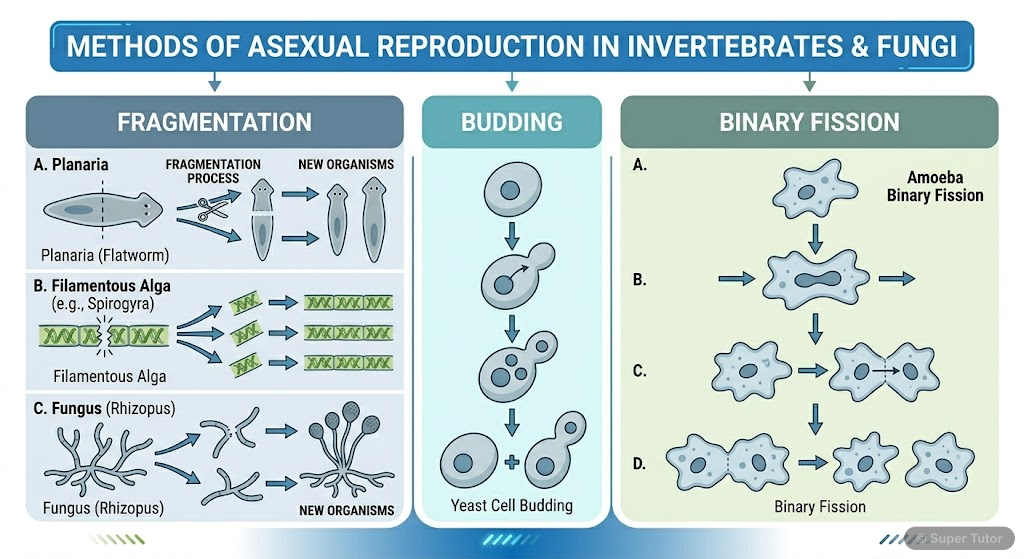
Learn better with visuals Super Tutor pairs illustrations like this with notes and quizzes for Reproduction In Plants.
Important Questions from Reproduction In Plants
Ginger, potato, and onion are all called 'modified stems'. A student claims that onion is a root because it grows underground. Which of the following best DISPROVES the student's claim?
Show answer
Onion has a condensed disc-like stem with nodes that bear fleshy overlapping scaly leaves and axillary buds, which are features of stems, not roots
Step 1: The key question is — what structural features define a STEM vs a ROOT? Step 2: Stems have nodes, internodes, leaves (even scaly ones), and buds. Roots have none of these; they have root hairs and root caps instead. Step 3: When an onion is cut vertically, you can see a thick, short, condensed disc-like stem at the bottom. This disc has nodes bearing fleshy overlapping scaly leaves (the layers of onion we peel) and axillary buds. Step 4: Option B is wrong — growing underground alone doesn't make something a root (ginger and potato also grow underground but are stems). Option C is wrong
In the technique of grafting, it is stated that 'the cambium layers of the stock and scion must come into very close contact'. Why is the cambium layer specifically mentioned as being crucial for a successful graft?
Show answer
The cambium is the actively dividing layer that produces new cells, so contact between the two cambium layers allows new tissue to form and join the stock and scion together
Step 1: In grafting, the 'stock' is the rooted plant that provides the root system, and the 'scion' is the desired shoot that is fixed onto it. Step 2: The cambium is a meristematic (actively dividing) layer of cells located just under the bark of stems. It is responsible for the growth in thickness of the stem. Step 3: When the cambium of the stock and scion are placed in very close contact, the actively dividing cells from BOTH sides produce new cells that grow together and unite the two pieces into one functional plant. Step 4: Option B is wrong — the cambium does not store sugar; that is t
In tissue culture (micropropagation), an 'explant' is placed in a nutrient medium and eventually grows into a 'callus'. What is a callus and what does it eventually become?
Show answer
A callus is an unorganised, undifferentiated mass of cells; with the addition of growth regulators it differentiates into a tiny plant called a plantlet
Step 1: In micropropagation, an explant (a small piece of plant tissue — shoot apex, vegetative bud, etc.) is sterilised and placed on a special nutrient medium. Step 2: The cells of the explant begin to grow and divide rapidly but WITHOUT forming any specific organs — this unorganised, undifferentiated cell mass is called a CALLUS. Step 3: Growth regulators (plant hormones) are then added to the callus. These hormones signal the cells to DIFFERENTIATE — to organise themselves into proper tissues and develop into a tiny plant called a PLANTLET. Step 4: After 4–6 weeks, the plantlets are transf
A student dissects a flower and finds four whorls. Moving from the outermost to the innermost whorl, what is the CORRECT order of these whorls?
Show answer
Calyx → Corolla → Androecium → Gynoecium
Step 1: A typical flower has four whorls arranged concentrically from outside to inside. Step 2: The OUTERMOST whorl is the CALYX, made of green leaf-like structures called sepals. They protect the inner parts when the flower is in bud form. Step 3: The SECOND whorl is the COROLLA, made of petals (usually coloured and scented) that attract pollinators. Step 4: The THIRD whorl is the ANDROECIUM, the male reproductive part consisting of stamens (filament + anther). Each anther contains pollen grains with male gametes. Step 5: The INNERMOST whorl is the GYNOECIUM (pistil), the female reproductive
+41 more questions on Reproduction In Plants (ICSE Class 8 Biology)
Practise AllFrequently Asked Questions
What are the important topics in Reproduction In Plants for ICSE Class 8 Biology?
How many important questions are there in Reproduction In Plants?
Sources & Official References
Content is aligned to the official syllabus. Refer to the board website for the latest curriculum.
More resources for Reproduction In Plants
For serious students
Get the full Reproduction In Plants chapter — start free.
Quizzes, flashcards, an AI doubt solver and a study plan for ICSE Class 8 Biology. Free to start, no card needed.