Atomic Structure — Chapter Summary
ICSE · Class 8 · Chemistry
Summary of Atomic Structure for ICSE Class 8 Chemistry. Key concepts: An atom is the smallest, Maharishi Kanada described and An atom contains electrons.
Interactive on Super Tutor
Studying Atomic Structure? Get the full interactive chapter.
Quizzes, flashcards, AI doubt-solver and a step-by-step study plan — built for chapter summary and more.
Free trial, no card needed.
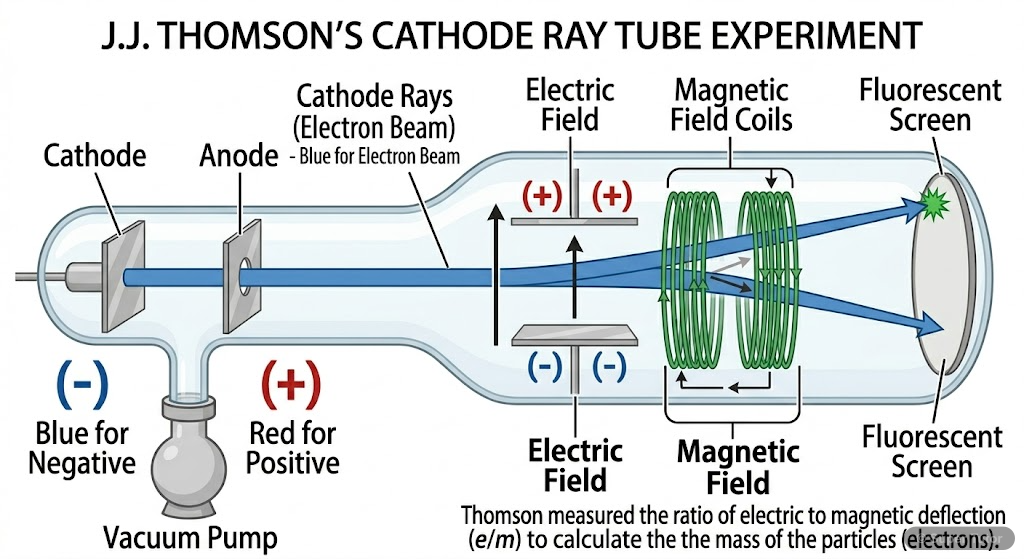
Learn better with visuals Super Tutor pairs illustrations like this with notes and quizzes for Atomic Structure.
Overview
Atoms are the building blocks of matter. Every substance is made of atoms, and atoms take part in chemical reactions. The chapter explains how the idea of the atom developed, what particles make up an atom, how these particles are arranged, and how atomic number, mass number, isotopes, valency, ions
Key Concepts
An atom is the smallest particle
An atom is the smallest particle of matter and the smallest particle of an element that shows all the properties of that element. Atoms are extremely
Maharishi Kanada described matter as made
Maharishi Kanada described matter as made of indestructible particles called paramanus, which combine to form anu. Democritus used the word atom from
An atom contains electrons
An atom contains electrons, protons, and neutrons. Electrons are negatively charged, protons are positively charged, and neutrons have no charge. Prot
J
J.J. Thomson discovered electrons by studying cathode rays. E. Goldstein discovered positively charged particles called protons using a discharge tube
Thomson proposed the Plum Pudding Model
Thomson proposed the Plum Pudding Model, where electrons are embedded in a positively charged sphere. Rutherford’s experiment with alpha particles sho
Learning Objectives
- Describe the three main sub-atomic particles in an atom.
- Define atomic number and mass number.
- Explain the arrangement of electrons in shells using the Bohr-Bury scheme.
- Understand isotopes, ions, radicals, and valency.
- Connect atomic structure with chemical stability and chemical reactions.
Frequently Asked Questions
What are the important topics in Atomic Structure for ICSE Class 8 Chemistry?
How should I revise Atomic Structure for Class 8 exams?
Sources & Official References
Content is aligned to the official syllabus. Refer to the board website for the latest curriculum.
More resources for Atomic Structure
For serious students
Get the full Atomic Structure chapter — start free.
Quizzes, flashcards, an AI doubt solver and a study plan for ICSE Class 8 Chemistry. Free to start, no card needed.